
I was just arguing with a friend about this. He thought I would be a lot more productive if I didn’t watch so much teevee.
I said that was how my brain rests, and that it actually made me more productive.
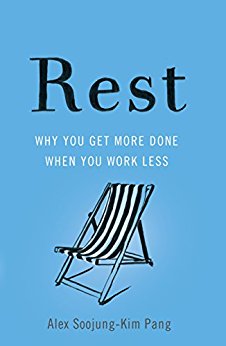
Now there’s a whole book about resting your brain, which I am all for! (It’s on my Amazon wish list and my birthday’s in two weeks. Just saying.) And Ian Welsh has reviewed it:
Too many people today think that working more equals working better. It’s not that that’s never the case; in many jobs and disciplines, the simplest and best way to increase what you get done is to just add more hours.
But that prescription, startlingly popular among many, has always struck me as dubious when it comes to anything creative. Speaking personally, even when perfectly healthy and happy, after more than about four hours of concentrated creative work my brain turns to mush. Work done after that time is not only non-productive, it’s likely to be so filled with mistakes that it’s counterproductive.
If I want to work more than that, the best strategy is to work about three hours and then rest. Best is to take a full sleep cycle nap of about 90 minutes to two hours. Then I can do another two to three hours.
And that’s it.
Further, the best strategy when working on a specific project which requires me to come up with ideas is to completely splurge, learning everything I can about the subject, over however long that takes (in four to five hour daily segments), and then to do something else.
The “something else,” and ideally that involves not work, but rest or play, is necessary, and it is during that time at some point, perhaps in the shower, after a nap, or during a long walk, that the key ideas will occur. They rarely occur during the study period, unless they are fairly obvious.
This is the prescription given by Graham Wallas in The Art of Thought and far more succinctly by ad-man James Webb Young in A Technique For Producing Ideas and it is at the core of Rest:
Prepare by immersing yourself.
Try to solve the problem.
Give up and rest.
Eureka.

“Work smarter, not harder.”
Meditation is a wonderful brain relaxer.
So is sleep.
As Benjamin Franklin might say, ” Early to bed and early to rise after a period of meditation, will allow you to work smarter not……..” or something like that.
I’ve always seen it as a second, harder to master, discipline, to be able to put something down and walk away from it when you pass the peak of your output curve, so as to only give it the best of your abilities. Almost anyone can figure out how to push themselves harder or longer, but far fewer can admit to themselves, in the thick of the doing of it, that it’s time to back off for a while.
Then there’s the whole question of having the resources, time and otherwise, to devote to the endeavor in the pursuit of its quality.