
Don Henry is one of Nashville’s best songwriters:
http://youtu.be/G77460nFl4U
Don Henry is one of Nashville’s best songwriters:
http://youtu.be/G77460nFl4U
Another voter lets us know what he thinks of Mitch McConnell:
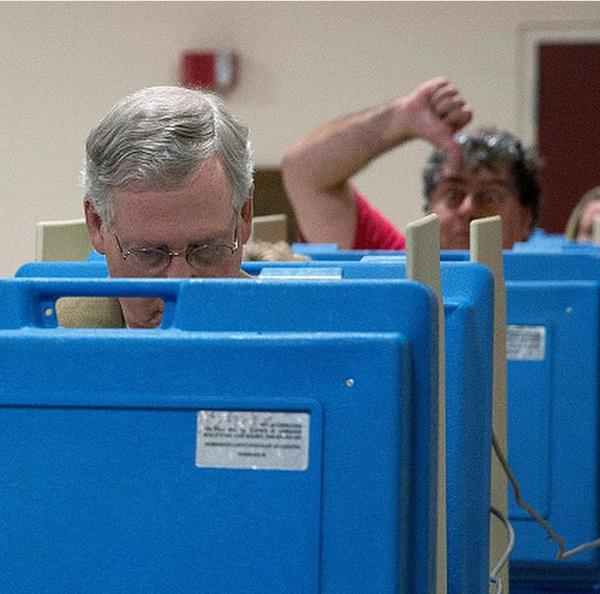
In my neighborhood today. How about yours?


If it’s true. I’d love to see Obama drop the hammer on Israel over these illegal settlements:
US President Barack Obama has threatened to lift the ban on the veto given to Israel, a decision that many view as a threat to Israel’s existence, Israeli news sites reported today.
The Israeli newspaper Maariv reported that Netanyahu supporters are worried at what they feel is Obama’s betrayal of Israel at the United Nations. The Israeli newspaper went on to describe the current tensions as “quite shocking and something that negatively affects relations between Tel Aviv and Washington”.
Maariv quoted an Israeli politician as saying: “Obama intends to abandon Israel as it faces the UN Security Council in an effort to block Israel’s decision to build on Palestinian territory that has been occupied since 1967.”
It was also reported that Prime Minister Benjamin Netanyahu told only a small number of his confidants about the true nature of this impending threat including Jewish Home members Naftali Bennett and Uri Ariel among others in his circle.
According to the newspaper, Netanyahu told his political circle that Obama plans to abandon Israel at the United Nations and that this will have many consequences. “This step was what Israel feared the moment Obama was re-elected and here it is happening today,” Netanyahu added.
The paper said: “Obama intends to destroy the most sacred of holy relationships between Israel and the United States and he intends to use the US veto against Israel at the UN. Without the power of the US veto, Israel would not be able to stay.”
It is unknown whether or not a proposal is even on the Security Council’s table or if any discussions are being had that could potentially block Israel’s decision to build settlements in the occupied territories.

Too late to make much of a difference, I suppose:
Voters in several key swing states have already started mailing in their November midterm ballots, and according to a poll conducted for three major environmental groups, they’re becoming more attuned to a range of environmental issues, including climate change.
Hart Research contacted 1505 likely voters by mobile phones and landlines in Colorado, Iowa, Michigan, New Hampshire, and North Carolina and found that 54 percent of voters were more likely to favor candidates who advocate for action on climate change.
“This year is really crystalizing just how much of a liability climate science denial has been,” national press secretary at the League of Conservation Voters Jeff Gohringer told VICE News. “You see candidates across the country — whether it’s Cory Gardner in Colorado or Scott Brown in New Hampshire — trying to muddy the waters of where they stand on climate change because they know climate science denial is bad politics that puts them wildly out of step with voters.”
Other green issues polled well. Sixty-six percent of swing state voters favored candidates who supported regulations to limit carbon dioxide emissions from power plants. And 68 percent of them had favorable views of candidates who backed clean energy programs, like solar and wind.
Only 23 percent of voters said they had a less favorable view of a candidate if they support action on climate change and curbing carbon dioxide pollution.

Boy, I really hope he runs. I’d love to volunteer:
In tiny Richmond, California, Sanders has gotten involved in the battle for control of the city council, a campaign that has received little mainstream media attention but has become a touchstone in progressive circles. There, lawmakers are engaged in a fight with Chevron over the oil giant’s plans to upgrade a local refinery and a group of local progressives has been trying to keep the city council under their control against a slate of business-backed candidates.
More than 500 people attended a rally that Sanders headlined in Richmond. He is the only national political figure to get involved.
“He helped bring national attention to it,” said Mike Parker, one of the leaders of the Richmond Progressive Alliance. “He was the first U.S. senator to have spoken in Richmond in my memory. Most people outside of the Bay Area don’t even know that Richmond exists. It really energized people here. We are up against a really tough operation that is sitting on millions of dollars. He helped give people the sense that we could do something just by pulling so many people together.”
Asked why no other national political figures have followed Sanders into the breach, Parker replied, “He has got more guts than they do, and he is independent of the big corporations.”
If Sanders has not been campaigning for some of the big-ticket senators and governors this cycle, it is because he has been hitting the hustings in a manner that resembles more what his eventual (possible) presidential campaign would look like—outside the system, and relying on labor unions and community groups.
Sanders has been hitting the hustings in a manner that resembles more what his eventual (possible) presidential campaign would look like.He has, for example, twice held rallies and town halls for the South Carolina Progressive Network, an umbrella group of grassroots organizations that tries to move the Palmetto State’s politics leftward. He keynoted the Fighting Bobfest, an annual gathering in central Wisconsin dedicated to the memory of the early-20th-century Senator Robert La Follette. And even if candidates haven’t embraced having Sanders on stage with them, he has made the rounds to local Democratic parties, hosting a fundraiser for the Hillsborough County Democratic Committee in New Hampshire (the first primary’s state Democratic senator, Jeanne Shaheen, was a no-show) and keynoting the Clinton County Democratic Hall of Fame Dinner in Goose Lake, Iowa. He has hosted town halls at the International Brotherhood of Electrical Workers union hall in Jackson, Mississippi, and fundraisers at the AFSCME headquarters in Philadelphia and a longshoreman’s hall in Charleston, South Carolina.
In an interview with Esquire magazine, Sanders explained that this approach was consistent with his belief that the two major political parties have failed to reach out to most voters.
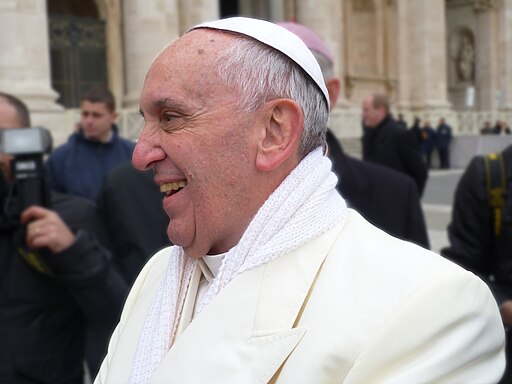
Photo by Gabriel Sozzi via Wikimedia Commons
As a fallen-away “cradle Catholic,” one who used to love arguing with my religion teachers about things like reincarnation, or women priests (“But if only men can be priests because Jesus only picked male apostles, shouldn’t priests have to be Jewish, too?”), I get a kick out of Pope Francis. He reminds me of that all-too-brief reign of Pope John XXIII, the last “people’s Pope.” He is a compassionate man who radiates the best qualities of the Church — namely, a strong foundation in social justice and mercy.
He hasn’t gone as far in liberalizing the Church as I’d like, but he shows signs that he’s getting there.
But the same Catholic conservatives who were so eager to snuggle under the covers with the worst elements of the right wing have learned a thing or two from U.S. politics — basically, how to undercut and erode the authority of a duly-elected leader. This is actually serious, and I’m only slightly kidding when I say I fervently hope this pope avoids small planes.
Matters came to a head last week when Pope Francis removed the extremely conservative U.S. Cardinal Raymond Burke from his influential post as head of the church’s highest court, the Supreme Tribunal of the Apostolic Signatura. (Think of him as Tony Scalia, making distorted pronouncements about “original intent.”) Burke proclaims his version of what the Pope can or can’t do, and Pope Francis is supposed to fall into a worshipful crouch in front of Burke’s embroidered slippers.
It’s not working out that way. Pope Francis has his own ideas, and when a recent report indicated that an upcoming church synod might loosen church policies on divorce and gay marriage, conservatives led by Cardinal Burke went on the attack. German Cardinal Walter Kasper hit back:
In an interview this week, Kasper expressed confidence that bishops at the back-to-back synods would ultimately back some change, and he hit back at critics like Burke, saying they are engaged in political maneuverings. He said they are afraid that any changes would lead to a “domino effect.”
“This is all linked to ideology, an ideological understanding of the gospel that the gospel is like a penal code,” Kasper, who is retired from a curial job but lives in Rome, told America magazine.
Heh. See what I mean? Scalia!
Burke is, to me, the worst kind of Church prelate, known not only for his rigid views on abortion and gays and his willingness to aid the Republican right wing, but for his love of the kind of gaudier ceremonial frippery most cardinals had the taste to leave behind a half-century ago. (All for the greater glory of God, I’m sure.)
As an authoritarian, of course, he was not so quick to address the sexual abuse scandal. As the National Catholic Reporter noted last month:
Cardinal Burke would do us all a favor to examine the second component of the clergy sex abuse scandal, that component that deals with his episcopal colleagues. He might ask why canon law has not come to the aid of the children in a forthright and active manner. He might ask how church law has allowed his fellow bishops to cover up the scandal rather than bringing to public. He might examine how church law has played a role in driving many Catholics, disaffected by the scandal, from the church.
And since he got demoted, he’s doing his best to damn Francis with faint praise:
American Cardinal Raymond Burke, the feisty former archbishop of St. Louis who has emerged as the face of the opposition to Pope Francis’ reformist agenda, likened the Roman Catholic Church to “a ship without a rudder” in a fresh attack on the pope’s leadership.
In an interview with the Spanish Catholic weekly Vida Nueva, published Thursday (Oct. 30), Burke insisted he was not speaking out against the pope personally but raising concern about his leadership.
“Many have expressed their concerns to me. At this very critical moment, there is a strong sense that the church is like a ship without a rudder,” Burke said.
Hey, we’ve seen “The Borgias,” Cardinal Burke. We know what you’re doing! (We’ve also seen Mitch McConnell, Karl Rove, and Fox News in action.)
Conservatives have privately labeled Francis “the anti-Christ” and illegitimate, just as Obama was “the Kenyan” who couldn’t legally be president. In the National Catholic Reporter, Michael Sean Winters calls them “Tea Party Catholics” and writes:
Regrettably, I suspect those who disapprove of Pope Francis constitute a larger share of the clergy and the episcopate than the laity. When bishops temporize in public, as we have seen for example in Bishop Robert Morlino’s ill-advised interviews, or in comments from Cardinal Raymond Burke, you can bet that those same prelates, in private, are hearing, or saying, the kinds of things Fr. Longenecker records in this remarkable piece. And, before he got booted off the Congregation for Bishops, Cardinal Burke was able to place many like-minded prelates in some prominent sees.
Longenecker writes:
Some have given up on Pope Francis. Others say he is “the false prophet” who will accompany the anti Christ in the end times. Others don’t like his dress sense, grumble about his media gaffes and some think they are all intentional and that he is a very shrewd Jesuit who wants to undermine the Catholic faith.
Clearly, Father is not speaking to the same Catholics I speak with, although I did hear a bishop speculate on the fact that “we can’t dismiss the possibility that there could be another anti-pope.” I like the way Fr. Longenecker, following a model set forth previously by Archbishop Chaput, and by the Wizard of Oz before that, places these concerns in the mouths of others, nonetheless giving them oxygen by reporting them. The idea that Pope Francis “is a very shrewd Jesuit who wants to undermine the Catholic faith” really did not need to be reported in order to continue with the article, did it? And, the observation reads like something you would find in an early eighteenth century Jansenist tract, an analogy that bears further reflection because of the Jansenist tendencies of the anti-Francis brigade.
It sounds so familiar, doesn’t it? The sly words, the implication of weakness, the veiled accusations of undermining the very foundations of the institution?
I remember enough of my twelve years of Bible study to know that Jesus, asked about the greatest commandment, reportedly replied: “‘Love the Lord your God with all your heart and with all your soul and with all your mind.’ This is the first and greatest commandment. And the second is like it: ‘Love your neighbor as yourself.’ All the Law and the Prophets hang on these two commandments.”
I could be wrong, but I think Pope Francis comes a lot closer to that spirit than Cardinal Burke. Your mileage, of course, may vary.
Tom Kimmel:
Patty Griffin:
Dar Williams: