What a joke

jamie_dimon

Oh, no. Hell, no. What kind of frickin’ con game is this?

What is is that the feds do not understand? We don’t care about Credit Suisse or some damned French bank that ignored sanctions. We want the bankers who crashed the economy and stole people’s homes, not the ones who sold tax shelters to the uber rich. They are so far down on the list. We want the men at the top of the mortgage casino operations, the people who ruined so many lives with a nod and a wink while their underlings did the dirty work.

Are we supposed to be impressed that the feds are throwing us what they allege to be a bone? Nothing has changed. The same banks that are too big to fail are still too big to jail:

Federal prosecutors are nearing criminal charges against some of the world’s biggest banks, according to lawyers briefed on the matter, a development that could produce the first guilty plea from a major bank in more than two decades.

In doing so, prosecutors are confronting the popular belief that Wall Street institutions have grown so important to the economy that they cannot be charged. A lack of criminal prosecutions of banks and their leaders fueled a public outcry over the perception that Wall Street giants are “too big to jail.”

[block]The new strategy underpins the decision to seek guilty pleas in two of the most advanced investigations: one into Credit Suisse for offering tax shelters to Americans, and the other against France’s largest bank, BNP Paribas, over doing business with countries like Sudan that the United States has blacklisted. [/block]

Addressing those concerns, prosecutors in Washington and New York have met with regulators about how to criminally punish banks without putting them out of business and damaging the economy, interviews with lawyers and records reviewed by The New York Times show.

The new strategy underpins the decision to seek guilty pleas in two of the most advanced investigations: one into Credit Suisse for offering tax shelters to Americans, and the other against France’s largest bank, BNP Paribas, over doing business with countries like Sudan that the United States has blacklisted. The approach applies to American banks, though those investigations are at an earlier stage.

In the talks with BNP, which has a huge investment bank in New York, prosecutors in Manhattan and Washington have outlined plans to extract a criminal guilty plea from the bank’s parent company, according to the lawyers, who were not authorized to speak publicly. If BNP is unable to negotiate a lesser punishment — the bank has enlisted the support of high-ranking French officials to pressure prosecutors — the case could counter congressional criticism that arose after the British bank HSBC escaped similar charges two years ago.

Such criminal cases hinge on the cooperation of regulators, some who warned that charging HSBC could have prompted the revocation of the bank’s charter, the corporate equivalent of the death penalty. Federal guidelines require prosecutors to weigh the broader economic consequences of charging corporations.

Economists warned after the crash that the economy would never really recover until the toxic banks were allowed to fail. The whole mess was a house of cards, and the Obama administration’s policy of “extend and pretend” simply didn’t work. The ripple effects spread through the economy, and it’s not coming back.

Can’t we at least see some of the perpetrators on trial, people like Jamie Dimon? Because if we don’t, no one should be surprised that we call this out as the farce it is.

Because the only possible use for humans is as a cog in the work wheel

259 2002_2003 Alia's Kindergarten Class

This is really disgusting. But that’s the point of this education “reform.” Enough of the critical thinking, your job is to do a good job for your employer, and the sooner you learn your place, the better:

An annual year-end kindergarten show has been canceled at a New York school because the kids have to keep working so they will be “college and career” ready. Really.

That’s what it says in a letter (see below) sent to parents by Ellen Best-Laimit, the interim principal of Harley Avenue Primary School in Elwood, N.Y., and four kindergarten teachers. The play was to be staged over two days, May 14 and 15, according to the school’s calendar.

One mother who received the letter, Ninette Gonzalez Solis, wrote on Facebook that parents learned recently the play was being canceled and started calling the principal, leading the school officials to send out the new missive. Solis wrote that she was very upset about the cancellation.

All but one of the people who signed the letter were unavailable for comment. One asked me to call back but then didn’t answer the phone. District Superintendent Peter Scordo declined to discuss it.

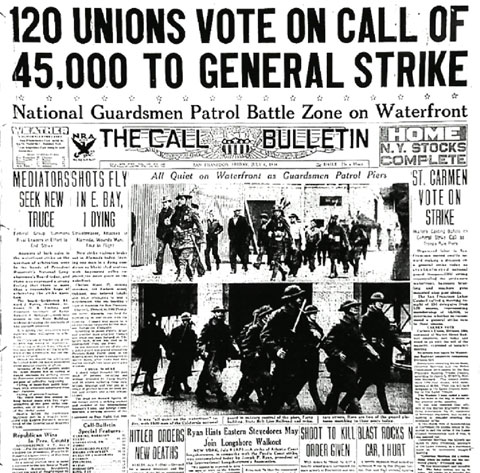
Remember when workers died for their rights?

strike

How did we end up right back where we started? Bill Moyers:

On April 20, 1914, the Colorado National Guard and a private militia employed by the Colorado Fuel & Iron Company (CF&I) opened fire on a tent camp of striking coal miners at Ludlow, Colo. At least 19 people died in the camp that day, mostly women and children.

A century later, the bloody incident might seem a relic of the distant past, but the Ludlow Massacre retains a powerful, disturbing and growing relevance to the present. After a century of struggling against powerful interests to make American workplaces safer and corporations responsive to their employees, the US is rapidly returning to the conditions of rampant exploitation that contributed to Ludlow.

That’s especially true in mining, where a coordinated union-busting campaign, the corporate capture of federal regulatory agencies, and widespread environmental degradation leave coal miners unsafe and mining communities struggling to deal with the massive environmental impact of modern mining practices.

A century ago, miners led the fight for workers’ rights. The Gilded Age of the late 19th and early 20th centuries was a period of great upheaval for the American working class. For decades, the United Mine Workers of America (UMWA) had worked to organize the nation’s coal miners. Its success often hinged on whether the government helped mining companies crush strikes or protected workers. In 1897, deputies in Luzerne County, Pa., killed 19 striking miners in the Lattimer Massacre. But five years later, when Pennsylvania miners struck again, President Theodore Roosevelt intervened on their behalf, providing them with a partial victory. Roosevelt’s actions, while hardly indicative a new pro-labor federal government, reflected a growing belief that labor deserved a fair shake.

Oil exec: Fracking technology is ‘dangerous and untested’

Barton Moss Fracking Test Well

See, this guy actually believes that the truth has something to do with these decisions. Isn’t that cute?

“In a message “straight from the horse’s mouth,” a former oil executive on Tuesday urged New York state to pass a ban on the controversial practice of hydraulic fracturing, or fracking, saying, ‘it is not safe.’

“Making fracking safe is simply not possible, not with the current technology, or with the inadequate regulations being proposed,” Louis Allstadt, former executive vice president of Mobil Oil, said during a news conference in Albany called by the anti-fracking group Elected Officials to Protect New York.

Up until his retirement in 2000, Allstadt spent 31 years at Mobil, running its marketing and refining division in Japan and managing Mobil’s worldwide supply, trading and transportation operations. After retiring to Cooperstown, NY, Allstadt said he began studying fracking after friends asked him if he thought it would be safe to have gas wells drilled by nearby Lake Otsego, where Allstadt has a home. Since that time, he’s become a vocal opponent of the shale oil and gas drilling technique.
“Now the industry will tell you that fracking has been around a long time. While that is true, the magnitude of the modern technique is very new,” Allstadt said, adding that a fracked well can require 50 to 100 times the water and chemicals compared to non-fracked wells.

He also noted that methane, up to 30 times more potent of a greenhouse gas than carbon dioxide, is found to be leaking from fracked wells “at far greater rates than were previously estimated.”

Please sign

From Rootstrikers:

The FCC is now planning to kill Net Neutrality by proposing rules that will explicitly allow corporations to pick winners and losers on the Internet.

We must fight back and stand up against this kind of corruption.

According to the New York Times, the new rules would “allow companies like Disney, Google or Netflix to pay Internet service providers like Comcast and Verizon for special, faster lanes to send video and other content to their customers.”

The Internet was designed to be a level playing field for all users, consumers, innovators, activists, artists, businesses, and everyone between. But the new rules amount to a playing field that is permanently tilted in favor of a handful of gigantic corporations.

Even though we shouldn’t be surprised that companies like Comcast, AT&T, and Verizon are getting exactly what they want, we should definitely be outraged.

Stand up to these corporations and tell the FCC to trash its rules and give us real Net Neutrality.

PETITION TO THE FCC: Your proposed rules are unacceptable and display the corruption of Washington at its worst. We demand you present new rules that enshrine Net Neutrality and don’t play favorites with a handful of giant corporations. 

Click here to sign — it just takes a second.

Frack you, too

Natural Gas Rig

This certainly cheered me up!

A family claiming they were sickened because of pollution from hydraulic fracturing operations near their home should be awarded $2.95 million for their troubles, a jury ruled on Tuesday.

The Parr family had sued Aruba Petroleum Inc. in 2011, alleging the oil and gas producer exposed them to hazardous gases, chemicals and industrial waste that seeped into the air from 22 wells drilled near the family’s 40-acre plot of land, which sits atop the Barnett Shale.

The jury returned a 5-1 verdict saying Aruba “intentionally created a private nuisance,” awarding $275,000 for losses on property value, $2 million for past physical pain and suffering, $250,000 for future physical pain and suffering, and $400,000 for mental anguish.

“They’re vindicated,” David Matthews, one of the Parr’s attorneys, wrote on his firm’s blog Tuesday. “I’m really proud of the family that went through what they went through … It’s not easy to go through a lawsuit and have your personal life uncovered and exposed to the extent this family went through.”

Obama to bail on net neutrality?

BREAKING: 3 judges just sided with Verizon and struck down Net Neutrality. As of right now, anything on the Internet can be censored by your ISP, and no one can stop them. Read on if you dare: http://ift.tt/1kBwb5B

Sounds like it:

Net neutrality is not dead. But it may be about to take a big blow to the head.

The Wall Street Journal has a foreboding scoop that provides details on an early draft of the Federal Communications Commission’s new net neutrality rules. And to put it mildly, Internet activists will not be thrilled.

According to the WSJ’s sources, the FCC’s plan would restructure the rules that govern online traffic by granting Internet service providers the ability to give some websites “preferential treatment” — i.e. faster traffic — in exchange for money.

If such rules were imposed, activists fear Internet service providers would make bandwidth-exhaustive websites — think Netflix and Skype — pay more for smoother delivery, which would theoretically mean higher prices for customers in turn.

According to the WSJ, companies in need of faster connections would have to pay for preferred treatment on the “last mile” of networks that connect to customers’ homes. Such pay-to-play schemes were banned under the old rules.

In a statement provided to Mashable, which the site described as “vague,” the FCC confirmed that its proposal would offer broadband providers “the ability to enter into individual negotiations with content providers.”

But there is some good news. The FCC’s proposal will ban Internet service providers from the most outright discriminatory practices, like blocking a legal website that offers a service that the Internet provider also offers. Unfortunately for defenders of the original tenets of net neutrality, these proposed rules will not be enough.

The local fight to save the Chesapeake Bay goes national

USA, Maryland - Annapolis, Chesapeake Bay Bridge

As you already know, I love the Chesapeake Bay. I remember how the waters were far too frequently too tainted for swimming, and how a moratorium on construction in the watershed brought the bay back to life. Now the contamination is creeping back, and of course big business will have its way:

So, in 2009, the Obama administration stepped in with an executive order, requiring the EPA to use a provision of the Clean Water Act to put together the Chesapeake Clean Water Blueprint. The Blueprint would set a “Total Maximum Daily Load,” or TMDL, an upper limit for the amount of nitrogen, phosphorus and sediment pollution that can enter the Bay each day. The plan reduced nitrogen and phosphorus loads by about 25 percent and sediment loads by 15 percent from 2009 levels (though the exact goals vary by state).

The six states in the Chesapeake Bay watershed — Delaware, Maryland, New York, Pennsylvania, Virginia and West Virginia — as well as Washington, DC, submitted proposals to meet those TMDL deadlines by 2025. If they missed those deadlines, the EPA would take action against them. For the first time, regulators had an enforceable plan for reducing pollution in the Bay.

But then monied interests made their voices heard.
Continue reading “The local fight to save the Chesapeake Bay goes national”

Kochs go after solar panels

our new solar panels (10)

Can’t be cutting into their oil bidness, you know!

Homeowners and businesses that wish to generate their own cheap, renewable energy now have a force of conservative political might to contend with, and the Koch brothers are leading the charge. The L.A. Times, to its credit, found the positive spin to put on this: Little old solar “has now grown big enough to have enemies.”

The escalating battle centers over two ways traditional utilities have found to counter the rapidly growing solar market: demanding a share of the power generated by renewables and opposing net metering, which allows solar panel users to sell the extra electricity they generate back to the grid — and without which solar might no longer be affordable. The Times reports on the conservative heavyweights making a fossil fuel-powered effort to make those things happen:

The Koch brothers, anti-tax activist Grover Norquist and some of the nation’s largest power companies have backed efforts in recent months to roll back state policies that favor green energy. The conservative luminaries have pushed campaigns in Kansas, North Carolina and Arizona, with the battle rapidly spreading to other states.

…The American Legislative Exchange Council, or ALEC, a membership group for conservative state lawmakers, recently drafted model legislation that targeted net metering. The group also helped launch efforts by conservative lawmakers in more than half a dozen states to repeal green energy mandates.

“State governments are starting to wake up,” Christine Harbin Hanson, a spokeswoman for Americans for Prosperity, the advocacy group backed by billionaire industrialists Charles and David Koch, said in an email. The organization has led the effort to overturn the mandate in Kansas, which requires that 20% of the state’s electricity come from renewable sources.

“These green energy mandates are bad policy,” said Hanson, adding that the group was hopeful Kansas would be the first of many dominoes to fall.

The group’s campaign in that state compared the green energy mandate to Obamacare, featuring ominous images of Kathleen Sebelius, the outgoing secretary of Health and Human Services, who was Kansas’ governor when the state adopted the requirement.

What’s especially disappointing is that for a while now, we’ve been hearing about how solar power is actually gaining traction in red states, with conservatives switching the focus from that liberal scourge, renewable energy, to something their base hates even more: taxes. Even Barry Goldwater Jr. has spoken out against the idea of allowing utilities to charge a monthly fee to the owners of rooftop solar panels, or what he and other advocates refer to as a “solar tax.”

The sliding scale of justice

Photo
Matt Taibbi’s new book is about how the rich are never punished for their crimes.

“The Divide” marks a shift in Taibbi’s tone. More Lincoln Steffens than Hunter Thompson, Taibbi drops most of the histrionics to reveal the corruption and injustice at hand. He even goes out of his way to be reasonable. He acknowledges that prosecuting financial cases can be expensive and risky, especially when the alleged crimes are complex and the defendants have vast legal resources at their disposal. That fact motivates prosecutors to settle such cases rather than try them in criminal court. He also concedes that many disadvantaged neighborhoods may benefit from tough policing. But he maintains that when combined, the two law-enforcement strategies add up to a glaring injustice. He also notes that it’s far too easy to introduce jurisdictional complications in financial cases that would never be allowed in less consequential cases. To make that point, he recounts a horrific case in which high-profile Wall Street financiers escaped punishment after trying to destroy a company they bet against as well as harassing its executives and their family members.

Taibbi’s is an important voice, especially in today’s media ecology. Support for investigative reporting has never been a given; when it comes to muckraking, you take it where you can get it. Taibbi has shown that he can deliver the goods, and “The Divide” is his most important book-length contribution to date. One wonders what the future holds for him. In February, he announced he was leaving Rolling Stone to join First Look Media, where his website will feature investigative stories with a satirical edge. In describing his new venture, he linked his Russian experience to his current interests. “There was a certain kind of corruption that I got to see up close in the ’90s,” he said, “and I think that a version of it is being repeated here in the United States.”