Militarization is profitable

Retired Philly police Captain Ray Lewis

Philly retired police captain Ray Lewis in Ferguson was interviewed by VICE:

In 2011, when Middle American thought of the Occupy Movement as a smorgasbord of drum circles, a photo emerged of a former police captain being arrested by the NYPD. That was Ray Lewis, 23-year veteran of the Philadelphia Police Department. The Occupy Movement turned him into some sort of legitimized and uniformed social advocate. He’s since traveled to various protests across the US, including the recent unrest in Ferguson. I caught up with him across the street from the QuikTrip where Mike Brown was killed.

VICE: What’s the most surprising thing you’ve seen in Ferguson?
Ray Lewis: Last night I saw officers not wearing name tags or badges. It’s unfathomable to me that officers, while being investigated, and with international attention, are still breaking the law. I can’t believe it. Officers on site are allowing it. That’s unheard of. If I ever saw that, the officer would be off the street in a second.

You’ve never seen anything like that before?
My officers knew better. They’d never think of doing something like that. The thing is, there’s no accountability. They get away with it here. That shows me one thing—it shows that nothing gets done to them.

Who did you see doing that?
It was the dark blue uniforms—either Ferguson or highway patrol. Speaking of which, I’ve got the St. Louis police right over my shoulder here. I don’t know what they’re doing, but I’m standing right next to CNN.

What do you think the solution in Ferguson is?
Well, Police Chief Jackson has got to go. He will go. That’s one of the ways they’ll persuade the citizens. They’re going to have to get rid of his top commanders and get new guys to come in. They’ll know that they have to do the job right. But [these officers] are going to say, “Now nobody is going to cover for me.” They’re going to try and undermine the new command. It takes time to get around that.

The new commanders need to designate an officer as a community-relations officer. He’s got to interact. The people get to know the officer, and the officer gets to know the people. Right now there is no interaction.

At Chief Jackson’s press conference where he announced the name of the officer [who shot Mike Brown], there were around 12 officers behind him—all white. If he had intermingled with the community in his four years, he’d have had 12 black people back there.

Go read the whole thing.

Here comes that deferred mortgage crisis

David Dayen warns that Big Shitpile was never really fixed and that all the “extend and pretend” programs propping it up are about to run out. Wheee!

Go read the whole thing, of course:

We are nearly eight years removed from the beginnings of the foreclosure crisis, with over five million homes lost. So it would be natural to believe that the crisis has receded. Statistics point in that direction. Financial analyst CoreLogic reports that the national foreclosure rate fell to 1.7 percent in June, down from 2.5 percent a year ago. Sales of foreclosed properties are at their lowest levels since 2008, and the rate of foreclosure startsthe beginning of the foreclosure processisat 2006 levels. At the peak, 2.9 million homes suffered foreclosure filings in 2010; last year, the number was 1.4 million.

Continue reading “Here comes that deferred mortgage crisis”

If you can’t think of any good reason to vote

Here’s one. Putting Democrats in control gives us a chance to fix things like this:

Joshua Cohen works with troubled student loan borrowers.

What’s surprised Cohen lately is the increasing number of gray-haired people walking in his doors with a problem: A portion of their meager Social Security benefits are being taken by the government to pay for old student loans they had mostly forgotten about.

It’s a growing national trend. Last year, 156,000 Americans had their Social Security checks garnished because of student loans they had defaulted on. It’s tripled in number from 47,500 in 2006, before the Great Recession. That’s according to analysis done by the U.S. Treasury for CNNMoney.

This is one of the things Liz Warren is trying to fix. A Democratic majority in both houses would help.

Band of America ‘record settlement’

Bank of America, Danbury, CT 8/2014 by Mike Mozart of TheToyChannel and JeepersMedia on YouTube

I don’t have a problem with pension funds being repaid per se, but it seems crazy to me that no one seems to give a shit about helping the individual homeowners whose lives were ruined by this pirate banking system:

As with the preceding JPMorgan Chase and Citigroup deals, questions have arisen about how much of the money will make its way to investors who purchased the securities. These are the people directly affected by the alleged misdeeds, but there is no specific carve-out to compensate investors, whereas funds are set aside to provide relief to homeowners and blighted communities.

One select group of investors is receiving some relief: public pension funds.

Almost $1 billion of the Bank of America settlement will go to states — California, Delaware, ­Illinois, Kentucky, Maryland and New York — whose attorneys general were investigating the bank or its Countrywide Financial or Merrill Lynch units. Those state prosecutors have earmarked that money for the retirement funds of teachers, police officers and fire fighters.
Continue reading “Band of America ‘record settlement’”

Bye bye

It was nice while the illusion lasted:

A new study from Princeton spells bad news for American democracy—namely, that it no longer exists.

Asking “Who really rules?” researchers Martin Gilens and Benjamin I. Page argue that over the past few decades America’s political system has slowly transformed from a democracy into an oligarchy, where wealthy elites wield most power.

Using data drawn from over 1,800 different policy initiatives from 1981 to 2002, the two conclude that rich, well-connected individuals on the political scene now steer the direction of the country, regardless of or even against the will of the majority of voters.

“The central point that emerges from our research is that economic elites and organized groups representing business interests have substantial independent impacts on U.S. government policy,” they write, “while mass-based interest groups and average citizens have little or no independent influence.”

Kochs are the kiss of death in Michigan

740park

Imagine that: When people know the Kochs want someone elected, they don’t want them! I applaud the citizens of Michigan for being awake enough to understand:

The Koch brothers’ front group Freedom Partners abruptly canceled $1.1 million in ads in Michigan aimed to help elect Republicans last week, according to Politico.

Did the brothers Koch look at the run of polls that show Mark Schauer running neck-and-neck with scandal-ridden Governor Rick Snyder or a stark assessment from the National Journal that illustrates how Senate nominee Terri Lynn Land is as bad a candidate as Republicans feared she’d be?

Likely not.

More likely, the Kochs realize that in the state preferred by four out of five of the Great Lakes, at least, their involvement may be doing more harm than good.

Last week, The Washington Post‘s Greg Sargent looked at the internals of poll showing Democrat Gary Peters leading Land by seven points. Michiganders, it showed, view the Kochs unfavorably by a margin of two-to-one.

“While it’s true that 33 percent have not heard of them, a total of 56 percent have heard of them, which is pretty high,” Sargent wrote. “A large majority finds the anti-Koch message — that Land is beholden to big oil billionaires bankrolling her campaign — convincing.”

Gee

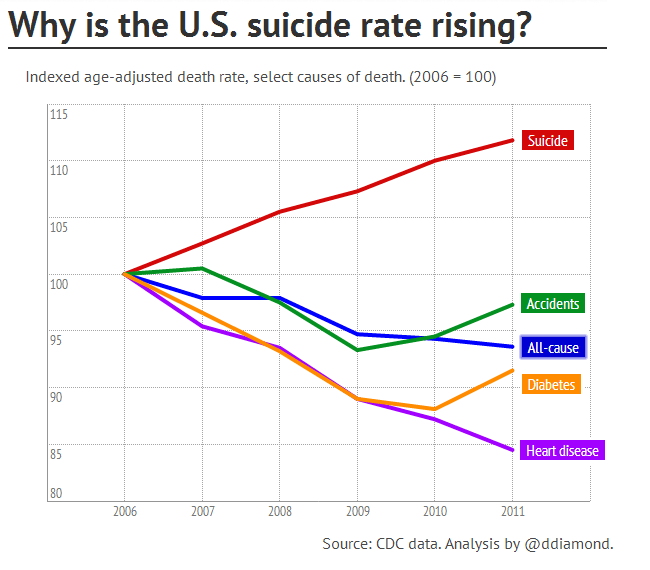
Now, what do you suppose happened to people over 50 that would make them want to kill themselves? Let me think about that for a minute:

In the United States, the age-adjusted death rate from suicide grew by more than 11% between 2006 and 2011, even as the overall death rate from all causes fell almost 7%. (To put that another way, more Americans now die from suicide than from car accidents.)

The spike has been particularly concentrated among middle-aged Americans, with age-adjusted suicide rates rising by more than 30% over the past decade.

SuicideRate

Given that suicide attempts generally increase in frequency as Americans get older, the aging Baby Boomers are especially at-risk, Rutgers sociologist Julie Phillips wrote in adraft paper she presented last year.

While suicide rates had declined in the early 2000s, Phillips noted that was appearing to reverse “as the large boomer cohort (particularly males) move into the older age ranges with traditionally higher suicide rates and with the development of increasing suicide rates among the middle-aged.”

“The boomers had great expectations for what their life might look like, but I think perhaps it hasn’t panned out that way,” Phillips subsequently told the New York Times. “All these conditions the boomers are facing, future cohorts are going to be facing many of these conditions as well.”

The libertarian fantasy

Visita de Paul Krugman

Paul Krugman:

More commonly, self-proclaimed libertarians deal with the problem of market failure both by pretending that it doesn’t happen and by imagining government as much worse than it really is. We’re living in an Ayn Rand novel, they insist. (No, we aren’t.) We have more than a hundred different welfare programs, they tell us, which are wasting vast sums on bureaucracy rather than helping the poor. (No, we don’t, and no, they aren’t.)

I’m often struck, incidentally, by the way antigovernment clichés can trump everyday experience. Talk about the role of government, and you invariably have people saying things along the lines of, “Do you want everything run like the D.M.V.?” Experience varies — but my encounters with New Jersey’s Motor Vehicle Commission have generally been fairly good (better than dealing with insurance or cable companies), and I’m sure many libertarians would, if they were honest, admit that their own D.M.V. dealings weren’t too bad. But they go for the legend, not the fact.

Libertarians also tend to engage in projection. They don’t want to believe that there are problems whose solution requires government action, so they tend to assume that others similarly engage in motivated reasoning to serve their political agenda — that anyone who worries about, say, environmental issues is engaged in scare tactics to further a big-government agenda. Paul Ryan, the chairman of the House Budget Committee, doesn’t just think we’re living out the plot of “Atlas Shrugged”; he asserts that all the fuss over climate change is just “an excuse to grow government.”

As I said at the beginning, you shouldn’t believe talk of a rising libertarian tide; despite America’s growing social liberalism, real power on the right still rests with the traditional alliance between plutocrats and preachers. But libertarian visions of an unregulated economy do play a significant role in political debate, so it’s important to understand that these visions are mirages. Of course some government interventions are unnecessary and unwise. But the idea that we have a vastly bigger and more intrusive government than we need is a foolish fantasy.

Reality check

College education ... McDonald's Wants to Turn Miami Into a Winter Wonderland (Mon., Nov. 11 2013) ...item 3.. As economy heals, teaching programs look for grow (Nov. 24, 2013) ...

I am surprised at how incredibly hostile and dismissive some Dems get when I point this out — you know, as if talking about the truth somehow gives some massive advantage to the other team, and preventing that is more important than acknowledging what’s happening:

The U.S. economy earlier this year recovered all the jobs lost during the recession, but those new jobs pay an average of 23% less than the ones lost in the downturn, according to an analysis released Monday by the U.S. Conference of Mayors.

Job losses in the higher-paying manufacturing and construction sectors were largely replaced by jobs in lower-wage industries, including hospitality and healthcare, the report said.

It also found a continuing accumulation of wealth among the top 20% of the nation’s earners. From 2005 to 2012, the highest income bracket was responsible more than 60% of all income gains in the country, the report said.

By contrast, the bottom 40% of earners saw only 6.6% of the increases.