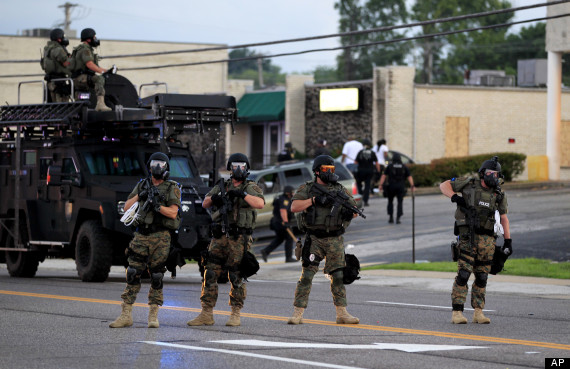
Militarization is profitable

Retired Philly police Captain Ray Lewis

Philly retired police captain Ray Lewis in Ferguson was interviewed by VICE:

In 2011, when Middle American thought of the Occupy Movement as a smorgasbord of drum circles, a photo emerged of a former police captain being arrested by the NYPD. That was Ray Lewis, 23-year veteran of the Philadelphia Police Department. The Occupy Movement turned him into some sort of legitimized and uniformed social advocate. He’s since traveled to various protests across the US, including the recent unrest in Ferguson. I caught up with him across the street from the QuikTrip where Mike Brown was killed.

VICE: What’s the most surprising thing you’ve seen in Ferguson?
Ray Lewis: Last night I saw officers not wearing name tags or badges. It’s unfathomable to me that officers, while being investigated, and with international attention, are still breaking the law. I can’t believe it. Officers on site are allowing it. That’s unheard of. If I ever saw that, the officer would be off the street in a second.

You’ve never seen anything like that before?
My officers knew better. They’d never think of doing something like that. The thing is, there’s no accountability. They get away with it here. That shows me one thing—it shows that nothing gets done to them.

Who did you see doing that?
It was the dark blue uniforms—either Ferguson or highway patrol. Speaking of which, I’ve got the St. Louis police right over my shoulder here. I don’t know what they’re doing, but I’m standing right next to CNN.

What do you think the solution in Ferguson is?
Well, Police Chief Jackson has got to go. He will go. That’s one of the ways they’ll persuade the citizens. They’re going to have to get rid of his top commanders and get new guys to come in. They’ll know that they have to do the job right. But [these officers] are going to say, “Now nobody is going to cover for me.” They’re going to try and undermine the new command. It takes time to get around that.

The new commanders need to designate an officer as a community-relations officer. He’s got to interact. The people get to know the officer, and the officer gets to know the people. Right now there is no interaction.

At Chief Jackson’s press conference where he announced the name of the officer [who shot Mike Brown], there were around 12 officers behind him—all white. If he had intermingled with the community in his four years, he’d have had 12 black people back there.

Go read the whole thing.

They don’t even pretend

To be logical. They just make up a cover story, and stick to it:

A coroner’s report obtained exclusively by NBC News directly contradicts the police version of how a 22-year-old black man died in the back seat of a Louisiana police cruiser earlier this year — but still says the man, whose hands were cuffed behind his back, shot himself.

In a press release issued March 3, the day he died, the Louisiana State Police said Victor White III apparently shot himself in an Iberia Parish police car. According to the police statement, White had his hands cuffed behind his back when he shot himself in the back.

But according to the full final report of the Iberia Parish coroner, which was released nearly six months later and obtained exclusively by NBC News, White was shot in the front, not the back. The bullet entered his right chest and exited under his left armpit. White was left-handed, according to family members. According to the report, the forensic pathologist found gunshot residue in the wound, but not the sort of stippling that a close-range shot can sometimes produce. He also found abrasions on White’s face.

And yet, despite the contradictions – and even though White’s hands were never tested for gunpowder residue – the Iberia Parish coroner still supported the central contention of the initial police statement issued back in March. Dr. Carl Ditch ruled that White shot himself, and declared his death a suicide.

Federal law on excessive force ignored for 20 years

image

So the “Just Us” Department is really, really good at going after medical marijuana users, but not so good at enforcing laws that might upset powerful special interest groups — and not just Wall Street!

One of the reasons we don’t have data on police use of excessive force is because compiling this information relies on law enforcement agencies being forthcoming about these incidents. Generally speaking, it takes FOIA requests and lawsuits to obtain any data gathered by individual police departments. This shouldn’t be the case. In fact, as AllGov reports, this lack of data violates a federal law.

In 1994, Congress passed the Violent Crime Control and Law Enforcement Act. Among its provisions was the order that “the Attorney General shall, through appropriate means, acquire data about the use of excessive force by law enforcement officers.” The Justice Department was also required to publish an annual report on the data collected.
Continue reading “Federal law on excessive force ignored for 20 years”

Ferguson cops raid church over illegal sleeping

Police Shooting Missouri

They really are at war with the residents:

For the third time since the police slaying of Michael Brown in Ferguson, Missouri, St. Louis County police raided the Greater St. Mark Church property Wednesday. Church leaders have allowed community activists to use the gymnasium of an abandoned private school on church property as a first aid station for treatment of people injured by tear gas in protests against the shooting of Brown. People could also get food and water there, and community activists used it to plan protest strategy. 

But all that apparently made it a special target for the cops whom one would think have enough on their plates in Ferguson not to be harassing a humanitarian operation. 

Police claimed that people had been sleeping in the gym, something not allowed under city zoning and a violation of occupancy rules. According to eyewitnesses, more than 20 officers showed up to search the building just before noon Wednesday. Probably the first time in the city’s history a platoon of cops has been sent to check out an alleged occupancy code violation. This time they didn’t come armed with assault weapons as witnesses said has been the case in previous raids. Nor did they take away any supplies, something that observers say happened in Tuesday’s raid. 

A church volunteer, Marcel Williams, spoke with a local television reporter about Wednesday’s raid: 

“They looked like they were looking for someone in particular, just because of the depth of the search they were doing. No guns were drawn at the time or anything of that nature, but it was an intensive search,” said Williams.

The church officials told News 4 nobody has been staying in the building overnight.


That wasn’t the police version. In a statement issued Wednesday night, the St. Louis County Police Department said that when police searched the building: “It appeared that five to seven people sleeping in the facility but no one was present. The representative stated that he would advise the individuals to leave.” The statement also said there was no animosity displayed between the cops and the church representative. 

In a video made after the police raid on Tuesday, Philip Agnew of the advocacy group Dream Defenders said: 

“But in no uncertain terms, this was a place where this community deemed, a place where we could come and feel—what? Safe. And what they did today was tell us what? There is no safety here.”


It’s unclear whether the protester in this video is correct in saying the police have “effectively” shut down the operation. A woman who answered the phone at the church Thursday morning told Daily Kos that she did not know whether the safe haven is still open and referred me to St. Mark’s pastor, who had not returned the call by the time this was posted.

‘They killed that man’

I read about this yesterday, but didn’t have time to look at it until today. This is a shocking video of St. Louis police killing 25-year-old Kajieme Powell, a mentally-ill man who stole a snack cake and two drinks from a convenience store:

The video shows that police told Powell to remove his hand from his pocket, which he did. Police said Powell held a knife in his hand, though it is unclear from the video if Powell actually brandished the knife at the officers. The owner of the convenience store from which Powell allegedly shoplifted told police he had a weapon, a claim corroborated by the owner of a nearby barber shop who called 911 about Powell, according to 911 calls obtained by St. Louis Public Radio.

Powell approached them, shouting, “Shoot me! Shoot me, already!” As Powell continued to approach them, the officers shot and killed him.

Fewer than 20 seconds elapsed from the time police arrived on the scene to the time they shot Powell. The two officers fired 12 shots at Powell, according to police chief Sam Dotson.

Powell allegedly took two energy drinks and donuts from a convenience store, the owner of the store told a 911 dispatcher.

Powell’s death marks the second time in less than two weeks that police in the St. Louis metropolitan area have shot and killed a young black man suspected of a minor crime

I don’t even know what to say. They squashed the man like he was a bug — and then they handcuff him?

.

Why cops lie

DSC_0470

I liked this NYT article, not the least because it agrees with what I was saying on my radio appearances last week: You’re not going to solve police brutality without changing the political pressures on their performance.

Police departments have been rewarded in recent years for the sheer numbers of stops, searches and arrests. In the war on drugs, federal grant programs like the Edward Byrne Memorial Justice Assistance Grant Program have encouraged state and local law enforcement agencies to boost drug arrests in order to compete for millions of dollars in funding. Agencies receive cash rewards for arresting high numbers of people for drug offenses, no matter how minor the offenses or how weak the evidence. Law enforcement has increasingly become a numbers game. And as it has, police officers’ tendency to regard procedural rules as optional and to lie and distort the facts has grown as well. Numerous scandals involving police officers lying or planting drugs — in Tulia, Tex. and Oakland, Calif., for example — have been linked to federally funded drug task forces eager to keep the cash rolling in.

THE pressure to boost arrest numbers is not limited to drug law enforcement. Even where no clear financial incentives exist, the “get tough” movement has warped police culture to such a degree that police chiefs and individual officers feel pressured to meet stop-and-frisk or arrest quotas in order to prove their “productivity.”
Continue reading “Why cops lie”

Michael Brown ID’d as suspect in strong-arm robbery

http://youtu.be/biv45ZA37z0

UPDATE: Police chief says Michael Brown was NOT a suspect when stopped.

This puts a completely different slant on the police stop, and I don’t think the cops would have ID’d him as the robber without having all the details nailed down. We’ll know for sure when they release the 911 tapes.

Okay, so the cop stops Michael Brown as a suspect because he fits the description in a strong-arm robbery. This moves things into a more serious category than shoplifting, because the suspect has now used violence. This puts the action of the cop into a different light, since he has reason to expect violence if this is the suspect.

And while I believe this was a tragedy, the cop will probably get off — in this case, on legal grounds.

Tennessee v. Garner, 471 U.S. 1 (1985)

No. 83-1035

Argued October 30, 1984

Decided March 27, 1985*

A Tennessee statute provides that, if, after a police officer has given notice of an intent to arrest a criminal suspect, the suspect flees or forcibly resists, “the officer may use all the necessary means to effect the arrest.” Acting under the authority of this statute, a Memphis police officer shot and killed appellee-respondent Garner’s son as, after being told to halt, the son fled over a fence at night in the backyard of a house he was suspected of burglarizing. The officer used deadly force despite being “reasonably sure” the suspect was unarmed and thinking that he was 17 or 18 years old, and of slight build. The father subsequently brought an action in Federal District Court, seeking damages under 42 U.S.C. § 1983 for asserted violations of his son’s constitutional rights. The District Court held that the statute and the officer’s actions were constitutional. The Court of Appeals reversed.

Held: The Tennessee statute is unconstitutional insofar as it authorizes the use of deadly force against, as in this case, an apparently unarmed, nondangerous fleeing suspect; such force may not be used unless necessary to prevent the escape and the officer has probable cause to believe that the suspect poses a significant threat of death or serious physical injury to the officer or others. Pp. 497 U. S. 7-22.

Page 471 U. S. 2

(a) Apprehension by the use of deadly force is a seizure subject to the Fourth Amendment’s reasonableness requirement. To determine whether such a seizure is reasonable, the extent of the intrusion on the suspect’s rights under that Amendment must be balanced against the governmental interests in effective law enforcement. This balancing process demonstrates that, notwithstanding probable cause to seize a suspect, an officer may not always do so by killing him. The use of deadly force to prevent the escape of all felony suspects, whatever the circumstances, is constitutionally unreasonable. Pp. 471 U. S. 7-12.

(b) The Fourth Amendment, for purposes of this case, should not be construed in light of the common law rule allowing the use of whatever force is necessary to effect the arrest of a fleeing felon. Changes in the legal and technological context mean that that rule is distorted almost beyond recognition when literally applied. Whereas felonies were formerly capital crimes, few are now, or can be, and many crimes classified as misdemeanors, or nonexistent, at common law are now felonies. Also, the common law rule developed at a time when weapons were rudimentary. And, in light of the varied rules adopted in the States indicating a long-term movement away from the common law rule, particularly in the police departments themselves, that rule is a dubious indicium of the constitutionality of the Tennessee statute. There is no indication that holding a police practice such as that authorized by the statute unreasonable will severely hamper effective law enforcement. Pp. 471 U. S. 12-20.

(c) While burglary is a serious crime, the officer in this case could not reasonably have believed that the suspect — young, slight, and unarmed — posed any threat. Nor does the fact that an unarmed suspect has broken into a dwelling at night automatically mean he is dangerous. Pp. 471 U. S. 20-22.

710 F.2d 240, affirmed and remanded.

WHITE, J., delivered the opinion of the Court, in which BRENNAN, MARSHALL, BLACKMUN, POWELL, and STEVENS, JJ., joined. O’CONNOR, J., filed a dissenting opinion, in which BURGER, C.J., and REHNQUIST, J., joined, post p. 471 U. S. 22.