God save us

From these so-called “Democrats” who think no further than the next election cycle and get under those toasty covers with the right wing. What will your budget costs be when there’s a sudden spike in demand for your poverty programs?

Last week San Jose Mayor Chuck Reed delivered his usual speech about the benefits of slashing the retirement benefits of his city’s public employees – and why he is now pushing for a statewide ballot measure that could dramatically change the lives of hundreds of thousands of Californians. Reed’s initiative – which he characterizes as a bipartisan effort and which hasn’t yet qualified for the 2014 ballot — would allow the state and local governments to reduce retirement benefits for current employees for the years of work they perform after the measure’s changes go into effect. What was not usual about Reed’s speech was its setting: The Roosevelt Hotel in New York City, 3,000 miles from California.

Reed was a keynote speaker at a “Save Our Cities” conference sponsored by the Manhattan Institute, a conservative think tank co-founded by Ronald Reagan’s CIA director, William Casey. There was another California presence at the gathering: The video-streamed image and voice of former Los Angeles mayor Richard Riordan who, like the ghost of Hamlet’s father, seemed to demand revenge – in this case, for the ignominious implosion of his own $800,000 effort in 2012 for an L.A. ballot measure that would have forced city employees into 401(k) plans.

New York wasn’t Reed’s only port of call last week. The following day he spoke again — on a panel at the Mandarin Oriental Hotel in Washington, D.C. There he discussed firefighter and police pensions as part of a conference on state and local retirement systems sponsored by the Pew Charitable Trusts, the Urban Institute and the Laura and John Arnold Foundation.
Continue reading “God save us”

Why means testing SS and Medicare is a bad idea

I hear this a lot: “Well, that sounds reasonable!” It isn’t, and you should read this so you can influence others not to support it:

In Washington-speak, “means-testing” is a scheme to deny or reduce Medicare and Social Security benefits for people who are “too wealthy” in the name of saving money. It’s a counterproductive, harmful idea, but one that well-intentioned liberals often end up embracing.

It’s easy to see why. Economic inequality has exploded to dangerous levels, and the argument for means-testing seems to appeal to a powerful sense that the rich are getting more than their fair share at the expense of everyone else. Combine this with the deficit hysteria promoted by conservatives, and the trap is set.

Don’t fall into it. The truth is that means-testing is a sneak attack on vital programs meant to weaken and eventually destroy them. There’s a reason why an ultra-conservative like Paul Ryan pushed means-testing during the presidential campaign. And there’s a reason why private equity billionaire Pete Peterson, enemy of Social Security and Medicare who served in Richard Nixon’s cabinet, makes a special point of bringing up means-testing [3] when he is talking to liberals.

Conservatives push means-testing because it’s a highly effective political strategy for getting liberals and progressives to act against their own values and interests — so effective that some economists billing themselves as liberal, such as Jared Bernstein, a former adviser to the Obama administration, sometimes promote means-testing as a reasonable idea. Bernstein recently went on CNBC [4] and said that means-testing “sounded like a good idea” and characterized people opposed to it as “fringe.”

Bernstein’s assertion that means-testing opponents are “fringe” is nonsense. Does that include Paul Krugman of the New York Times, who describes [5] means-testing as “an even worse idea, on pure policy grounds, than even most liberals realize”? In researching this article, I communicated with several highly respected economists, including Nobel Prize-winner Joseph Stiglitz, James K. Galbraith, Dean Baker, and Thomas Ferguson. All of them expressed their concerns about means-testing and provided a variety of sound arguments against it. (Bernstein, after being roundly criticized, backtracked in a blog [6] and admitted that means-testing is a bad policy idea and a questionable way to address income inequality. He just forgot that when he was on TV!)

Here are six reasons why you should be on high alert any time you hear the phrase “means-testing” — whether it comes from government-hating conservatives or liberals who wish to appear “moderate.” The truth is that there is nothing moderate or reasonable about means-testing – or any other plan to weaken Social Security and Medicare.

Go on, go read the rest.

While I won’t hold my breath

It does seem like the Grand Bargain has been abandoned, at least for now. We’ll see:

Even Obama’s proposed grand bargain leaves tax rates in place, and raises revenue by reducing tax deductions. The plausible small deal would probably entail something even smaller — a user fee here or there, perhaps a couple of high-profile tax loopholes. As I pointed out, it’s notable that Cole and Obama have not only moved toward each other’s position on revenue but crossed over, with Obama seeming to demand even less revenue than Cole is now offering.

Obama’s budget offers $200 billion in mandatory budget savings that are not major safety-net programs. It’s all completely boring stuff, that doesn’t touch major cornerstones of the New Deal, but adds up: cuts to farm subsidies, cuts to retirement benefits for federal workers, aviation fees, higher contributions for unemployment insurance, selling off under-utilized federal property — I’d go on, but you’re probably already half asleep. This is the tedious guts of the likely agreement that will take shape.

As I wrote, plenty could go wrong. A conceptual agreement between the main negotiators is only the first step. Then we get to the conservative freak-out. Failure remains a highly plausible outcome, but, if you look closely enough, the signs of a desire on both sides to make a deal are there.

The Democrats will cave on Social Security if we let them

We already know Dick Durbin is a Wall Street whore:

WASHINGTON — Sen. Dick Durbin (D-Ill.) on Sunday opened the door to Social Security cuts as part of a budget deal with congressional Republicans. But Durbin pushed back against GOP calls for entitlement cuts as the negotiating price to curb or extinguish the economically damaging sequester cuts.

“If this is the bargain that the Republicans are now pushing for, that we have to cut Medicare to avoid cuts at the Department of Defense, they need to take a step back,” Durbin said on “Fox News Sunday.”

[…] Durbin said that Republicans had to put tax revenue on the table to get entitlement cuts. Fox host Chris Wallace noted that Durbin has previously supported entitlement cuts, and asked why Republicans should have to give up tax increases to get something that many Democrats support. President Barack Obama has repeatedly endorsed Social Security cuts as part of budget deals, and Durbin acknowledged that he did support Social Security reforms.

“Social Security is gonna run out of money in 20 years,” Durbin said. “The Baby Boom generation is gonna blow away our future. We don’t wanna see that happen.”

Social Security will not run out of money in 20 years. The program currently enjoys a surplus of more than $2 trillion. Social Security will, however, be unable to pay all benefits at current levels if nothing is changed. If a 25 percent benefit cut were implemented in 20 years, the program would be solvent into the 2080s.

They’re lining people up, moving the guns into place. I gotta tell you, this shit really gets to me. I’m feeling so stressed out, seeing the moves, knowing what they’re up to and knowing that most people don’t even believe me.

I’m starting to have chest pains over this shit, and that ain’t good.

H/t Jennifer Mayer.

Quote of the day

E.J. Dionne on Meet the Press:

“A lot of times, though, when people say the president should lead, what they want him to do is adopt Republican positions and then push for those,” Dionne explained. “That’s not leadership, that’s capitulation.”

And yet, he keeps doing it! I’m so confused…

Memory lane

Back in February, in a letter to Bob Woodward, Gene Sperling (Obama’s top economic advisor at the time) wrote:

The idea that the sequester was to force both sides to go back to try at a big or grand bargain with a mix of entitlements and revenues (even if there were serious disagreements on composition) was part of the DNA of the thing from the start.

It was an accepted part of the understanding — from the start. Really. It was assumed by the Rs on the Supercommittee that came right after: it was assumed in the November-December 2012 negotiations. There may have been big disagreements over rates and ratios — but that it was supposed to be replaced by entitlements and revenues of some form is not controversial. (Indeed, the discretionary savings amount from the Boehner-Obama negotiations were locked in in BCA: the sequester was just designed to force all back to table on entitlements and revenues.)

Just so you understand where this is all headed. Straight from the horse’s mouth!

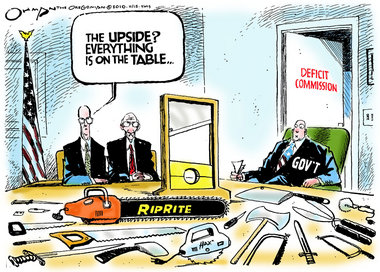
The great sucker play

upside

Charlie Pierce:

All weekend, the conservative pivot on the shutdown-debt-ceiling-spittlepalooza was consistent and obvious. This is now no longer entirely about the beastly tyranny of Obamacare. Oh, no. This is now about federal spending and about the deficit. Never mind that the deficit is dropping, and that the Democrats are now pleading to return to a level of federal spending below that which even Paul Ryan recommended. The old scarecrows are all coming out in time for Halloween. Poor, befuddled John Cornyn tried to make the case on CBS yesterday. And, on ABC, castrato Speaker Of The House John Boehner made it plain that there would be no movement on his side regarding the debt ceiling unless he gets what he wants in a further reduction of federal spending, and that there would be no tax increases of any kind from his side. He even trotted out the single most threadbare argument of all — that the government should run its books like “an American family” does. (Sadly, this is a misbegotten trope to which even the president has resorted from time to time.) I am increasingly coming to believe that, for all the talk of how the conservatives have hurtled into a box canyon, it is the administration, bright people all, that may have been euchred into a situation that will truly damage it. After all, if the shutdown ended tomorrow, the sequester would still be in place. Austerity still would be the tacitly agreed upon program for both parties, and Paul Krugman likely still would be drinking before noon. The administration’s brilliant eleventy-dimensional chess in 2010 looks more and more like a case of being too smart by half. It created a new reality in which both sides decided that what a country barely out of a devastating recession really needed was some belt-tightening and some fiscal discipline. If the administration really believed that the conservative monkeyhouse elected in 2010 wasn’t going to be completely at home in this new reality, then somebody over there needs to be fired.

In the current political context, there was no reason for Jack Lew to go on television yesterday and utter the words “entitlement reform.” There should be memos circulating throughout the Executive branch to the effect that, in the current circumstances, anyone who goes about with “entitlement reform” on his lips, should be boiled in his own pudding, and buried with a stake of holly through his heart. (Scrooge is very much on my mind these days. I’m getting a little worried.) Jesus God, entitlement reform? Now? Who is this man negotiating for? There also was no reason for him to talk about “tax reform, closing loopholes,” without mentioning that what we really need is a higher top rate, and a financial-transaction tax, and a lot of other things that will make the Wall Street side of the Republican party howl.
Continue reading “The great sucker play”

The rebirth of the zombie benefit cut

As I’ve been predicting, talk of the chained CPI is rising again as part of a budget deal. Remember, this also means a major tax hike for the working poor! Michael Hiltzik of the LA Times:

The chained CPI has risen to walk among us again in the muttering and jawboning around the government shutdown/debt limit standoff and the search for an exit. We’re hearing again about a “grand bargain” on the government deficit — never mind that the deficit is falling, not rising — that would trade, say, cuts in Social Security and Medicare and some kind of tax reform for an end to the government shutdown and an increase in the debt limit.

In other words, the average person gets a kick in the slats, and the politicians in Washington get to deliver it. That’s some bargain.

A few things to remember about the chained CPI, which I’ve written about herehere, and here. (If you’re going to kill a zombie, you have to keep coming at it.)

First, its vaunted accuracy is a myth. An index like the CPI can’t be judged more or less accurate, because it measures only what it’s defined to measure. Does the market basket measured by the CPI accurately define what people spend money on? Yes, if they spend money on what’s in the basket. And we know that retirees don’t spend money the same way as young or middle-aged families; they spend disproportionately more on healthcare and housing.

The agency that produces the inflation index recognized that elderly consumers are a special case bydeveloping an experimental index, known as the CPI-E, for those 62 and older.

What really makes the chained CPI  attractive to budget cutters is that it consistently comes in lower than the traditional CPI. For retirees, the gap builds over time; after 30 years, benefits would be 10% lower than under the traditional CPI. The CPI-E, however, rises slightly faster than the traditional index. That’s why you never hear pundits praising it for its “accuracy.”

The chained CPI also involves another nasty shock for average Americans. For the sake of fairness, using it as the Social Security cost of living measure would mean using it for other government calculations indexed to inflation, such as income tax brackets.

What would that mean? Well, according to the Tax Policy Center, it would hit low-income taxpayers especially hardSomeone earning $30,000 to $40,000 would get whacked three times as hard, measured by the tax increase as a share of total income, as someone earning more than $1 million.

Social Security advocates have always considered President Obama to be a little squishy when it comes to resisting Republican efforts to cut Social Security and Medicare and hit the middle class with higher taxes. Thus far, Democrats in Congress have held the line.

But every crisis brings yet another effort to preserve the prerogatives of the wealthy and take the cost out of middle- and working-class hides. On this occasion, when the costs of the shutdown have fallen on Head Start children, medical patients and middle-class workers, to slice away another portion of their safety net would be a truly unspeakable act.

Both sides want it

I don’t know if Ian Welsh is completely right, but I think there’s a large element of truth:

I don’t know if there’ll be a debt default. What I do know is this: if Obama doesn’t want to default he has options. Forget the platinum coin nonsense (though he could if he wanted), Obama can just tell the Treasury to keep on keeping on, and continue selling treasuries. There isn’t anything Congress can do about that, they don’t have the votes to actually impeach him, they don’t have an army, they don’t have the balls to, say, lock up the Treasury Secretary. In short, they don’t have an army.

Now I assume Obama doesn’t want a default. But, to be sure, I could be wrong. Why? Because a default throws all the cards in the air. It lets you remake the country in your image. Obama has long wanted a “Grand Bargain” and the ultimate neo-liberal no-no is defaulting on bond-holders. Then, of course, there are all the SS checks…

If there is a default, whoever sets the terms of the new arrangement gets to remake America in their image. Obama might want a crack that that.

Hey, no big deal

Remember that most congressmen got elected because they were good at socializing and gladhanding, not because they’re rocket scientists. They deal in marketing and strategy, not reality:

In interviews with more than a dozen GOP lawmakers, the Republicans rejected the notion that Washington could default on its debt unless a borrowing increase is approved before Oct. 17. For the United States to actually default, these Republicans argue, the Treasury Department would have to stop paying interest on its debts—something GOP lawmakers claim is inconceivable.

“There’s always revenue coming into the Treasury, certainly enough revenue to pay interest,” said Rep. Justin Amash, R-Mich. “Democrats have a different definition of ‘default’ than what we understand it to be. What I hear from them is, ‘If you’re not paying everything on time that’s a default.’ And that’s not the traditionally understood definition.”

If this sounds familiar, it’s because it has been Republicans’ line of attack since their debt-ceiling battle with Obama in the summer of 2011.

Then, as now, the GOP argues it’s not the debt limit that would cause default, it’s Obama. The country would have the funds to pay its creditors if the administration would just delay payments to certain agencies.

Hoping to turn that argument into law, Republicans have touted legislation that would force Treasury to prioritize which bills it pays, pushing interest payments to the country’s creditors, as well as to senior citizens and veterans, to the front of the line and putting everything else second.

The measure makes for solid messaging—few voters are likely to disagree that Social Security and veterans’ disability payments should be top priorities—but budget wonks and financial industry experts criticize the idea.

“I don’t know any serious person who doesn’t think this will be cataclysmic,” said Steve Bell, a former Republican staff director of the Senate Budget Committee and now senior director with the Bipartisan Policy Center.

This is, of course, a wonderful setup for the Grand Bargain. We had to! To save the country! These Republicans just aren’t rational!

And this “no big deal” is the new talking point.