I don’t believe Jack Lew

And Matt Yglesias is a moron if he does:

Late Monday, the Treasury Department announced that the federal government will hit the statutory debt ceiling in the middle of October, setting the rough date for the next political/economic crisis. Republicans have been offering a lot of wild theories about their negotiating strategy around this, but on CNBC this morning Secretary Jack Lew said the right thing about the administration’s bargaining strategy—there is no strategy because there is no bargain.

No, really, this time they really, really mean it! Uh huh.

I promise you, the Grand Bargain is coming. Obama is not sucking up to all those Republican senators, meeting them for extended meals, because he wants to stonewall them. That’s not the plan.

I’ve told you what the plan is. I’m tired of trying to explain it to people who don’t want to listen. It’s coming, and we have to get ready to fight back.

‘Cory Booker is even worse than his critics say’

Noam Schieber at the New Republic:

Cory Booker has just won New Jersey’s Democratic Senate primary in a rout, making him an easy favorite to claim the seat this fall. But even stronger than the pundit consensus that Booker will soon be in Washington is the belief that the camera-savvy Twitter celebrity will be a rabble-rouser once he gets there. “He would be a disruptor,” the pros at NBC’s First Read have predicted. “Someone who wants to shake things up.” A vehicle for bringing “street-level experience to a Senate that often seems disembodied from the whole planet,” is how The New York Times endorsement put it. No less an expert than Booker himself has suggested that agitprop will be his preferred mode of discourse, approvingly citing Ted Cruz and Rand Paul as his senatorial role models.

You might be inclined to conclude from this that Booker intends to be the Senate’s liberal conscience—someone who can channel the progressive id from a perch inside Washington, in the same way that Cruz and Paul function as voices of the Tea Party from deep within the capital. Booker is, after all, an inner-city Democrat from a solidly blue state, whose predecessor was a reliably liberal vote. Who better than him to swing for the fences? But, if you happened to conclude this, you’d be way off the mark. What Booker has in mind when he alludes to being an agitator is agitating for the cause of himself.

Cory Booker isn’t the first politician to run for office because he wants recognition and power without any idea of what he wanted it for. In his case, it seems to be that he wants everyone to love him.

Grand bargain

Everyone keeps telling me “the Republicans won’t allow it to happen,” but I’m not so sure:

A group of Republican senators who have been meeting privately with top White House officials have concluded that they want to try again to reach a sweeping budget deal that would cut deficits and make changes to Medicare, according to participants in the meetings.

The Senate contingent met for more than two hours at the White House on Thursday and got an unexpected visitor. President Barack Obama joined the meeting in White House Chief of Staff Denis McDonough’s office and stayed for about an hour.

The senators had been uncertain about whether to seek a more modest deal that would simply replace the across-the-board spending cuts known as the sequester, or to pursue a more ambitious “grand bargain” aimed at shoring up the major entitlement programs, among other goals.

Previous attempts to strike a grand bargain have faltered over familiar partisan disagreements over spending and taxes.

But the senators seem determined to try again.

Sen. Bob Corker (R., Tenn.) who is part of the group of eight GOP senators taking part in the talks, said in an interview after the session at the White House: “I think we’re looking at something larger than [replacing] the sequester.”
Continue reading “Grand bargain”

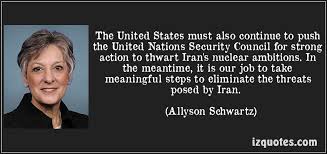
Allyson Schwartz

allyson

Why would any progressive support her?

Look, this is a tough one. One of the worst features of Pennsylvania politics is our state’s dismal track record in electing women candidates, so a female governor would be a giant breakthrough. Still, if your goal is to make Pennsylvania a more progressive place, it would be less important to elect a woman than to elect someone who is actually progressive.

Schwartz’s mediocre track record make you think that she is not that person. Instead, she comes across as one of a new disturbing new breed of uptown/suburban politico — typified by New York’s Michael Bloomberg and his likely successor as mayor, Christine Quinn. They are 100 percent true-blue liberal on social issues like gay marriage and a woman’s right to choose, but take pro-business stances that aren’t helpful to the struggling middle class, and don’t seem much troubled by creeping police-statism to protect what the affluent have in 21st Century America.

Yesterday was rock-bottom for Schwartz, as she joined with a rag-tag army of Republican neo-conservatives and some Obama-loyal flip-floppers in defeating a House amendment that would have defunded the Natural Security Administration’s spying overreach on Americans’ phone records, a measure that would have been a dramatic statement that Congress is listening to the voice of the people who are tired of the growing power of the surveillance state. You can run for higher office as “a progressive” — or you can support a government that operates in violation of the 4th Amendment. I don’t understand how you can do both.

And Schwartz’ unprogressive vote on the NSA might be excusable is it were a one-time thing — but there are other questions. In a time when fracking is ruining the rural environment across Pennsylvania, Schwartz has taken a surprisingly business-friendly (and future campaign-contributor friendly?) stance. Upon taking office in 2005, Schwartz had a choice between the Big Banks or the middle class on a bankruptcy bill — and she voted with the banks. She’s a leader of something called the New Democrat Coalition — which ProPublica recently described as “a group of 69 lawmakers whose close relationship with several hundred Washington lobbyists makes them one of the most successful money machines since the K Street Project collapsed.” Again…ugh. Democrats do have other choices.

One candidate whose energy level has been remarkable, and who has taken consistently progressive stances on the issues facing Pennsylvania, is the former Environmental Protection commissioner, John Hanger. Hanger is also problematic — he’s completely lacking in name recognition, and he’s also not perfect. But the point is that Schwartz’s bad vote yesterday on government spying is another reason why Democrats would be smart to have a real primary, and not a coronation. The fact that Corbett couldn’t be elected Harrisburg dog-catcher right now means that Dems can relax and focus on the best candidate for a change, and not try to guess who they think will win (which never works, anyway). If progressives are determined to vote for Allyson Y. Schwartz, they should stop and ask themselves…why?

The return of Obama’s Grand Bargain

http://youtu.be/ldeb_eGn_pM

As I said the last time they brought this up, this is the point of Obama’s charm offensive with Republican senators, and the point of the sequestration “crisis”. The time to watch for the Grand Bargain will be the debt ceiling negotiations this fall. That’s why it’s important to get to your congressional town halls this summer, because they need to know there will be hell to pay if they go anywhere near this:

At least a dozen Republican senators are regularly meeting with President Obama’s top aides in an attempt to plot a way forward on the looming fiscal challenges facing leaders this fall, senators involved in the meetings tell National Journal.

The meetings, which began after Obama hosted GOP senators for dinner earlier this year, are the first sign that Democrats and Republicans are in talks to strike a deal that would reduce the deficit and reform entitlements and taxes.

“Everybody’s trying to assess whether we can accomplish something that would be big,” said Republican Sen. Richard Burr of North Carolina, who has attended the meetings. “Big is reforming entitlements and it’s impossible to see a path where you get additional revenue without tax reform being part of it.”
Continue reading “The return of Obama’s Grand Bargain”