‘Clean Earth’

000057560028

Sure it is:

A Montgomery County waste disposal company called Clean Earth is proposing to haul in 400,000 tons of gas industry waste– specifically treated drill cuttings. If its plans are approved by state regulators, the company would relocate its Williamsport-based processing facility to the airport grounds. It would pay to lease the land, then use the cuttings to extend the runway by 600 feet, and eventually turn over the processing building to the airport for use as a hanger.

Musser thinks this will help the airport and, in turn, the local economy.

“To bring growth–an airport is a vital step towards that,” he says.

The plan has been met with major push back here in Tioga County—one of the most drilled-on places in the state.

That’s because the airport sits high atop one of the region’s most beautiful natural assets, and a major tourist destination: the Pine Creek Gorge. It’s often called the Grand Canyon of Pennsylvania. The airport’s runway is next to a steep embankment that’s a half-mile from a tributary to the gorge.

And that embankment is exactly where Clean Earth wants to put the drill cuttings.

Tioga County Commissioner Eric Coolige (R) says drillers have been “a godsend” to the area. But he and many other gas industry supporters (including state Senate Pro Tempore Joe Scarnati, who represents the area) are not sold on this idea.

“My concern is this product has not yet been given a 100 percent OK,” says Coolige. “And until it does, I’m not going to be in favor of it.”

Ed Osgood is a member of the Pine Creek Gorge Headwaters Protection Group. He also thinks it would be a big mistake to put so much drilling waste next to the gorge.

“We have no long-term, peer-reviewed studies to indicate this material is safe,” says Osgood.

He’s worried the waste could run into the gorge when it rains.

“I think the name Clean Earth is ironic,” he says. “This is anything but clean earth.”

Research and development?

Thanks to an exemption in federal law, none of the waste generated by the oil and gas industry is considered hazardous. No matter what’s in it. Clean Earth declined multiple interview requests for this story but says in a statement it’s been handling the waste “with the highest integrity.” The company has already disposed of 172,000 tons of it in recent years thanks to a special permit from the state Department of Environmental Protection (DEP).
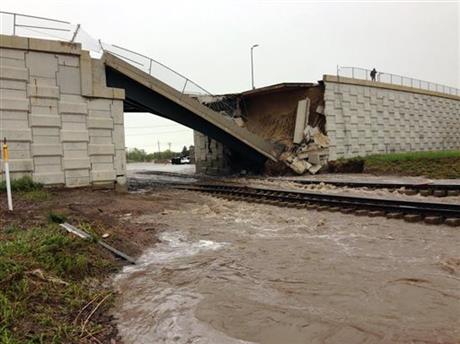
Nope, no damned global warming here

This photo provided by the Wyoming Highway Patrol shows a portion of a bridge over railroad tracks on the north side of the small eastern Wyoming town of Lusk that was collapsed by flash flood waters early Thursday. June 4, 2015. Up to 6 inches of rain fell in the area overnight Wednesday and early Thursday, forcing some residents to leave their homes and causing damage to area highways. (Wyoming Highway Patrol via AP)

Seems like a lot of those “freak storms” going around lately:

CHEYENNE, Wyo. (AP) — A freak thunderstorm dumped up to 6 inches of rain and inundated a tiny Wyoming town, collapsing a bridge, damaging homes and businesses, and sending about a dozen people to higher ground.

Another brief thunderstorm dumped more rain on the flooded area Thursday afternoon before Gov. Matt Mead was scheduled to arrive to tour the damage.

In Lusk, population 1,500, floodwaters rushed down Main Street, swamping four blocks and shutting down the town’s water supply, said Niobrara County Emergency Management Coordinator James Santistevan.

There were no reports of anyone being hurt, he said.

Afternoon Roundup…

The clown car is getting bigger as George Pataki enters the race…

It should be a mild Atlantic hurricane season and here’s the summer forecast for the U.S….

Astrologer Susan Miller tells how to survive and plan for (yeah, right) the Mercury retrograde

Here’s a nice NPR story about independent booksellers making a come back…

For many rural areas, Walmart has become the center of life. Here is one person’s experience…

And if you are having a sad lunch break, here is a cat that is even sadder than you…


Executive Action to regulate wetlands, streams, and tributaries …

President Obama has taken executive action regulating wetlands, streams and tributaries of larger waterways. The administration said this action was necessary to clarify rules under the Clean Water Act…

“We’re finalizing a clean water rule to protect the streams and the wetlands that one in three Americans rely on for drinking water. And we’re doing that without creating any new permitting requirements and maintaining all previous exemptions and exclusions,” EPA head Gina McCarthy told reporters Wednesday.

McCarthy and other Obama officials sought to emphasize that the rule is about increasing clarity for businesses and helping make it easier to determine which waterways are subject to the pollution rules of the Clean Water Act.

“This rule is about clarification, and in fact, we’re adding exclusions for features like artificial lakes and ponds, water-filled depressions from constructions and grass swales,” she said

“This rule will make it easier to identify protected waters and will make those protections consistent with the law as well as the latest peer-reviewed science. This rule is based on science,” she continued.

The new regulations will help the EPA control pollutants from these waterways and help prevent issues like algal blooms.

“There is nothing complicated about the idea that we should protect the tributary system that flows into our nation’s rivers,” said David Uhlmann, a law professor at the University of Michigan who previously led the prosecution of environmental crimes at the Justice Department. “What is more difficult is deciding when to protect wetlands, which perform essential ecological functions but often make it difficult or impossible for landowners to develop their property.”

These new rules have not come about without significant opposition…

The American Farm Bureau has led the opposition. “The proposed rule provides none of the clarity and certainty it promises,” the bureau wrote in a letter to Congress. “Instead, it creates confusion and risk by providing the agencies with almost unlimited authority to regulate, at their discretion, any low spot where rainwater collects.” That could include farm ditches, agricultural ponds and isolated wetlands, it said. “The proposed rule provides none of the clarity and certainty it promises,” the bureau wrote in a letter to Congress. “Instead, it creates confusion and risk by providing the agencies with almost unlimited authority to regulate, at their discretion, any low spot where rainwater collects.” That could include farm ditches, agricultural ponds and isolated wetlands, it said.

The EPA has a website up to explain the changes and clarify the Clean Water rules.


They want to pay for TPP deal by stealing from Medicare

Republicans want to pay for an assistance program for workers whose jobs are lost through TPP by… taking the money out of Medicare! Nice! Michael Hiltzik of the L.A. Times explains: Medicare means many things to many people. To seniors, it’s a program providing good, low-cost healthcare at a stage in life when it’s most needed.… Continue reading “They want to pay for TPP deal by stealing from Medicare”

‘99% certain’ pesticides causing health problems

Green the Green/Students Lounging on the Green

Well, there you go! Fortunately, we would never inconvenience American food manufacturers with any socialist restrictions:

Exposure to hormone-disrupting chemicals is likely leading to an increased risk of serious health problems costing at least $175 billion (U.S.) per year in Europe alone, according to a study published Thursday.

Chemicals that can mimic or block estrogen or other hormones are commonly found in thousands of products around the world, including plastics, pesticides, furniture, and cosmetics.

The new research estimated health care costs in Europe, where policymakers are debating whether to enact the world’s first regulations targeting endocrine disruptors. The European Union’s controversial strategy, if approved, would have a profound effect on industries and consumer products worldwide.

Linda Birnbaum, the leading environmental health official in the U.S. government, called the new findings, which include four published papers, “a wake-up call” for policymakers and health experts.

“If you applied these [health care] numbers to the U.S., they would be applicable, and in some cases higher,” says Birnbaum, director of the U.S. National Institute of Environmental Health Sciences.

The researchers detailed the costs related to three types of conditions: neurological effects, such as attention deficit disorders; obesity and diabetes; and male reproductive disorders, including infertility.

Talcum powder and ovarian cancer

Let our Bubbas play outdoors longer and stay fresh with Johnson's Baby Active Fresh Bath and Powder. #johnsonsbaby #baby #activeplay #activefresh

This is a horrifying story. If you’re lucky, there’s no asbestos in your powder — but it might kill you anyway. Fortunately for me, since we grew up poor, we’d put cornstarch in a sock, tie it up and dab ourselves with it when we were hot and sweaty. Hopefully, that won’t kill us!

Suspicions about talc and ovarian cancer go back decades. In 1971, British researchers analyzed 13 ovarian tumors under a microscope and found talc particles ‘’deeply embedded” in 10.

In 1982, the journal Cancer published the first study showing a statistical link between genital talc use and ovarian cancer. Soon after, lead author Dr. Daniel Cramer, a gynecologist and Harvard Medical School professor, was visited by a senior scientist from J&J. He “spent his time trying to convince me that talc use was a harmless habit,” Cramer recalled in a document filed in court, “while I spent my time trying to persuade him … that women should be advised of this potential risk.”

Altogether, about 20 epidemiological studies have found increased rates of ovarian cancer risk for women using talc for hygiene purposes, though some studies have found no association. One report, published by Cramer and several co-authors in 1999, said talc use could be the cause of about 10 percent of ovarian cancers in the U.S.–or some 2,000 cases per year. “Balanced against what are primarily aesthetic reasons for using talc in genital hygiene, the risk benefit decision is not complex,” the study said. “Appropriate warnings should be provided to women about the potential risks of regular use of talc in the genital area.”

In response to such findings, the Cancer Prevention Coalition, an advocacy group, asked the Food and Drug Administration in 1994 to require warnings against talc use for genital hygiene. The agency said it lacked evidence to require warnings, and J&J refused to issue them voluntarily.

Instead, the company and its allies circled the wagons. In 1992, the cosmetic and fragrance association launched a Talc Interested Party Task Force to develop talking points and find experts to rebut studies linking talc to ovarian cancer.

But some statements by the trade group were “inaccurate, to phrase it euphemistically,” a consultant for J&J warned. In two 1997 letters to company officials (here and here), toxicologist Alfred P. Wehner attacked statements that “the scientific evidence did not demonstrate any real association between talc use in consumer products and ovarian tumors.”
Continue reading “Talcum powder and ovarian cancer”

Of course we know it’s nothing

Governor Cuomo Receives Briefing at Indian Point Nuclear Power Plant

Right? Because if it was something, they would let us know and they’d evacuate the area? Ha ha, just kidding!

NEW YORK/WASHINGTON (Reuters) – A nuclear power reactor 40 miles (65 km) north of New York City was shut down on Saturday after a transformer fire, but officials said the Indian Point plant was stable and there was no threat to residents nearby.

People in the area reported an explosion and smoke coming from the plant at Buchanan in New York state. But the U.S. Nuclear Regulatory Commission said the fire had been quickly extinguished.

“These events happen occasionally. They are not unheard of and the plant responded as designed,” NRC spokesman Eliot Brenner said in a statement. He added the fire occurred at 5:50 p.m. (2150 GMT) and was put out 25 minutes later.

The NRC designated the incident an “unusual event,” which is the lowest of four categories the agency gives to potential safety or security threats at nuclear plants.

Pollen may help clouds form, increase rainfall

It’s common knowledge that rain helps flowers bloom. But new research suggests the opposite may also be true: Pollen from flowers could help form clouds and bring about rain. In a study published this week in the journal Geophysical Research Letters, atmospheric scientists from the University of Michigan and Texas A&M found that pollen from six… Continue reading “Pollen may help clouds form, increase rainfall”

I don’t really like turkey, anyway

02. Turkey

I go for the cranberry sauce:

The largest-ever U.S. outbreak of avian influenza, which has devastated Midwestern poultry and egg producers in recent weeks, could be felt at Thanksgiving tables across the nation come November, farmers and some trade groups say.

The virulent H5N2 strain has already spread to 14 states and led to the deaths or scheduled euthanizations of more than 21 million birds, including 3.3 million turkeys in Minnesota, the nation’s top turkey producer.

And now, with Thanksgiving just seven months away, farmers say they may be running out of time to raise enough turkeys –the traditional centerpiece of holiday feasts – to meet the demand.

Once a farm has been infected, flocks must be culled, composted in barns, then disposed of. Buildings must then be thoroughly disinfected. The whole process can take up to three months before a new flock of turkey poults can be brought in, said Steve Olson, executive director of the Minnesota Turkey Growers Association.