How they paid for climate change denial

funding

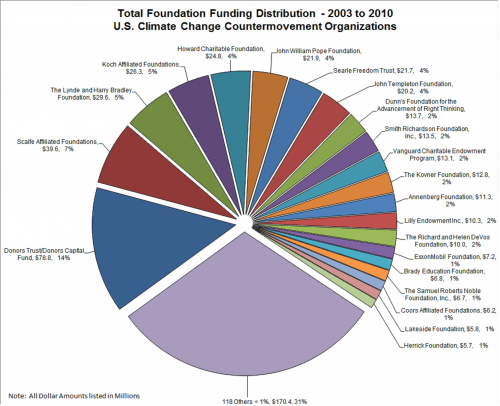
A Drexel University professor has untangled how the funding was established by special interests to push climate change denial:

To uncover how the countermovement was built and maintained, Brulle developed a listing of 118 important climate denial organizations in the U.S. He then coded data on philanthropic funding for each organization, combining information from the Foundation Center with financial data submitted by organizations to the Internal Revenue Service. The final sample for analysis consisted of 140 foundations making 5,299 grants totaling $558 million to 91 organizations from 2003 to 2010.

Key findings include:

  • Conservative foundations have bank-rolled denial. The largest and most consistent funders of organizations orchestrating climate change denial are a number of well-known conservative foundations, such as the Searle Freedom Trust, the John William Pope Foundation, the Howard Charitable Foundation and the Sarah Scaife Foundation. These foundations promote ultra-free-market ideas in many realms.
  • Koch and ExxonMobil have recently pulled back from publicly visible funding. From 2003 to 2007, the Koch Affiliated Foundations and the ExxonMobil Foundation were heavily involved in funding climate-change denial organizations. But since 2008, they are no longer making publicly traceable contributions.
  • Funding has shifted to pass through untraceable sources. Coinciding with the decline in traceable funding, the amount of funding given to denial organizations by the Donors Trust has risen dramatically. Donors Trust is a donor-directed foundation whose funders cannot be traced. This one foundation now provides about 25% of all traceable foundation funding used by organizations engaged in promoting systematic denial of climate change.
  • Most funding for denial efforts is untraceable. Despite extensive data compilation and analyses, only a fraction of the hundreds of millions in contributions to climate change denying organizations can be specifically accounted for from public records. Approximately 75% of the income of these organizations comes from unidentifiable sources.

“The real issue here is one of democracy. Without a free flow of accurate information, democratic politics and government accountability become impossible,” said Brulle. “Money amplifies certain voices above others and, in effect, gives them a megaphone in the public square. Powerful funders are supporting the campaign to deny scientific findings about global warming and raise public doubts about the roots and remedies of this massive global threat. At the very least, American voters deserve to know who is behind these efforts.”

This study is part one of a three-part project by Brulle to examine the climate movement in the U.S. at the national level. The next step in the project is to examine the environmental movement or the  movement. Brulle will then compare the whole  flow to the entire range of organizations on both sides of the debate.

Dept. of Trust Us, We Wouldn’t Do Anything To Hurt You

Fracking wastewater site

Imagine that. I suppose we’ll have to imagine, since by law, they don’t have to tell us what they’re using to pollute our water supply. From the University of Pennsylvania MedPage:

Surface and ground water samples taken from hydraulic fracking sites in a drilling-dense area of Colorado showed higher levels of estrogenic, anti-estrogenic and anti-androgenic chemical activity than reference sites with limited drilling, researchers found.

Evidence of endocrine-disrupting activity in a selected subset of chemicals used in the controversial oil and natural gas extraction process was also shown in a study published online ahead of print in the journal Endocrinology.

Fracking Spill Sites Had Twice the EDCs

Water samples from drilling sites in Garfield County, Colo. that experienced fracking spills or accidents showed moderate to high levels of the endocrine-disrupting chemical (EDC) activity, while samples from sites with little drilling showed very little activity, wrote Susan C. Nagel, PhD, of the University of Missouri in Columbia, and colleagues.

“We found no significant anti-androgenic activity at any of our control sites and significant anti-androgenic activity at all of the spill sites,” Nagel told MedPage Today.

On average, water at fracking spill sites had double the amount of total endocrine-disrupting activity compared with control sites, she said.

Nagel characterized this association as strong, and said the study is the first to show an association between fracking and endocrine-disrupting activity.

Around 750 chemicals have been reported to be used in hydraulic fracking, including more than 100 known or suspected to be endocrine-disrupting.

Fracking Exempt From Water Protection Regulations

But the permanent underground injection of chemicals used in fracking is not regulated by the Environmental Protection Agency and has been exempted from multiple federal regulatory acts, including the Safe Drinking Water Act, the Clean Water Act, and the Clean Air Act.

Thanks to Karin Riley Porter.

Polluting our kids’ brains

We all know this. And it’s not as if the establishment would be willing to rock this particular boat when there are campaign contributions to be had:

As many as one in six children nationwide has a neurodevelopmental disability, including autism, speech and language delays, and attention deficit hyperactivity disorder. The Centers for Disease Control and Prevention estimates that ADHD alone affects 14 percent of children, although experts debate whether it may be overdiagnosed. In any case, the number of children needing special education services has increased 200 percent in the past 25 years. In a 2000 report, the National Research Council of the National Academy of Sciences estimated that 3 percent of brain disorders are caused outright by environmental toxicity and an additional 25 percent by environmental exposures interacting with genetic susceptibilities.

Every day, America’s pregnant women and young children are exposed to a trifecta of suspected neurotoxicants in the form of pesticides (mostly via food and water but also home, lawn, and farm applications), polycyclic aromatic hydrocarbons, or PAH (mostly via exposure to vehicle exhaust), and polybrominated diphenyl ethers, or PBDEs (flame retardants, mostly in upholstered furniture and electronics). The CDC routinely samples Americans for these and other industrial by-products in our bodies, so we know their reach is pervasive. But we are not all equally exposed, and some of us appear to be more vulnerable to them for reasons that may include genetic susceptibility, poor nutrition, stress, and age.

What happened to the Hurricane Sandy money?

062812_4822_NJACE Award

I think this will turn out to be quite a story.

TRENTON — In advance of an expected 2016 presidential campaign, Chris Christie’s administration is stepping up efforts to control the Republican governor’s image at all costs — even skirting sunshine laws that permit public access to government records.

Getting the Christie administration to release its grip of records tracking use of federal Sandy recovery money has been particularly difficult for watchdog groups and media outlets, including the Asbury Park Press.

The Fair Share Housing Center recently received the first detailed information about housing recovery programs supported by federal grants — only after suing the administration for not complying with a public records request.

The Press has yet to receive Sandy recovery information the newspaper first sought four months ago. The Press asked for internal administration records from the contract bidding that resulted in Christie and his family starring in TV commercials for the $25 million “Stronger Than the Storm” tourism campaign.

In September, state officials told the Press a search had “identified hundreds of potentially responsive documents’’ and promised to begin sharing the information “on a rolling basis” starting in the second week of October.

For two months after the deadline, nothing was forthcoming — until some of the documents were released Friday, just hours after this story first appeared on the newspaper’s APP.com website. State officials said more information would be available later this month.

Not only are they blocking info on the federal funding, IIRC, we still don’t have an accounting of the private donations raised by the Springsteen-BonJovi-Billy Joel concert — which is being handled by Mary Pat Christie, former Wall St. banker and the governor’s wife.

The next time a wingnut says we had a ‘quiet’ hurricane season

And that proves there’s no global warming, remind him the world is a much bigger place than the United States:

European winter storm claims nine lives (via AFP)

Icy winter storms with hurricane-force winds Friday lashed northern Europe, where the death toll rose to nine while hundreds of thousands were left without power or stranded by transport chaos. Emergency services across the region battled to evacuate…

Continue reading “The next time a wingnut says we had a ‘quiet’ hurricane season”

Why Pennsylvanians should support Daylin Leach

Just one more reason to give this guy a contribution:

Believe it or not, yesterday I heard the following from E. Christopher Abruzzo, Tom Corbett’s Nominee for Department of Environmental Protection Secretary:

“I have not read any scientific studies that would lead me to conclude that there are adverse impacts to human beings or to animals or to plant life at this small level of climate change.”

While it is absolutely galling that Corbett would have the audacity to nominate someone for the post of protecting our environment who hasn’t read anything, ANYTHING, about the human impact on climate change, it’s not unexpected.

However, I was the only member of the State Senate yesterday to hold Corbett’s nominee accountable, to ask hard questions, and to vote against his nomination.

Not good

So it’s even worse than we thought:

WASHINGTON (AP) — The United States is spewing 50 percent more methane — a potent heat-trapping gas — than the federal government estimates, a new comprehensive scientific study says. Much of it is coming from just three states: Texas, Oklahoma and Kansas.

That means methane may be a bigger global warming issue than thought, scientists say. Methane is 21 times more potent at trapping heat than carbon dioxide, the most abundant global warming gas, although it doesn’t stay in the air as long.

Much of that extra methane, also called natural gas, seems to be coming from livestock, including manure, belches, and flatulence, as well as leaks from refining and drilling for oil and gas, the study says. It was published Monday in the Proceedings of the National Academy of Science.

The study estimates that in 2008, the U.S. poured 49 million tons of methane into the air. That means U.S. methane emissions trapped about as much heat as all the carbon dioxide pollution coming from cars, trucks, and planes in the country in six months.

That’s more than the 32 million tons estimated by the U.S. Environmental Protection Administration or the nearly 29 million tons reckoned by the European Commission.

“Something is very much off in the inventories,” said study co-author Anna Michalak, an Earth scientist at the Carnegie Institution for Science in Stanford, Calif. “The total U.S. impact on the world’s energy budget is different than we thought, and it’s worse.”

Still conflicted about the Keystone pipeline? Read this.

No one likes to talk about the dangers:

Jason Thompson used to love fishing in the lake he can see from his window in Mayflower, Arkansas, but these days, when he throws a line out into the water, the lure he reels back is covered in a sour, stinking black tar, the skirt of the jig stuck uselessly together. When he brings the fingers that touched the line up to his nose, he gets a whiff of the same putrid stench that filled the air for weeks after the oil pipeline burst—the smell that still rises out of the ground every time it rains.

Thompson hasn’t been fishing much. Ever since Exxon Mobil’s Pegasus pipeline burst in March and spilled an estimated 210,000 gallons of Canadian heavy crude oil two miles from his house, he’s had headaches of preternatural intensity, so bad they wake him up in the middle of the night. He has nosebleeds, and hemorrhoids even though he’s only 36; there’s a rash on his neck that has only gotten worse in the eight months since the spill; and some days he feels so weak that he can hardly get out of bed. He estimates that he has lost almost 35 pounds since the rupture, falling from a fit 220 down to 185. When he went to see a doctor in April, he was told he has a mysterious spot on one lung—but he hasn’t been able to afford to go back.

Hundreds of people in this working-class town of 2,200 have complained of symptoms like Thompson’s. And their maladies—respiratory disorders, nausea, fatigue, nosebleeds, bowel issues, throbbing headaches—echo the ones that appeared in Marshall, Michigan, where an Enbridge Energy pipeline burst in 2010. The two pipelines were carrying the same kind of oil: a heavy crude, or bitumen, mined in the tar sands of Alberta, Canada, which is thicker and rawer than the oil extracted in the United States. This is also the oil that would flow in record quantities through the controversial Keystone XL pipeline, if President Barack Obama decides to approve it.
Continue reading “Still conflicted about the Keystone pipeline? Read this.”