Hurricane Sandy and the poor

Helen Kromm at the Smirking Chimp:

To put it bluntly, Irene simply kicked our asses. Irene devastated us locally. I am fifty-one years old, and had never, ever been afraid of a weather event in my life. And I was petrified as I experienced Irene, and thought it would never end.


So now we are preparing for Sandy, and we know and are told that this storm will be worse. And believe me when I say that worse than Irene is a frightening thought. And for several days now, we’ve been receiving the usual warnings in the media. And with those usual warnings are the instructions as to what we should do and how we should prepare.


And for many residents in the impact area, and specifically many of the residents in my city, these instructions are both farcical and entirely impractical. Because the simple fact of the matter here is that the poor and the working poor don’t have the resources to make any preparations at all.


We as a community are told to stock up on batteries and such. But the poor and working poor generally lack the resources even for something as simple as buying batteries. We are told to stock up on non-perishable food items. Lost in that particular precaution is the fact that this is the end of the month, and the poor and working poor exhausted what meager food stamp benefits they had for this month days ago. They have been eating pasta and ramen noodles for days now, and doing what they do every month- which is to say they are holding on until they receive their monthly allotment sometime at the beginning of next month. And those allotments are coming too late.


And this is an issue that you really have to wonder about. An issue of such stupidity that it borders on being unbelievable and is utterly outrageous. This area and the people that live here are told to stock up on non-perishable foods, and have enough readily available for at least a week or two. And that power could be off for even longer than that. And they are told that at the exact moment of the month when they have absolutely no resources to do that or achieve that.


By simply replenishing the balances on their food cards a mere two or three days early, people with absolutely no means could actually buy this weeks’ worth of food and prepare. And without it they can’t. It is craven stupidity beyond comprehension.


Roughly 40% of the residents of our city rely on food stamps for survival. So as this once in a lifetime storm bears down upon us, they see those people with means getting cash out of ATM machines. Rushing to Home Depot for their generators and batteries, and mobbing the grocery stores for bread and milk and ice and who knows what else.


And they are afraid. And they have reason to be. Because they remember Irene and how brutal that was. And they have kids and families and are wondering how in the hell they can feed them. And they watch this cavalcade of mad preparations and they are absolutely left out and left behind.


If you are poor and in the path of this event, the term “perfect storm” has a whole new meaning. Perfect storm not only defines the event itself, it also defines the calendar. As the calendar goes, this is well and truly the perfect storm. Because the calendar works against you in a diabolical way that could not possibly be worse. It is a cruel Catch 22 that is leveled at the most vulnerable in our community. On the one hand being told that it is absolutely vital to stock up in preparation for this event. And on the other hand realizing that you don’t have the means to do so, and won’t have access to those means until after the storm hits and when in all probability it will be impossible to do so.


If you aren’t poor or working poor, you probably don’t understand fully what this means. And what it means is fear and terror. It means being left behind. It means staring at empty cupboards with absolutely no hope and no way to replenish them at a time when you are told to do exactly that.
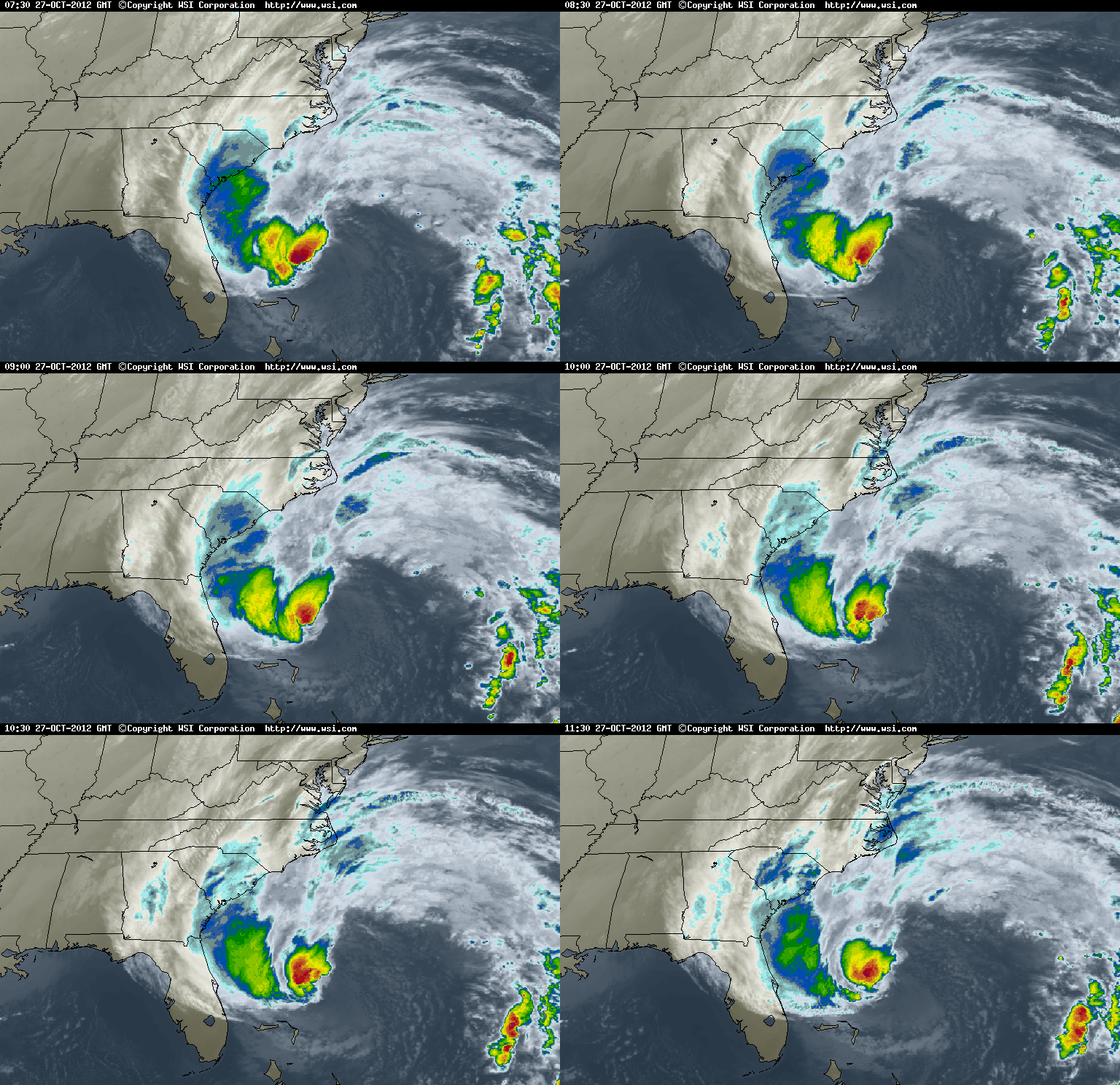
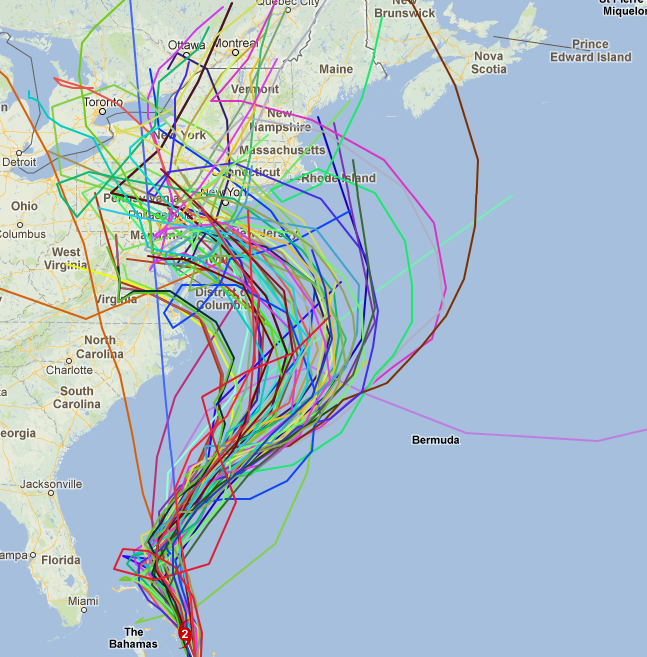
Public service announcement

From the Mt Holly NJ National Weather Center:

Sandy is expected to slam into the New Jersey coast later Monday night, bringing very heavy rain and damaging winds to the region. The storm is a large one, therefore do not focus on the exact center of the storm as all areas will have significant impacts.

This has the potential to be an historic storm, with widespread wind damage and power outages, inland and coastal flooding, and massive beach erosion. The combination of the heavy rain and prolonged wind will create the potential for long lasting power outages and serious flooding.

Preparations should be wrapping up as conditions are expected to worsen tonight and especially on Monday.

Some important notes…

1. If you are being asked to evacuate a coastal location by state and local officials, please do so.

2. If you are reluctant to evacuate, and you know someone who rode out the ’62 storm on the barrier islands, ask them if they could do it again.

3. If you are reluctant, think about your loved ones, think about the emergency responders who will be unable to reach you when you make the panicked phone call to be rescued, think about the Rescue/recovery teams who will Rescue you if you are injured or recover your remains if you do not survive.

4. Sandy is an extremely dangerous storm. There will be major property damage, injuries are probably unavoidable, but the goal is
zero fatalities.

5. If you think the storm is over-hyped and exaggerated, please err on the side of caution.

We wish everyone in harms way all the best. Stay safe!

And if you’re dumb enough to stay, please write your name and Social Security number in permanent market on your arm, so they can identify your body.

The calm before the storm

I’m starting to realize just how stressful it is, being hypervigilant. This morning, they’re saying the models are starting to indicate Sandy will be coming ashore in the vicinity of the Delmarva peninsula (where I live) and along the I-95 corridor (I live a few blocks from I-95), just as the “longshot” European model has said all along. They also make a point of saying it doesn’t much matter where the storm makes landfall, it’s still going to have a massive impact. Still thinking about storm surge and flooding ALL. THE. TIME. It would be hard not to, when NOAA is predicting coastal waves of 15-36 feet. (Thanks, petroleum lobbyists!)

The thing is, it’s also really dangerous to travel when there’s so much flooding. So I’m probably going to stay put until the storm passes, and then if the power’s out, I’ll go stay with friends.

Sandy was downgraded to a tropical storm last night, but NOAA is reporting hurricane-force winds again this morning. They’ve said all along not to be fooled by a downgrade, that the closer it gets, the more powerful it will become as it passes over the abnormally warm Atlantic ocean.

With a major storm headed my way really my neuroses are in full bloom!

The Mid-Atlantic and Northeast coasts should be prepared for a storm surge no matter their exact location. A large portion of the coast will feel the impact of up to 60 mph winds and heavy rain. According to the most recent H*Wind analysis from the Hurricane Research Division is that storm surge has a destructive potential of 4.8 out of 6.0, which is a slight increase from previous analyses. Wind damage potential is holding steady around 2.3 out of 6.0. NOAA’s HPC is forecasting rainfall totals of 5 to 10 inches in the Mid-Atlantic and Northeast, and possibly more in coastal locations close to the core of the storm. Widespread power outages from Maine south to Virginia are likely, due to the combination of long-lived gale-force winds, leaves on trees, and rain that will moisten the soil and possibly increase the chances of falling trees. Snow in the Appalachians is also possible as the intense moisture meets the cold air being pulled south by the mid-latitude trough.


During September 2012, ocean temperatures off the mid-Atlantic coast in the 5×10° latitude-longitude box between 35 – 40°N, 65 – 75° W were 2.3°F (1.3°C) above average, according to the UK Met Office. This is the 2nd greatest departure from average for ocean temperatures in this region since reliable ocean temperature measurements began over a century ago (all-time record: 2.0°C above average in September 1947.) These unusually warm waters have persisted into October, and will enable Sandy to pull more energy from the ocean than a typical October hurricane. The warm waters will also help increase Sandy’s rains, since more water vapor will evaporate into the air from a warm ocean. I expect Sandy will dump the heaviest October rains on record over a large swath of the mid-Atlantic and New England.


Hurricanes are expected to dump 20% more rain in their cores by the year 2100, according to modeling studies (Knutson et al., 2010). This occurs since a warmer atmosphere holds more water vapor, which can then condense into heavier rains. Furthermore, the condensation process releases heat energy (latent heat), which invigorates the storm, making its updrafts stronger and creating even more rain. We may already be seeing an increase in rainfall from hurricanes due to a warmer atmosphere. A 2010 study by Kunkel et al. “Recent increases in U.S. heavy precipitation associated with tropical cyclones”, found that although there is no evidence for a long-term increase in North American mainland land-falling tropical cyclones (which include both hurricanes and tropical storms), the number of heavy precipitation events, defined as 1-in-5-year events, more than doubled between 1994 – 2008, compared to the long-term average from 1895 – 2008. As I discussed in a 2011 post “Tropical Storm Lee’s flood in Binghamton: was global warming the final straw?”, an increase in heavy precipitation events in the 21st Century due to climate change is going to be a big problem for a flood control system designed for the 20th Century’s climate.

For those of you have never lived in hurricane country, the approach of a major storm is always accompanied by several days of ominious overcast skies, the outer cloud band that covers hundreds of miles. We haven’t seen much of the sun for the past week.

Today I need to get my plants and patio furniture out of the way, and get my cooler out of the garage, since it would be nice to have some real food through this ordeal.

Frankenstorm

Can we talk about global warming yet?

“It really is a worst-case scenario,” one of the Weather Channel anchors said late last night. I have battery-operated lights, but I wish I had a propane heater, because the storm is going to bring cold weather in its wake, and I’m not happy about the possibility of sitting in the cold and the dark for days. (And not incidentally, without a phone or computer.) Plus, I live about a half-mile or so from the Delaware River. If there’s a strong enough storm surge up the Delaware Bay, I’m pretty sure my neighborhood will be flooded. How much, I don’t know — because this kind of storm has never happened before.

A friend of a friend who works in emergency services said in a call with the feds yesterday, they were told to prepare for two-week power outages along the East Coast. As I’ve written before, this is because power companies are understaffed to keep the stock prices up. I have a feeling they won’t want to brag about that in the aftermath of this monstrous storm. Please, if you’re in its path, make preparations:

Hurricane Sandy, having blown through Haiti and Cuba on Thursday, continues to barrel north. A wintry storm is chugging across from the West. And frigid air is streaming south from Canada.


And if they meet Tuesday morning around New York or New Jersey, as forecasters predict, they could create a big wet mess that settles over the nation’s most heavily populated corridor and reaches as far inland as Ohio.


With experts expecting at least $1 billion in damage, the people who will have to clean it up aren’t waiting.


Utilities are lining up out-of-state work crews and canceling employees’ days off to deal with the power outages. From county disaster chiefs to the federal government, emergency officials are warning the public to be prepared. And President Barack Obama was briefed aboard Air Force One.


“It’s looking like a very serious storm that could be historic,” said Jeff Masters, meteorology director of the forecasting service Weather Underground. “Mother Nature is not saying `trick-or-treat.’ It’s just going to give tricks.”


National Oceanic and Atmospheric Administration forecaster Jim Cisco, who coined the nickname Frankenstorm, said: “We don’t have many modern precedents for what the models are suggesting.”


Government forecasters said there is a 90 percent chance – up from 60 percent two days earlier – that the East will get pounded starting Sunday and stretching past Halloween on Wednesday. Things are expected to get messier once Sandy, a very late hurricane in what has been a remarkably quiet season, comes ashore, probably in New Jersey.


Coastal areas from Florida to Maine will feel some effects, but the storm is expected to vent the worst of its fury on New Jersey and the New York City area, which could see around 5 inches of rain and gale-force winds close to 40 mph. Eastern Ohio, southwestern Pennsylvania, western Virginia and the Shenandoah Mountains could get snow.


And the storm will take its time leaving. The weather may not start clearing in the mid-Atlantic until the day after Halloween and Nov. 2 in the upper Northeast, Cisco said.


“It’s almost a weeklong, five-day, six-day event,” he said from a NOAA forecast center in College Park, Md. “It’s going to be a widespread, serious storm.”


It is likely to hit during a full moon, when tides are near their highest, increasing the risk of coastal flooding. And because many trees still have their leaves, they are more likely to topple in the event of wind and snow, meaning there could be widespread power outages lasting to Election Day.


Eastern states that saw blackouts that lasted for days after last year’s freak Halloween snowstorm and Hurricane Irene in late August 2011 are already pressuring power companies to be more ready this time.


Asked if he expected utilities to be more prepared, Massachusetts Gov. Deval Patrick responded: “They’d better be.”


Jersey Central Power & Light, which was criticized for its response to Irene, notified employees to be ready for extended shifts. In Pennsylvania, PPL Corp. spokesman Michael Wood said, “We’re in a much better place this year.”


Some have compared the tempest to the so-called Perfect Storm that struck off the coast of New England in 1991, but that one didn’t hit as populated an area. Nor is this one like last year’s Halloween storm, which was merely an early snowfall.


“The Perfect Storm only did $200 million of damage and I’m thinking a billion,” Masters said. “Yeah, it will be worse.”

Big Oil vs. clean energy: no contest

The more money they make, the more they want:

…Koch Industries and fossil fuel groups are mobilizing to defeat the extension of modest tax incentives for wind energy, even though oil tax breaks are permanent. The American Energy Alliance, which has Koch ties, aims to make the credit “so toxic” for Republicans it would be “impossible for John Boehner to sit at a table with Harry Reid.” The Koch-funded Americans For Prosperity is also campaigning against wind energy. Meanwhile, the industry has argued its own century-old tax breaks are necessary to maintain, despite years of record-breaking profits…

Sandy: a potential billion-dollar storm for the mid-Atlantic and New England

Keep an eye on this, kids:

On Friday, a very complicated meteorological situation unfolds, as Sandy interacts with a trough of low pressure approaching the U.S. East Coast and trough of low pressure over the Central Atlantic. The Central Atlantic trough may be strong enough to pull Sandy northeastwards, out to sea, as predicted by the official NHC forecast, and the 06Z GFS, 00Z UKMET, 00Z Canadian, and 06Z HWRF models (00Z is 8 pm EDT, and 06Z is 2 am EDT.) However, an alternative solution, shown by the 00Z ECMWF, 06Z GFDL, and 06Z NOGAPS models, is for Sandy to get caught up by the trough approaching the Eastern U.S., which will inject a large amount of energy into Sandy, converting it to a powerful subtropical storm that hits the mid-Atlantic or New England early next week with a central pressure below 960 mb and sustained winds of 60 – 70 mph. Such a storm would likely cause massive power outages and over a billion dollars in damage, as trees still in leaf take out power grids, and heavy rains and coastal storm surges create damaging flooding. The full moon is on Monday, which means astronomical tides will be at their peak for the month, increasing potential storm surge flooding. A similar meteorological situation occurred in October 1991, when Hurricane Grace became absorbed by a Nor’easter, becoming the so-called “Perfect Storm” that killed 13 people and did over $200 million in damage in the Northeast U.S.

Fracking permit granted one mile from PA nuclear plant

I mean, what could possibly go wrong? This article doesn’t mention where the company plans to inject their fracking waste, which is the practice that’s now associated with triggering seismic activity. As long as it’s legal under laws written back in 1979 doesn’t mean common sense has to enter into the decision to do what they want near a nuclear power plant. After all, if they do trigger an earthquake that damages the plant and contaminates the area, it probably won’t be the frackers who will pick up the cost of dealing with it. They’ll declare bankruptcy and walk away:

Chesapeake has a permit to frack one mile from the Beaver Valley Nuclear Power Station in Shippingport, Pa. Whether that is cause for alarm, experts can’t say.

But one thing is for sure — in the midst of the Marcellus boom, drilling companies are going to keep fracking, pockmarking the earth with their mile-deep wells, blasting away at the subterranean feature that is the Marcellus shale.

As the fracking continues, does anyone, driller or geologist, know what really lies beneath the surface? Does the improbability of seismic activity as a result of fracking become more likely as more wells are drilled?

The new permit granted to Chesapeake is located 1.06 miles from FirstEnergy Corp. nuclear facility in Shippingport. According to DEP records, the permit for an unconventional well was issued to Chesapeake on Oct. 3. Drilling has not yet started.
Continue reading “Fracking permit granted one mile from PA nuclear plant”

What could possibly go wrong with cutting fire funds during record droughts?

It’s a helluva way to run the richest country in the world, isn’t it? We are going to play chicken with every potential catastrophe in a time of extreme weather (and so, extreme risk), just so politicians can make a lot of noise about cutting the deficit:

In the worst wildfire season on record, the U.S. Department of Agriculture Forest Service ran out of money to pay for firefighters, fire trucks and aircraft that dump retardant on monstrous flames.


So officials did about the only thing they could: take money from other forest management programs. But many of the programs were aimed at preventing giant fires in the first place, and raiding their budgets meant putting off the removal of dried brush and dead wood over vast stretches of land — the things that fuel eye-popping blazes, threatening property and lives.


Recently, Congress stepped in and reimbursed the Forest Service and the Interior Department, which plays a far lesser role in fighting fires, with $400 million from the 2013 Continuing Resolution, allowing fire prevention work to continue. Forestry experts at state agencies and environmental groups greeted it as good news.


But they also faulted Congress for providing at the start of the fiscal year only about half of the $1 billion dollars it actually cost to fight this year’s fires. They argued that the traditional method that members of an appropriations conference committee use to fund wildfire suppression — averaging the cost of fighting wildfires over the previous 10 years — is inadequate at a time when climate change is causing longer periods of dryness and drought, giving fires more fuel to burn and resulting in longer wildfire seasons.


Once running from June to September, the season has expanded over the past 10 years to include May and October. It was once rare to see 5 million cumulative acres burn, agriculture officials said. But some recent seasons have recorded millions more than that.


This year’s wildfire burn was nearly 8 million acres at the end of August, about the time that the budget allocated to fight them ran dry.


“They knew they were running out of money early on, in May,” said Chris Topik, director of North American Forest Restoration for the Nature Conservancy. “They were telling people in May, ‘Be careful, don’t spend too much [on prevention].’ ”


Over seven years starting in 2002, $2.2 billion was transferred from other accounts for fire suppression when the budget came up short, according to records provided by the Forest Service. Congress at times reimbursed a fraction of those funds.