The con-artist wing of the Democratic party

Stress Test: Reflections on Financial Crises

Matt Stoller reviews “Stress Test,” Tim Geithner’s new book:

There are a few glaring problems with how Geithner portrays this debate. First of all, his main foil during the crisis was a fellow technocrat, former International Monetary Fund (IMF) official Simon Johnson, who actually had significant crisis-management experience parachuting into panicked countries and imposing structural reform on their bankers. Johnson became increasingly irate as he saw Geithner diverge from what Geithner himself at the US Treasury and the IMF forced on other countries: conditions. Geithner was hard on oligarchs when they were foreign, but when it was US bankers, well, then the wall of money argument triumphed. In fact, in a paper released in 2013, it was revealed that financial firms with a personal relationship with Geithner himself saw an abnormal 15% bump in share prices when Geithner’s name was floated for Treasury Secretary, and a corresponding though smaller, abnormal decline when his nomination was on the rocks due to his being caught not paying taxes by Senate investigators.

In 2009, Johnson published his essential argument about the US bailouts in an article titled “The Quiet Coup.” Johnson’s argument was political—he portrayed Geithner’s strategy as fundamentally entrenching a political oligarchy. That article put forward the theory that through the bailouts, America’s democratic system was being replaced by rule by financial titans. Geithner has never acknowledged that power was involved in the bailouts; those with power are loath to admit it exists. Critics of Geithner come as close as possible to calling him personally corrupt and have even marshaled the evidence that his cronies did fantastically well.

The second problem with Geithner’s argument is that the reform bill passed in the aftermath, the Dodd-Frank financial-reform law, is inconsistent with the wall of money theory. In the book, Geithner argues that Treasury lacked the legal ability to deal with large failing banks, to put them in a sort of bankruptcy process. Dodd-Frank provides those tools. However, according to Geithner’s wall of money, this doesn’t matter. Either you provide the assurance and everyone gets paid off, or it’s a collapse. If that’s true, why pass Dodd-Frank? Geithner wants it both ways.

The third problem is housing. Economists Amir Sufi and Atif Mian lead the charge in arguing that the Geithner strategy failed to restart the economy because it focused on leverage at the large banks rather than leverage among households, i.e., foreclosures. The shape of the Geithner policy architecture is two-tiered: The financiers recovered; everyone else did not. And the economy, even today, sputters along at just above stall speed because of this. Geithner halfheartedly admits he should have done more here, but then in the book he argues that there was absolutely no more that could be done. It’s a non-apology apology. Even in that, he’s inconsistent. He said on The Daily Show recently that he supported the judicial modification of mortgage debt for bankrupt homeowners, a pivotal policy, while in his book he says he didn’t think it was “fair” or “economically effective.”

So that’s a rehash: wall of money versus the real economy, or Tim Geithner versus Elizabeth Warren populist school or Simon Johnson technocratic school or however you want to frame it. Yes, there are disagreements on how to run society.

This piece sums him up nicely:

And then there’s the mystery of how he managed to climb up the career ladder so quickly. He never really explains how this happens. He wasn’t a good student. He notes, as a grad student, that he mostly played pool. “During my orals, when one professor asked which economics journals I read, I replied that I had never read any. Seriously? Yes, seriously. But not long after we returned from our honeymoon in France, Henry Kissinger’s international consulting firm hired me as an Asia analyst; my dean at SAIS had recommended me to Brent Scowcroft, one of Kissinger’s partners.”

I’m sorry, but what? How does this just happen? And it goes on. One day, when Geithner was a junior Treasury civil servant, Treasury Secretary Lloyd Bentsen just called him out of the blue to ask his advice on a matter about which he knew nothing. Why? He doesn’t say—he’s just puzzled. Later on, he advances in Treasury without any real credentials in a department where a law degree or economics PhD is essential. Even Alan Greenspan eventually expressed surprise; he had just assumed Geithner had a doctorate.

Power just always seemed to flow to Geithner, and he never says why. He knows why, of course—he’s an exceptional political climber. He just doesn’t say who was grooming him, why he ended up where he ended up, and what he paid to get there. It’s clear he had ideas about how the world should work, but he pretends otherwise.

Go read it, it’s fascinating. Also, here’s Felix Salmon’s take.
We’re destroying everything

Puffin

And no one seems to want to stop it:

Now, thanks to a grant from the Annenberg Foundation, the Puffin Cam offered new opportunities for research and outreach. Puffin parents dote on their single chick, sheltering it in a two-foot burrow beneath rocky ledges and bringing it piles of small fish each day. Researchers would get to watch live puffin feeding behavior for the first time, and schoolkids around the world would be falling for Petey.

But Kress soon noticed that something was wrong. Puffins dine primarily on hake and herring, two teardrop-shaped fish that have always been abundant in the Gulf of Maine. But Petey’s parents brought him mostly butterfish, which are shaped more like saucers. Kress watched Petey repeatedly pick up butterfish and try to swallow them. The video is absurd and tragic, because the butterfish is wider than the little gray fluff ball, who keeps tossing his head back, trying to choke down the fish, only to drop it, shaking with the effort. Petey tries again and again, but he never manages it. For weeks, his parents kept bringing him butterfish, and he kept struggling. Eventually, he began moving less and less. On July 20, Petey expired in front of a live audience. Puffin snuff.

“When he died, there was a huge outcry from viewers,” Kress tells me. “But we thought, ‘Well, that’s nature.’ They don’t all live. It’s normal to have some chicks die.” Puffins successfully raise chicks 77 percent of the time, and Petey’s parents had a good track record; Kress assumed they were just unlucky. Then he checked the other 64 burrows he was tracking: Only 31 percent had successfully fledged. He saw dead chicks and piles of rotting butterfish everywhere. “That,” he says, “was the epiphany.”

Why would the veteran puffin parents of Maine start bringing their chicks food they couldn’t swallow? Only because they had no choice. Herring and hake had dramatically declined in the waters surrounding Seal Island, and by August, Kress had a pretty good idea why: The water was much too hot.

Thanks to Shawn Sukumar Attorney at Law.

I’m biting my tongue

Rendell

Because it wouldn’t be nice to say it out loud:

PHILADELPHIA (AP) — Former Pennsylvania Gov. Ed Rendell said Philadelphia Inquirer co-owner Lewis Katz invited him on the doomed flight that crashed, killing seven.

Rendell said Katz tried to persuade him Friday to attend an event at historian Doris Kearns Goodwin’s Massachusetts home, but he had another commitment.

Katz, a 72-year-old business mogul, and six others were returning home to New Jersey on Saturday night when the plane crashed on takeoff. The National Transportation Safety Board is investigating what may have caused the crash.

The former Democratic governor said Katz died at ‘‘maybe the high point of his life.’’ Katz was thrilled this week after he and a partner won an $88 million auction for the Inquirer and Philadelphia Daily News, Rendell said.

Five ways massive inequality paralyzes society

tradingplaces

The answer may be an international financial transaction tax:

1. A Broken System of Compensation: The Combined Salaries of 350,000 Pre-School Teachers is Less Than That of Five Hedge Fund Managers

Pre-school teaching may be our nation’s most important job. Numerous studies show that with pre-school, all children achieve more and earn more through adulthood, with the most disadvantaged benefiting the most.

[…]
2. Diminishing Support for Society: The 1% Made More from their Investments in 2013 than the Entire Cost of Social Security, Medicare, Medicaid, and the Safety Net

America’s wealth grew by almost $9 trillion in 2013. The richest 1% own 34 percent of the wealth (Table 6 here or Table 2 here), or about $3 trillion of the 2013 gain.

[…]
3. Capital’s Long-Term Dominance of Labor: Since 1900, a Dollar of Labor has Grown to $127, a Dollar of Stocks to $1,247

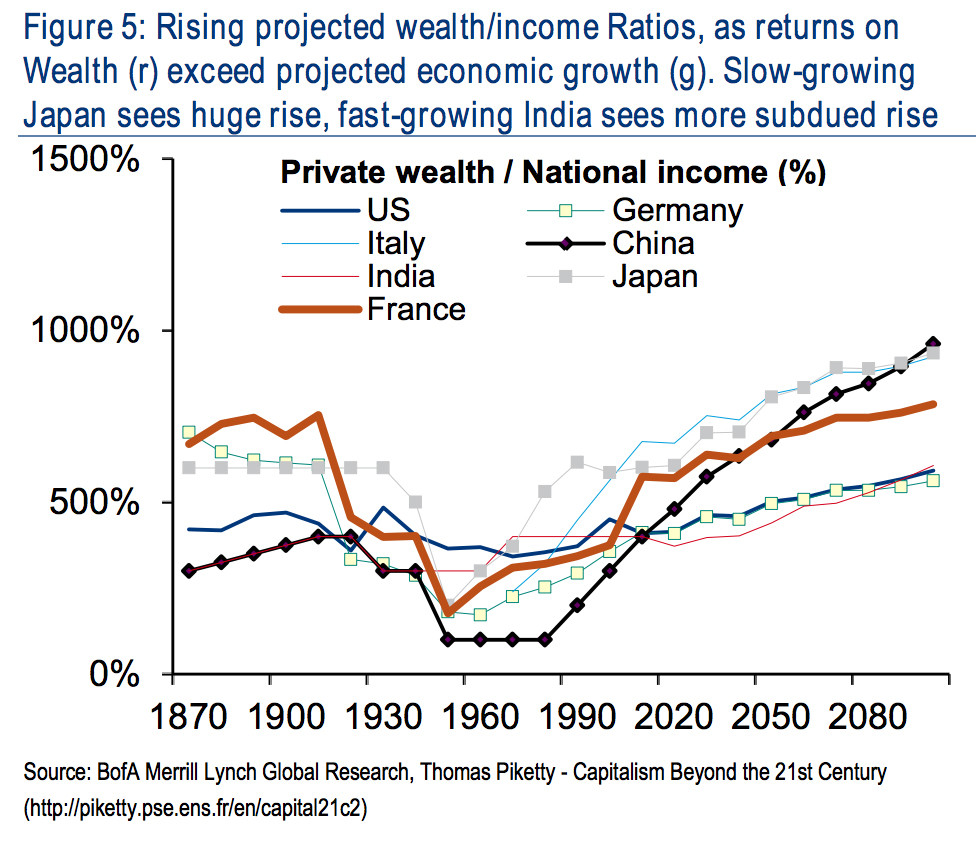
There’s a good reason why the super-rich are cleaning up in the stock market. Thomas Piketty explains that, barring war or depression, the return on capital far outpaces economic growth, causing average workers without a stock portfolio to drop further and further behind. A look at stock market growth over 114 years (Page 60) confirms that a dollar of capital is now worth ten times more than a dollar of labor value.

[…]
4. The Walmartization of America: A Few Super-Rich at the Top, then Everyone Else

Just like at Walmart, a few big moneymakers are ruling over a great majority of increasingly low-income workers. Low-wage jobs ($7.69 to $13.83 per hour) made up 1/5 of the jobs lost to the recession, but accounted for nearly 3/5 of the jobs regained during the recovery. And it’s getting worse. Nine out of ten of the fastest-growing occupations are considered low-wage, generally not requiring a college degree.

[…]
5. Toward Third-World Status: Our Shrinking Middle Class Gets a Smaller Cut of National Wealth than Anywhere except China and India

From a global perspective, we’re becoming the type of country that we used to dismiss as “third-world.” Among developed and fast-rising nations only the middle classes of China and India get a smaller cut of their country’s wealth than in the United States. Both of them are rapidly catching up to us.

HT Karin Riley Porter Attorney at Law

My head is exploding

Marc Benioff.
Marc Benioff.

Go read the rest of the mostly self-serving blather:

Marc Benioff, the philanthropist and billionaire founder of Salesforce, may have been the angriest man at last week’s Code Conference, held at the Terranea Resort in Rancho Palos Verdes, Calif.

Onstage, Benioff launched into a fervent monologue, calling out the audience for failing on a range of social initiatives. The income discrepancy was growing, and techies were being too stingy. Benioff called out conference presenter Re/code for not having a charitable component, and asked people there to raise their hands if their companies had charity programs. Fewer than half did.

“You’ve got to show that we are part of the solution, not just part of the problem,” said Benioff, his voice rising in intensity.

San Francisco, the heart of the tech industry, now has the fastest-growing income inequality in the country, a gap on par with Rwanda’s. This has led to range of protests, including those that have begun targeting public tech symbols like Google’s commuter shuttle buses.

The connection between inequality and the tech industry may be fair: Innovation tends to make things more efficient, so fewer people can accomplish more work (in the Bay area, the WhatsApp texting service sold for $19 billion with 55 employees, while the Gap, worth about the same, has 136,000 employees).

So, what did the wealthy and influential attendees at Code — which was held at a secluded and exclusive beachfront resort — think about income inequality, the housing shortage, and whether tech was to blame or not?

The responses were varied, but the most common answer — no surprise, perhaps — was that tech wasn’t the cause of San Francisco’s income gap, but rather the best solution.

“Tech is solving the problem, because now we have these new qualified, nonprofessional market verticals,” said Mike Jones, CEO of Science and former CEO of Myspace. “You’re qualified to drive a car, but not professionally doing it. Congratulations, boom, you’re making [a] $90,000-a-year average Uber salary.”

Assuming you can afford a car. Assuming no one sues you for tripping on the way out of your car. Assuming… oh, never mind.

Thanks to Karin Riley Porter.

Our betters are getting nervous

Guillotine

But not enough yet to substitute public relations for substance:

Yesterday’s Conference on Inclusive Capitalism co-hosted by the City of London Corporation and EL Rothschild investment firm, brought together the people who control a third of the world’s liquid assets – the most powerful financial and business elites – to discuss the need for a moresocially responsible form of capitalism that benefits everyone, not just a wealthy minority.

Leading financiers referred to statistics on rising global inequalities and the role of banks and corporations in marginalising the majority while accelerating systemic financial risk – vindicating the need for change.

While the self-reflective recognition by global capitalism’s leaders that business-as-usual cannot continue is welcome, sadly the event represented less a meaningful shift of direction than a barely transparent effort to rehabilitate a parasitical economic system on the brink of facing a global uprising.

Central to the proceedings was an undercurrent of elite fear that the increasing disenfranchisement of the vast majority of the planetary population under decades of capitalist business-as-usual could well be its own undoing.

The Conference on Inclusive Capitalism is the brainchild of the Henry Jackson Society (HJS), a little-known but influential British think tank with distinctly neoconservative and xenophobic leanings. In May 2012, HJS executive director Alan Mendoza explained the thinking behind the project:

“… we felt that such was public disgust with the system, there was a very real danger that politicians could seek to remedy the situation by legislating capitalism out of business.”

Well, we can’t have that, can we?

The Initiative for Inclusive Capitalism’s recommendations for reform seem well-meaning at first glance, but in reality barely skim the surface of capitalism’s growing crisis tendencies: giant corporations should invest in more job training, should encourage positive relationships and partnerships with small- and medium-sized businesses, and – while not jettisoning quarterly turnovers – should also account for ways of sustaining long-term value for shareholders.

The impetus for this, however, lies in the growing recognition that if such reforms are not pursued, global capitalists will be overthrown by the very populations currently overwhelmingly marginalised by their self-serving activity. As co-chair of the HJS Inclusive Capitalism taskforce, McKinsey managing director Dominic Barton, explained from his meetings with over 400 business and government leaders worldwide that:

“… there is growing concern that if the fundamental issues revealed in the crisis remain unaddressed and the system fails again, the social contract between the capitalist system and the citizenry may truly rupture, with unpredictable but severely damaging results.”

There’s more, go read it.

I’m sure it’ll be fine

Oyster Creek Nuclear Station After Sandy

It’s not as if they’d lie to us:

Operators at the nation’s oldest nuclear plant have terminated an “unusual event” status that was briefly declared after staffers detected an odor of chlorine at the plant’s intake structure. The declaration at the Oyster Creek plant in Lacey Township occurred at 10:34 a.m. Wednesday.

Plant officials say the odor was emanating from piping that provides service water to plant systems. The leak was isolated and the odor dissipated, and officials say it posed no threat to plant workers, the environment or the public.

The “unusual event” declaration — which is the lowest of four levels of emergency classification — was terminated at 11:40 a.m. Normal plant operations continued while the declaration was in effect.

Oyster Creek is located about 60 miles east of Philadelphia.

What a great plan

Big Rig

This whole “let’s inject chemicals into the earth and we’ll worry later about the results”:

Range Resources on Tuesday disposed of Marcellus shale drilling sludge in West Virginia that was deemed too radioactive for a Washington County landfill.

The Cecil-based company sent two roll-off boxes of material from a well pad in Smith Township in Washington County to Meadowfill Landfill in Bridgeport, W.Va., spokesman Matt Pitzarella said. On March 1, representatives from Arden Landfill in Chartiers turned the material away after it tripped radioactivity monitors.

“It’s incredibly rare that you get hits for any radiation that all landfills cannot accept,” Pitzarella said, noting that hospital materials and municipal waste also contain radiation. “This same scenario exists in every single industry.”

Range Resources returned the material to the work site to be tested before finding a place to dispose of it. No residents or workers were at risk, said John Poister, a spokesman for the Pennsylvania Department of Environmental Protection.