

I thought it meant I was disorganized!
I thought it meant I was disorganized!
I’m ashamed to admit I knew nothing about this. But this is fascinating.

This will be useful to the world:
As the authors note, the Romans were aware of the virtues of their concrete, with Pliny the Elder waxing lyrical in his Natural History that it is “impregnable to the waves and every day stronger”.
Now, they say, they’ve worked out why. Writing in the journal American Mineralogist, Jackson and colleagues describe how they analysed concrete cores from Roman piers, breakwaters and harbours.
Previous work had revealed lime particles within the cores that surprisingly contained the mineral aluminous tobermorite – a rare substance that is hard to make.
The mineral, said Jackson, formed early in the history of the concrete, as the lime, seawater and volcanic ash of the mortar reacted together in a way that generated heat.
But now Jackson and the team have made another discovery. “I went back to the concrete and found abundant tobermorite growing through the fabric of the concrete, often in association with phillipsite [another mineral],” she said.
She said this revealed another process that was also at play. Over time, seawater that seeped through the concrete dissolved the volcanic crystals and glasses, with aluminous tobermorite and phillipsite crystallising in their place.
These minerals, say the authors, helped to reinforce the concrete, preventing cracks from growing, with structures becoming stronger over time as the minerals grew.
By contrast, modern concrete, based on Portland cement, is not supposed to change after it hardens – meaning any reactions with the material cause damage.

This isn’t a major find, but I still love it when diggers find hidden stuff:
Rome (CNN)Thirty-three feet underground, at the bottom of a concrete-lined pit, archeologist Gilberto Pagani patiently scrapes dirt from a charred beam of wood that has laid undisturbed for around 1800 years.
It’s part of a house, perhaps once belonging to a senior Roman army officer, destroyed by fire. Last year construction workers discovered the site near the Colosseum as they were digging a shaft to the tunnel of Rome’s new metro Line C.
It was only this week that archaeologists revealed what they’ve found during the ensuing excavation.
This discovery is particularly interesting because the fire that destroyed the house left some things intact, including wooden beams that, under normal circumstances, would have decayed ages ago.
“It’s an extraordinary situation,” says Rome’s archaeological superintendent Francesco Prospetti. “The collapse of the ceiling sealed everything inside. It was carbonized without being burned.”

Ongoing excavation works in Mexico City have confirmed the existence of a legendary, and terrible, edifice: the Aztec tower of skulls. Stock photo. Image credits Peter Dargatz. As Spanish soldiers first made their way to the sprawling Aztec capital of Tenochtitlan in 1521, they came upon a terrible and terrifying sight: the tzompantli. Our first recount… Continue reading “Aztec tower of skulls unearthed in Mexico City”
Thomas Jefferson’s mistress Sally Hemings’ secret living quarters finally discovered https://t.co/00pOYAMOqq pic.twitter.com/T1WuWM32pn
— NBC News (@NBCNews) July 3, 2017
I toured historic Monticello a couple of years ago, and the legacy of slavery permeated the place. Some of Jefferson’s letters are on display, and while reading them, it became apparent to me that his reputation as a master planter was probably grounded in the expertise of the slaves left him by his father.
Monticello recently opened a couple of small, cramped cabins that were living quarters for the house slaves, and I looked at them and thought about how the great Jefferson felt about summoning the slave Sally Hemings to his alcove bed. Now we know she was right next door, and not out back with the rest of the slaves.

I wondered how the 6″2 Jefferson managed to rape her in such a confined space. He may have been a great man in many ways, but damn. He was a slaveowner, and that makes everything else feel just a little soiled.

You know I love this stuff:
A lost city thought to be more than 1,000 years old has been discovered in Ethiopia and may offer insight into Islam’s origins in the country.
The settlement, located near Ethiopia’s second largest city of Dire Dawa, in the east of the country, consisted of buildings constructed with large stone blocks, which gave rise to a local myth that giants lived there. Researchers believe it may date back as early as the 10th century.
Archaeologists discovered a 12th-century mosque in the settlement at Harlaa, as well as evidence of Islamic burials and headstones. The team, from the University of Exeter and the Ethiopian Authority for Research and Conservation of Cultural Heritage, also found artifacts from as far afield as India and China, suggesting that the region functioned as a hub for foreign traders.

Paul Markowski, Pennsylvania State University and Yvette Richardson, Pennsylvania State University
Editor’s note: May and June are typically peak months for tornadoes in North America. We asked Penn State meteorology professors Paul Markowski and Yvette Richardson to explain why tornadoes form, how to stay safe if you’re near one and whether climate change is affecting tornado patterns.
1. Where are tornadoes most likely to occur?
Most headline-making tornadoes are spawned by what are known as supercell thunderstorms. These are large, intense storms characterized by an updraft (rising air) that rotates.
Thunderstorms develop when warm, humid air near the surface lies beneath a thick layer of air in which the temperature decreases rapidly with height. We call this type of atmosphere “unstable,” meaning that when air is nudged upward, the water vapor that it contains condenses. This releases heat, making the air warmer than its surroundings. The air becomes buoyant and rises, creating the towering clouds we associate with thunderstorms.
The second key condition for supercell formation is wind shear – large changes in wind at different levels. Winds at different altitudes blowing at different speeds and/or from different directions is associated with horizontally spinning air, like a rolling pin. As this horizontally spinning air flows into the updraft, the spin is tilted into the vertical, creating a rotating updraft.
Tornadoes are especially likely to be spawned by supercell thunderstorms when the lowest altitudes are particularly humid and possess exceptionally strong wind shear. These conditions are more likely to come together in certain locations, such as the U.S. Great Plains and Southeast.
2. How do actual tornadoes form?
Not all supercell thunderstorms produce tornadoes. Once wind shear has created a rotating updraft in our supercell thunderstorm, other processes develop rotation near the ground, in the cool air underneath the storm, which we call its “cold pool.” The cold pool is produced mostly by the evaporation of rain.
Within and beneath the storm, warm air is rising and cooler air is descending. As air descends and flows through the cold pool, the horizontal differences in temperature and acceleration of air along the ground combine to produce more horizontal spin. If there is strong upward suction from the overlying rotating updraft of the supercell storm, and the air in the cold pool is not too cold, the horizontally spinning air can be tipped toward the vertical and sucked upward. It also can be contracted inward and spin faster, just as skaters increase the speed of their spins by pulling in their arms. This forms the tornado.

3. How precisely can we predict tornado strikes?
In the past decade, forecasters have become skillful at identifying conditions that can support strong tornadoes – those rated EF2 or higher on the Enhanced Fujita Scale. The National Weather Service’s Storm Prediction Center routinely predicts large outbreaks days in advance. “High-risk” outlooks capture most major tornado events, and strong tornadoes rarely occur outside of tornado watches. We have less ability to forecast tornadoes in more marginal situations, such as within non-supercell storms.
Even if the environment is extremely favorable for supercell tornadoes, forecasters have limited ability to say when or if a specific storm will produce a tornado. Researchers are studying triggers for tornado production, such as small-scale downdraft surges and descending precipitation shafts on a supercell storm’s rear flank, and processes that sustain tornadoes once they form.
We don’t understand tornado maintenance well, or how tornadoes might be affected by interactions with obstacles such as terrain and buildings. This means that when a tornado is occurring, forecasters have limited ability to tell the public how long they expect it to last.
4. What should I do during a tornado warning?
Basements, storm cellars or “safe rooms” that meet federal guidelines provide excellent protection. If none of these is available, the best strategy is to go to the lowest floor of a sturdy building and put as many walls between you and the tornado as possible. In other words, shelter in an interior room, such as a closet or bathroom. Also, make sure you are wearing good shoes. If your area takes a direct hit, you do not want to walk through a debris field barefoot.
Don’t chase tornadoes without professional training. Observations from spotters are valuable to forecasters who are issuing warnings, but they can be made from a distance. We don’t need people driving in harm’s way to know that a dangerous storm is approaching.

5. Is climate change making tornadoes bigger or more frequent?
It’s hard to say. Reliable U.S. records of tornadoes go back only to roughly 1950, and records outside of the United States are even less complete. Thanks to storm chasing and the spread of camera phones, more tornadoes are counted today compared with yesteryear, but that does not necessarily mean that more are occurring. And there’s a lot of natural variability from year to year. Over the past decade, the annual U.S. tornado count has ranged from 886 to 1,690 storms per year.
Estimates of wind speeds based on post-storm damage surveys can be off by 50 percent or more. And many tornadoes in remote areas leave no clues as to how strong their winds were.
 Most climate models predict that there will be more days per year when the atmosphere would have sufficient instability and wind shear to support tornadoes. But we need to be careful in interpreting this result. Climate models don’t capture tornadoes, their parent thunderstorms or nuances in the lowest level of the atmosphere that affect tornado formation. So it is hard to say whether there will be more tornadoes, even if tornado-supporting environments become more common.
Paul Markowski, Professor of Meteorology, Pennsylvania State University and Yvette Richardson, Professor of Meteorology, Pennsylvania State University
This article was originally published on The Conversation. Read the original article.
This was a really interesting piece about how Heinrich Schliemann found ancient Troy but didn’t know it:
The story that he told about the day he and Sophia found the treasure has long been repeated in introductory archaeology textbooks, although it is unlikely to be true. Schliemann later admitted that he lied about Sophia’s role in his story. She wasn’t even at the dig on the day that he claims to have found the treasure. Some scholars have also suggested that Schliemann didn’t find the treasure all in one place. Instead, they think he gathered the best of his finds from the entire season and announced to a gullible public that he had found them all together as a single treasure. Moreover, since the objects were found in Troy II, they are a thousand years too early to have belonged to Priam.
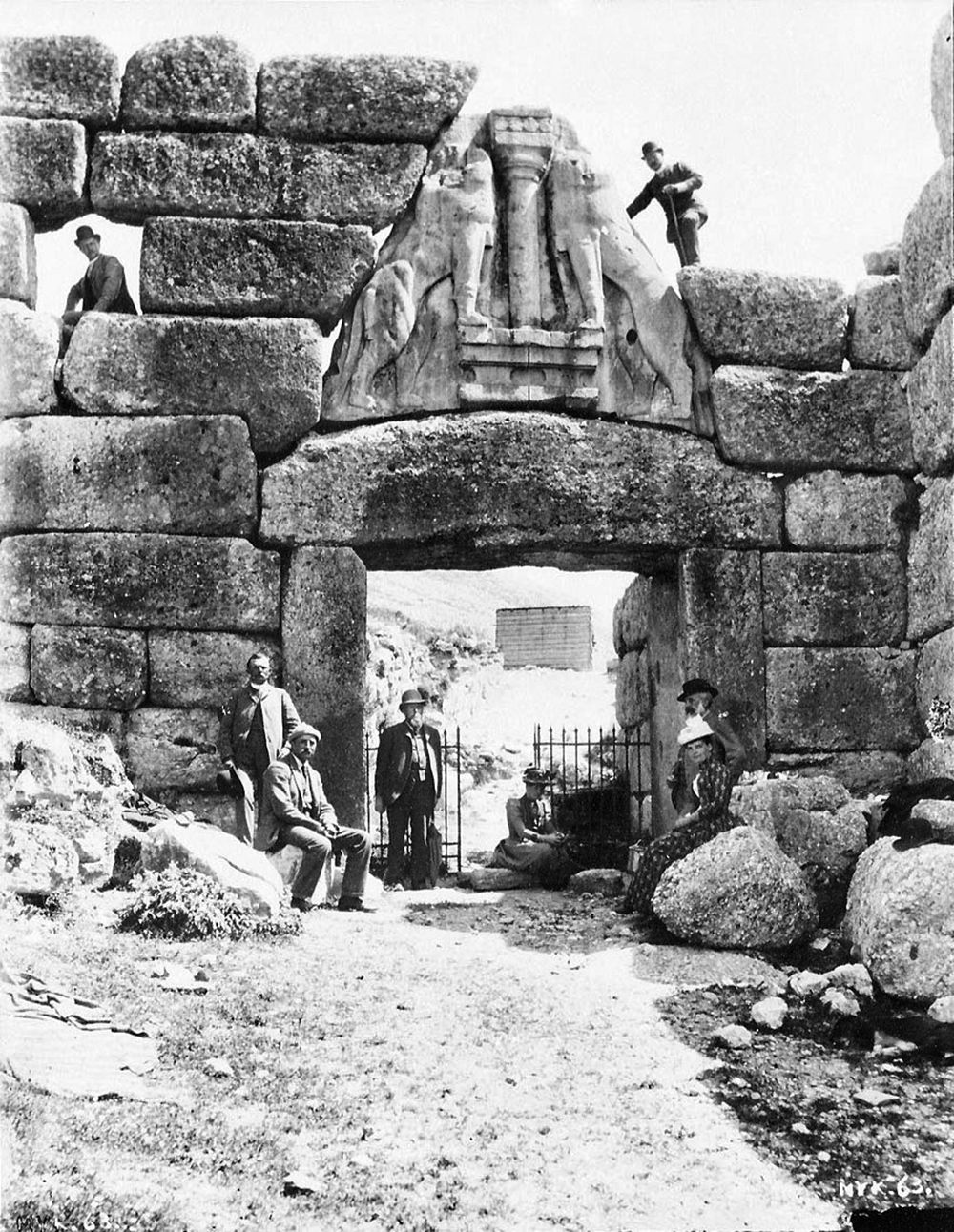
Schliemann continued to dig at Troy throughout the 1870s and 1880s, though he also was digging at Mycenae at that time, looking for material remains of King Agamemnon. To help him at Troy, he hired Wilhelm Dörpfeld, an architect with some previous archaeological experience, who eventually persuaded Schliemann that he had been wrong and that it was actually the layers called Troy VI or Troy VII at Hissarlik that he should have been investigating all along. Schliemann began to make plans for an additional attack on the mound, focused on these later levels, but on Christmas Day in 1890, he collapsed on a street in Naples and died the next day.
It was left to Dörpfeld to carry on. And so he did, with the financial assistance of Sophia Schliemann, who wanted him to continue her husband’s work at the site. He concentrated on excavating the remains that Schliemann had left untouched, mostly around the edges of the mound. As it turned out, those remains were extremely impressive. He unearthed tall stone walls, each several meters thick, that would have stymied any attackers, and large gateways allowing entrance to the interior, but only after one got past the guards.
One of the reasons I’m fascinated by archaeology is that it’s very easy to get it wrong, and I’ve no doubt that much of what is thought to be settled knowledge really isn’t. From being a reporter, and seeing how five different journalists can come up with five different versions of events, I’m well aware that perspective is everything.
Here’s a fun little exercise. Look at random items around your house, and imagine how the archaeologists of the future would interpret them as artifacts of a long-gone civilization.


Erin Connelly, University of Pennsylvania
For a long time, medieval medicine has been dismissed as irrelevant. This time period is popularly referred to as the “Dark Ages,” which erroneously suggests that it was unenlightened by science or reason. However, some medievalists and scientists are now looking back to history for clues to inform the search for new antibiotics. 
The evolution of antibiotic-resistant microbes means that it is always necessary to find new drugs to battle microbes that are no longer treatable with current antibiotics. But progress in finding new antibiotics is slow. The drug discovery pipeline is currently stalled. An estimated 700,000 people around the world die annually from drug-resistant infections. If the situation does not change, it is estimated that such infections will kill 10 million people per year by 2050.
I am part of the Ancientbiotics team, a group of medievalists, microbiologists, medicinal chemists, parasitologists, pharmacists and data scientists from multiple universities and countries. We believe that answers to the antibiotic crisis could be found in medical history. With the aid of modern technologies, we hope to unravel how premodern physicians treated infection and whether their cures really worked.
To that end, we are compiling a database of medieval medical recipes. By revealing patterns in medieval medical practice, our database could inform future laboratory research into the materials used to treat infection in the past. To our knowledge, this is the first attempt to create a medieval medicines database in this manner and for this purpose.
In 2015, our team published a pilot study on a 1,000-year old recipe called Bald’s eyesalve from “Bald’s Leechbook,” an Old English medical text. The eyesalve was to be used against a “wen,” which may be translated as a sty, or an infection of the eyelash follicle.

A common cause of modern styes is the bacterium Staphylococcus aureus. Methicillin-resistant Staphylococcus aureus (or MRSA) is resistant to many current antibiotics. Staph and MRSA infections are responsible for a variety of severe and chronic infections, including wound infections, sepsis and pneumonia.
Bald’s eyesalve contains wine, garlic, an Allium species (such as leek or onion) and oxgall. The recipe states that, after the ingredients have been mixed together, they must stand in a brass vessel for nine nights before use.
In our study, this recipe turned out to be a potent antistaphylococcal agent, which repeatedly killed established S. aureus biofilms – a sticky matrix of bacteria adhered to a surface – in an in vitro infection model. It also killed MRSA in mouse chronic wound models.
Premodern European medicine has been poorly studied for its clinical potential, compared with traditional pharmacopeias of other parts of the world. Our research also raises questions about medieval medical practitioners. Today, the word “medieval” is used as a derogatory term, indicating cruel behavior, ignorance or backwards thinking. This perpetuates the myth that the period is unworthy of study.
During our eyesalve study, chemist Tu Youyou was awarded the Nobel Prize in Physiology or Medicine for her discovery of a new therapy for malaria after searching over 2,000 recipes from ancient Chinese literature on herbal medicine. Is another “silver bullet” for microbial infection hidden within medieval European medical literature?
Certainly, there are medieval superstitions and treatments that we would not replicate today, such as purging a patient’s body of pathogenic humors. However, our work suggests that there could be a methodology behind the medicines of medieval practitioners, informed by a long tradition of observation and experimentation.
One key finding was that following the steps exactly as specified by the Bald’s eyesalve recipe – including waiting nine days before use – was crucial for its efficacy. Are the results of this medieval recipe representative of others that treat infection? Were practitioners selecting and combining materials following some “scientific” methodology for producing biologically active cocktails?
Further research may show that some medieval medicines were more than placebos or palliative aids, but actual “ancientbiotics” used long before the modern science of infection control. This idea underlies our current study on the medieval medical text, “Lylye of Medicynes.”
The “Lylye of Medicynes” is a 15th-century Middle English translation of the Latin “Lilium medicinae,” first completed in 1305. It is a translation of the major work of a significant medieval physician, Bernard of Gordon. His “Lilium medicinae” was translated and printed continuously over many centuries, until at least the late 17th century.
The text contains a wealth of medical recipes. In the Middle English translation, there are 360 recipes – clearly indicated with Rx in the text – and many thousands more ingredient names.
As a doctoral student, I prepared the first-ever edition of the “Lylye of Medicynes” and compared the recipes against four extant Latin copies of the “Lilium medicinae.” This involved faithfully copying the Middle English text from the medieval manuscript, then editing that text for a modern reader, such as adding modern punctuation and correcting scribal errors. The “Lylye of Medicynes” is 245 folios, which equates to 600 pages of word-processed text.
I loaded the Middle English names of ingredients into a database, along with translations into modern equivalents, juxtaposed with relationships to recipe and disease. It is very time-consuming to format medieval data for processing with modern technologies. It also takes time to translate medieval medical ingredients into modern equivalents, due in part to multiple synonyms as well as variations in modern scientific nomenclature for plants. This information has to be verified across many sources.
With our database, we aim to find combinations of ingredients that occur repeatedly and are specifically used to treat infectious diseases. To achieve this, we are employing some common tools of data science, such as network analysis, a mathematical method to examine the relationships between entries. Our team will then examine how these patterns may help us to use medieval texts as inspiration for lab tests of candidate “ancientbiotic” recipes.

In March, we tested a small portion of the database to ensure that the method we developed was appropriate for this data set. At present, the database contains only the 360 recipes indicated with Rx. Now that the proof-of-concept stage is complete, I will expand the database to contain other ingredients which are clearly in recipe format, but may not be marked with Rx.
We are specifically interested in recipes associated with recognizable signs of infection. With Bald’s eyesalve, the combination of ingredients proved to be crucial. By examining the strength of ingredient relationships, we hope to find out whether medieval medical recipes are driven by certain combinations of antimicrobial ingredients.
The database could direct us to new recipes to test in the lab in our search for novel antibiotics, as well as inform new research into the antimicrobial agents contained in these ingredients on the molecular level. It could also deepen our understanding of how medieval practitioners “designed” recipes. Our research is in the beginning stages, but it holds exciting potential for the future.
Erin Connelly, CLIR-Mellon Fellow for Data Curation in Medieval Studies, University of Pennsylvania
This article was originally published on The Conversation. Read the original article.