Why the drug war is a joke

lanny

I kept forgetting to post this. It’s Matt Taibbi’s take on the HSBC settlement (naturally, with no criminal charges!) and what it all means. Go read it all:

If you’ve ever been arrested on a drug charge, if you’ve ever spent even a day in jail for having a stem of marijuana in your pocket or “drug paraphernalia” in your gym bag, Assistant Attorney General and longtime Bill Clinton pal Lanny Breuer has a message for you: Bite me.

Breuer this week signed off on a settlement deal with the British banking giant HSBC that is the ultimate insult to every ordinary person who’s ever had his life altered by a narcotics charge. Despite the fact that HSBC admitted to laundering billions of dollars for Colombian and Mexican drug cartels (among others) and violating a host of important banking laws (from the Bank Secrecy Act to the Trading With the Enemy Act), Breuer and his Justice Department elected not to pursue criminal prosecutions of the bank, opting instead for a “record” financial settlement of $1.9 billion, which as one analyst noted is about five weeks of income for the bank.

The banks’ laundering transactions were so brazen that the NSA probably could have spotted them from space. Breuer admitted that drug dealers would sometimes come to HSBC’s Mexican branches and “deposit hundreds of thousands of dollars in cash, in a single day, into a single account, using boxes designed to fit the precise dimensions of the teller windows.”

This bears repeating: in order to more efficiently move as much illegal money as possible into the “legitimate” banking institution HSBC, drug dealers specifically designed boxes to fit through the bank’s teller windows. Tony Montana’s henchmen marching dufflebags of cash into the fictional “American City Bank” in Miami was actually more subtle than what the cartels were doing when they washed their cash through one of Britain’s most storied financial institutions.

The ill logic of the lower classes

Lone marsh tree

It’s the Ninth Day After the Solstice, and I’m back at the shack after checking up on my house, which stopped feeling homey after a tree fell on it last year. Some of my old neighbors are doing OK, judging by the number of houses with Christmas decorations. Some of the those who weren’t doing OK have died. Others — the ones who, because of joblessness or a catastrophe, couldn’t make their mortgage payments — have simply disappeared.

On my way back to the swamp I ran into one of the disappeared — a big, blustery guy who used to remind me of a circus strong man, probably because of the striped tank tops he wore in the summer. Today he was wearing dark glasses and a ratty coat with a big hood, and he seemed about four inches shorter, but I recognized him and said hello as we crossed paths on the sidewalk. He returned my hello but didn’t stop walking. I got the impression he was homeless but I can’t be sure, because I didn’t stop walking either.

When I got back here I asked the swamp rabbit, an amateur shrink as well as a closet bibliophile, why my former neighbor and I had shied away from one another. He spit into the Tinicum swamp and said, “Your ex-neighbor feels like a bum. He’d feel even more like a bum talking to you, because you knew him when he had a house. And I reckon you didn’t want him to know you feel like a bum, too.”

I reminded the rabbit that I’m a fiction writer, not a bum. He asked me what the difference was. It was noon, but he already smelled like he’d finished off a bottle.

I said, “You’ve got a lot of nerve, all you do is drink Wild Turkey and spit in the swamp.”

“Think about it,” he replied. “It ain’t just them hyper-capitalists and their lap dogs in Congress that blame the poors for being poor. The poors blame themselves. They don’t even raise hell when food stamps get cut and unemployment benefits get killed after six months. If they do raise hell, it’s agin each other.”

“You don’t understand the fear, you dumb rodent. Things only get worse when people rock the boat. Demand better wages and you just get fired and disappear. The New Deal is done, the rich have the whip hand until things change again.”

I read him the tail end of a column by Paul Krugman:

Too many Americans currently live in a climate of economic fear. There are many steps that we can take to end that state of affairs, but the most important is to put jobs back on the agenda.

The rabbit twitched his nose and chuckled. “Whose agenda? Jobs are on your agenda if you’re jobless, but they ain’t if you’re in the owner class. The owners don’t need more workers, they’re making bigger profits without them. Who’s gonna make them hire, especially when they know the poors are busy blamin’ themselves for being poor?”

I threw one of his empty bottles at him. I hate it when the varmint makes more sense than that guy in The New York Times.

The Unwinding

This is, by the way, a really good book. I highly recommend it:

Tracking the breakdown of American social institutions in ‘The Unwinding’ (via PBS News Hour)

JUDY WOODRUFF: Even as the U.S. economy continued its recovery, 2013 was yet another year that raised sobering questions about inequality and the nation’s ability to tackle some of its biggest problems. Some of those issues, and an unusual perspective…

Continue reading “The Unwinding”

Morning Reads: Pope Francis’s Populism Rattles GOP; Debtors’ Prisons Return

Pope Francis on Trickle Down Economic theory

Morning Reads: Pope Francis’s Populism Rattles GOP; Debtors’ Prisons Return (via Moyers & Company)

Good morning! Only 364 shopping days left until Christmas! Before working on your list, take a look at some of the stories we’re reading on this slow holiday news day… He’s freaking them out –> Katie Glueck reports for Politico that Pope Francis…

Continue reading “Morning Reads: Pope Francis’s Populism Rattles GOP; Debtors’ Prisons Return”

How they paid for climate change denial

funding

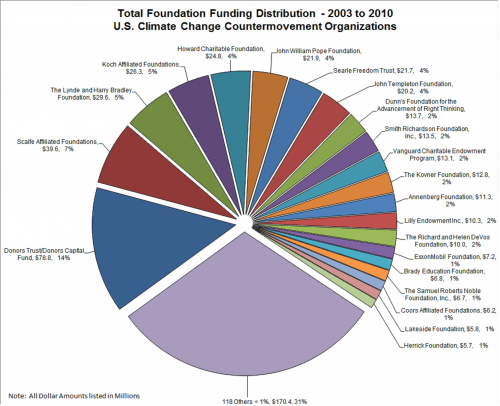
A Drexel University professor has untangled how the funding was established by special interests to push climate change denial:

To uncover how the countermovement was built and maintained, Brulle developed a listing of 118 important climate denial organizations in the U.S. He then coded data on philanthropic funding for each organization, combining information from the Foundation Center with financial data submitted by organizations to the Internal Revenue Service. The final sample for analysis consisted of 140 foundations making 5,299 grants totaling $558 million to 91 organizations from 2003 to 2010.

Key findings include:

  • Conservative foundations have bank-rolled denial. The largest and most consistent funders of organizations orchestrating climate change denial are a number of well-known conservative foundations, such as the Searle Freedom Trust, the John William Pope Foundation, the Howard Charitable Foundation and the Sarah Scaife Foundation. These foundations promote ultra-free-market ideas in many realms.
  • Koch and ExxonMobil have recently pulled back from publicly visible funding. From 2003 to 2007, the Koch Affiliated Foundations and the ExxonMobil Foundation were heavily involved in funding climate-change denial organizations. But since 2008, they are no longer making publicly traceable contributions.
  • Funding has shifted to pass through untraceable sources. Coinciding with the decline in traceable funding, the amount of funding given to denial organizations by the Donors Trust has risen dramatically. Donors Trust is a donor-directed foundation whose funders cannot be traced. This one foundation now provides about 25% of all traceable foundation funding used by organizations engaged in promoting systematic denial of climate change.
  • Most funding for denial efforts is untraceable. Despite extensive data compilation and analyses, only a fraction of the hundreds of millions in contributions to climate change denying organizations can be specifically accounted for from public records. Approximately 75% of the income of these organizations comes from unidentifiable sources.

“The real issue here is one of democracy. Without a free flow of accurate information, democratic politics and government accountability become impossible,” said Brulle. “Money amplifies certain voices above others and, in effect, gives them a megaphone in the public square. Powerful funders are supporting the campaign to deny scientific findings about global warming and raise public doubts about the roots and remedies of this massive global threat. At the very least, American voters deserve to know who is behind these efforts.”

This study is part one of a three-part project by Brulle to examine the climate movement in the U.S. at the national level. The next step in the project is to examine the environmental movement or the  movement. Brulle will then compare the whole  flow to the entire range of organizations on both sides of the debate.

It’s as bad as we thought

Voter ID

Sure. Wasn’t that the point?

The news: According to new research by University of Massachusetts Boston sociologist Keith Bentele and political scientist Erin O’Brien, the states that have enacted tougher voter ID laws in the past few years are also the same states where both minority and lower-income voter turnout had increased in recent years. Focusing further analysis on just 2011, when the vast majority of voter ID regulations were passed, the researchers found that states which passed the legislation were highly likely to have:

– Republicans in control of both houses of the state legislature and the governorship
– Strong probabilities of being swing states in the 2012 elections
– Minority turnout which was higher in the 2008 election and with high proportions of African-American voters
– Larger numbers of allegations of fraud in 2004, though these had a “much smaller substantive impact relative to partisan and racial factors”

The authors note that the study’s results carry ominous implications and demonstrate voter ID laws have “an uncomfortable relationship to the political activism of blacks and the poor.” Their paper further situates voter ID within a realm of policies that “collectively reduce electoral access among the socially marginalized.”

Sign of the times

http://youtu.be/mkCHfqnAXG0

An artist traveled around New York City and bought the signs of people begging on the street. Here is his story.

I won’t say Sign of the Times is a political piece, because if it is, whose politics? Mine or those of the people I encountered? But it’s a timely piece, marking the end of Mayor Bloomberg’s term. It’s the mayor’s parting shot, what he left us with. Ironically, many people do not see a homeless problem. They are too busy going about their business to see the people lying at their feet. But I believe the homeless have influenced New Yorkers in at least one way: they’ve made sitting on the streets acceptable. On several occasions I approached someone sitting on the street only to discover it was a student or tourist looking at an iPhone or at the people walking by as if they were sitting at home watching television.

Sign of the Times is a reaction to a social injustice and tragedy. It’s a testimony to the homeless men and women who roam the streets in search of food and shelter. It’s also a chronicle of the times we live in. A few days ago I went to Paris for an exhibition of mine. I was immediately struck by all the people I saw on the streets of Paris. I have been to Paris more than 20 times and have never seen so many homeless in the City of Love. I easily could have done this project in Paris.

Although the homeless are at the bottom of the economic ladder, many Americans are not far from it. They may not be homeless, but they’re poor. Fifty million or more Americans live at or below the poverty line.

I call this piece a collection because that’s what it is, a collection, and I’m the collector. But I’m also an artist, and I’ve made my collection a work of art. It’s a voice, an instrument, mine and theirs, telling a story that needs to be heard. It’s the story of the poor in New York City, in America and in the world.

Stating the obvious

Life doesn't go on, it goes by.

Good York Times piece today:

And yet for all the shortcomings of the government’s strategy, the main reason for America’s persistent poverty is the disappearance of jobs with decent pay that can take workers above the poverty line without the government’s help.

The war on poverty was not just about the poor. President Johnson saw it as a way to “prove the success of our system; to disprove those cynics and critics at home and abroad who question our purpose and our competence.”

Our system provides extraordinary rewards for the successful. But as long as so many are left so far behind, the success of our system remains in doubt.

America has not stopped fighting the war on poverty. President Obama’s health law should, when functioning properly, prevent medical expenses from dragging many families into bankruptcy.

Yet winning this war will require more than expanded government benefits. It will probably require a different sort of labor market that provides a better first line of defense. That is a much tougher war to win.

Go read it, it’s a good overview.

How dare you?

One of the questions going round right now is, why isn’t Jamie Dimon being prosecuted over his very obvious Sarbanes-Oxley oversight violations? We all know the answer: Because he’s Jamie fucking Dimon, damn it, and laws are for the little people!

Go to about 3:30 and watch that “What the fuck?” look on his face when Rep. Brad Miller has the audacity to imply he wasn’t doing his job.