The difference between DeBlasio and Warren

Wise - 734 - Elizabeth Warren

The New Republic’s Noam Scheiber piece, “Here Comes The Anti-Government Left” does an interesting compare and contrast between Bill DeBlasio and Elizabeth Warren. He says Warren’s populism is more radical — and more popular across the country:

de Blasio accepts that today’s rich and powerful will continue to be rich and powerful; he just thinks they should do more to help the rest of us. Warren questions the very legitimacy of their wealth and power. “I’ve been in the Senate for nearly a year and believe as strongly as ever that the system is rigged,” she said in a recent speech.

This difference of emphasis isn’t shocking: New York City would fall into a deep depression if the financial sector shrunk substantially. And I don’t mean to belittle de Blasio’s agenda, which I consider important. But neither is that agenda especially ambitious in any cosmic sense. As other politicians have demonstrated before him, there’s no particular tension between a concern for the poor and a deference to the rich.*

It’s why some have begun to think of de Blasio’s worldview as “Bloombergism with a populist mask.” De Blasio helped nurture this impression himself by courting the lords of finance and real estate during his general election campaign, then making a handful of Bloomberg-esque appointments, like the Goldman Sachs executive he named as his deputy mayor for housing and development.2

But here’s the thing: In addition to being more radical substantively, Warren’s agenda is much more sale-able politically.

The reason is that it plays directly to the source of today’s anti-government skepticism. While trust in government has been steadily falling since hitting a decades-long peak after 9/11, voters’ particular beef against government changed in the aftermath of the 2008 financial crisis. Around that time, a variety of indicators suggested that voters’ suspicions were tied to the relationship between the government and powerful interests, whom voters believed were lavishing benefits on themselves at taxpayer expense. Pew found a sharp bipartisan drop in the number of voters who felt “government is really run for the benefit of all the people” beginning in 2009. Gallup found a spike in the number of people dissatisfied with “size and influence of major corporations.”

It turns out that many of the voters who’d lost faith in government weren’t anti-government per se. They’d simply concluded it was working for the powerful and not for them.
Continue reading “The difference between DeBlasio and Warren”

Class war

When poverty is the obstacle of education.............

This is the school that David Brooks attended and talked about how they all grew out of marijuana. Well, of course they did: they had actual futures, and they knew it. Even the heroin users I knew on the Main Line still went to college and entered the upper classes.

In the meantime, I have a friend who teaches in the inner city who asked if I would give her a box of sharpened pencils for her students.

Read the article, and then read the truly, deeply misinformed and hostile comments. I despair for our country.

Bread and water? Beats jail food

Fog Over Disturbed Water

Pig meat gives me bad dreams; I don’t eat it unless there’s nothing else. Philosopher and Animal Liberation author Peter Singer would tell me there is always something else, that “We are, quite literally, gambling with the future of our planet — for the sake of hamburgers.” And hot dogs. But Singer hangs out at Princeton, not in a swamp.

“Why didn’t you swipe soyburgers instead of swine meat?” the swamp rabbit asked me again today, in the spirit if not the style of Singer. “Or a head of lettuce. How hard is it to steal lettuce, Odd Man?”

He’s still angry about having to split a pack of wieners with me on Saturday, when the temperature in these parts plunged to near zero. He was angry on Sunday, too, but the weather was better. Warm air flowed in so fast the whole swamp fogged up as the ice melted.

I woke up Sunday night — or dreamed I woke up — and saw dead people floating out of the fog toward my shack. One was my late Great Aunt Nan, who used to give me candies and warn me to stop being a bad boy. This time she issued her old warning in a ghostly tone. “Bread and water. That’s all they feed you in jail.”

Not true, I thought, recalling a piece last month in Truthdig by Pulitzer Prize-winning journalist Chris Hedges about Aramark Corporation, a Philadelphia-based professional services company that supplies food for inmates at 600 jails and prisons nationwide — food that, according to Hedges, sometimes isn’t fit for your dog to eat, or maybe even your rabbit:

…In February 2009 a Camden County, N.J., health report found that the Aramark-run kitchen in the county jail had “mice throughout kitchen and storage area.” Mouse droppings were discovered in butter. Several food items, including grits, chicken, rice and beef, were not stored at temperatures low enough to protect against contamination. Prisoners at the county jail in Santa Barbara, Calif., went on a hunger strike last summer to protest the Aramark food, and inmates at Bayside State Prison in New Jersey went on a hunger strike in October for the same reason…

I’ll stop there, in case you’re looking forward to lunch. Hedges’ piece is reminiscent of passages from The Jungle and addresses some of the ways big corporations are cashing in on the fact that incarceration rates in the United States are the highest in the world.

Hedges is an unabashed foe of corporatism, so it’s no surprise he wrote a negative piece about Aramark. But I’m wondering why The Philadelphia Inquirer or some other prominent mainstream news entity hasn’t done an “objective” report on the many complaints about the kitchen facilities and jail food served up by this services giant, a Fortune 500 company that has its own high-rise office building in Philly and generates $12 billion a year in revenues.

Maybe I just answered my own question.

Footnote: See Prison Legal News for more on prison food services.

Race to the bottom

BCAP064

We’re winning! More economic progress:

According to the U.S. Census Bureau, 31.6 percent of Americans were in poverty for at least two months from 2009 to 2011, a 4.5 percentage point increase over the prerecession period of 2005 to 2007. Poverty was a temporary state for most people; however, 3.5 percent of Americans were in poverty for the entire three-year period.

The report, Dynamics of Economic Well-Being: Poverty, 2009-2011, traces a sample of U.S. residents through the Survey of Income and Program Participation — statistics are presented by various demographic and socio-economic characteristics, and statistical comparisons are made to data collected from 2005 to 2007.

“When people see poverty statistics, they often think these are people who were poor during an entire period,” said Ashley Edwards, a poverty analyst with the Census Bureau’s Social, Economic and Housing Statistics Division. “This survey allows us to investigate how individuals moved into and out of poverty during and immediately following the most recent recession, while making comparisons to the earlier three-year period immediately leading into the recession.” According to the National Bureau of Economic Research, the last recession spanned from December 2007 to June 2009.

Poverty was a persistent condition for many; among the 37.6 million people who were poor at the start of the period — January and February 2009 — 26.4 percent remained poor throughout the next 34 months. However, many people escaped poverty: 12.6 million, or 35.4 percent, who were poor in 2009 were not in poverty in 2011.

As some moved out of poverty, others moved into it. About 13.5 million people, or 5.4 percent, who were not in poverty in 2009 slipped into poverty by 2011.

Other highlights from the report include:

•The percent of individuals experiencing a poverty spell lasting at least two months increased from 27.1 percent over the period of 2005 to 2007 to 31.6 percent from 2009 to 2011. Chronic poverty rates (poor all 36 months) also increased, from 3.0 percent over the prerecession period to 3.5 percent from 2009 to 2011.

•For those who were in poverty for two or more consecutive months from 2009 to 2011, the median length of a poverty spell was 6.6 months, up from 5.7 months over the period from 2005 to 2007.

•Approximately 44.0 percent of poverty spells occurring from 2009 to 2011 ended within four months, while 15.2 percent lasted more than 24 months.

•While 35.4 percent of individuals who were in poverty in 2009 managed to escape poverty in 2011, approximately half (49.5 percent) continued to have income below 150 percent of their poverty threshold.

•People 65 and older had lower annual poverty rates than children or working-age adults, but once the elderly entered poverty their median spell durations of 8.3 months were longer than both children and working-age adults.

•People in families with a female head of household had longer median poverty spell lengths than those in married-couple families (8.4 and 5.6 months, respectively).

•Hispanics were more likely than blacks to enter poverty over the course of 2009 to 2011, but also more likely than blacks to exit poverty. Hispanics also had shorter median spell durations, 6.5 months, while the median duration for blacks was 8.5 months.

How to simulate sincerity

Over the House unemployment extension vote:

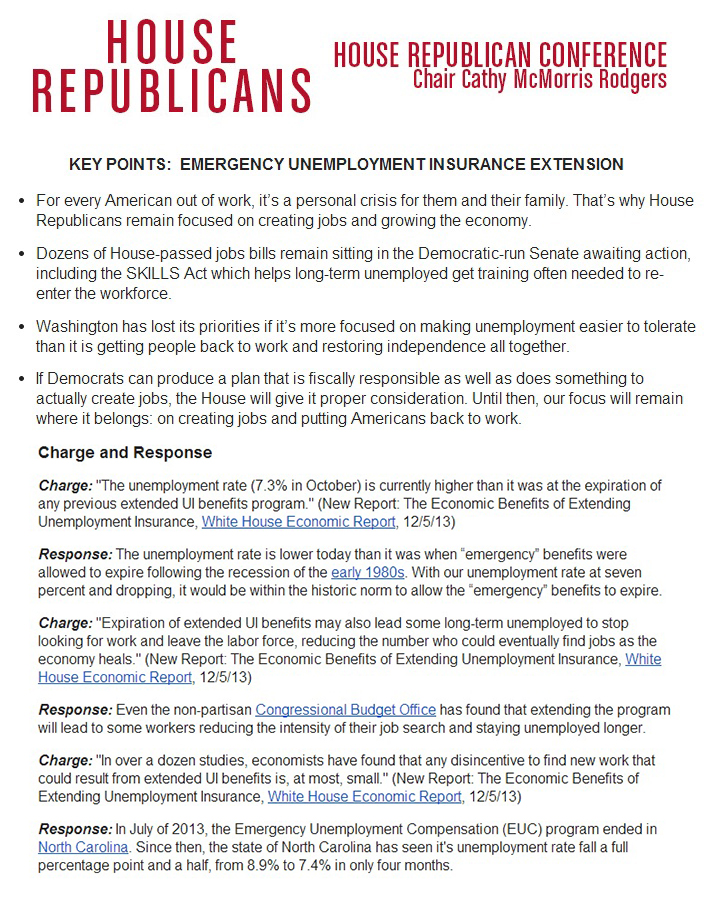
House Republican leaders sent a memo this week to the entire GOP conference with talking points designed to help rank-and-file Republicans show compassion for the unemployed and explain the Republican position on unemployment benefits. In the memo, which was obtained by The Washington Post, House Republicans are urged to be empathetic toward the unemployed and understand how unemployment is a “personal crisis” for individuals and families. The memo also asks Republicans to reiterate that the House will give “proper consideration” to an extension of long-term insurance as long as Democrats are willing to support spending or regulatory reforms.

fullmemo

Poverty gets more expensive every day

A view of Philly from my shack before the weather changed
From my shack, a view of Philly when the weather was good

Yesterday at the shack we woke to bone-chilling wind and a blanket of ice. The swamp rabbit was huddled in a corner with a bottle from the case of Wild Turkey I stole to help him get through his post-holiday funk. I told him to fetch wood from the swamp so we don’t freeze, it would be two below zero soon.

“That booze won’t warm you for long,” I said. “I’ll find you stiff as a board tomorrow morning.”

“Won’t be my fault,” the rabbit said. “You ain’t nothin’ but an enabler, don’t ya know?”

While the rodent fetched wood, I chopped ice off the roof and surfed the Net for more weather and news and so on. I saw a letter to the Naked Capitalism guy that I read to the rabbit when he got back with some dead branches that looked like bones:

My expenses are beginning to get the better of me and month’s end is stretching beyond my dollars. Next year is looking the same. So, yesterday I was pointedly reminded how expensive it is to be poor. Instead of buying a lot when something I use is on sale, I have to buy what I have dollars for. No savings for me! And instead of buying by unit price–I’m a ferocious unit price shopper–I have to buy whatever size I have dollars for. And now I have to make more trips because I can only buy small dollars worth at a time.

“Amen to that,” the swamp rabbit said. “I used to buy carrots at twelve bucks a carton when I worked for that magician, gettin’ pulled out of a hat. Now I can barely afford one of them two-dollar bags that don’t hold no more’n a half-dozen carrots.”

The lying varmint never worked for a magician but I could feel his pain, especially now that our secessionist Congress is cutting food stamps and unemployment, and reactionary governors in 25 states, with help from our neo-Confederate Supreme Court, are denying Medicaid to 4.8 million people who aren’t eligible for Obamacare. I read to the rabbit from something by William Greider:

The Supremes have done quite a lot in the last fifteen years to mess up our already weakened democratic system. They stole the presidential election in 2000. They cut loose Big Money to swamp elections by destroying lawful restraints. They are trying step-by-step to restore hoary old legalisms that favor capital over labor, corporations over individuals. Shouldn’t we be talking about how to stop them?

“No, we should be talkin’ about gettin’ somethin’ to eat,” the rabbit said. “I’m too hungry to talk politics.”

I told him to get a fire going in the stove so I could unfreeze the pack of wieners I pinched from Pathmark.

“What you take me for, a heathen?” he said. “I don’t eat no swine.”

“Better get used to it,” I said, “or start growing your own carrots.”

Footnote: Now I’ve got in my head Captain Beefheart’s “A Carrot Is as Close as a Rabbit Gets to a Diamond.”

The Wolf of Wall Street

The wolf of Wall Street
I wanted to see this movie (I mean, Scorcese, right?) but only because I had some vague misunderstanding that of course it would show the comeuppance of the Wall Street vultures! Now that I know what it’s really about, I won’t spend the money:

For three hours, Belfort, portrayed with manic intensity by Leonardo DiCaprio, lies, humps and snorts his way through a binge of fraud and frolic that would make Gordon Gekko, and possibly a few Roman emperors, blush. Belfort starts out hustling penny stocks, selling “garbage to garbage men,” but quickly works his way up from screwing over poor people to ripping off wealthy investors, using the proceeds to hire truckloads of hookers and dwarves used for target practice at office parties (seriously!).

Not everyone was amused. In an open letter to Scorsese and DiCaprio, Christina McDowell, the daughter of one of Belfort’s partners in crime, describes the emotional pain and financial ruin she suffered as a teen when the dad she believed in turned out to be a crook. She doesn’t mince words about the treatment of the Belfort saga in the film:

“So here’s the deal. You people are dangerous. Your film is a reckless attempt at continuing to pretend that these sorts of schemes are entertaining, even as the country is reeling from yet another round of Wall Street scandals. We want to get lost in what? These phony financiers’ fun sexcapades and coke binges? Come on, we know the truth. This kind of behavior brought America to its knees. And yet you’re glorifying it—you who call yourselves liberals.”

She’s got a point. Why does Hollywood celebrate financial fraudsters when just about the entire country has been victimized by them?

Some thoughts on Russell Brand

Beauty Vamp Castle

I thought this was a perfect summation of the kind of crap I hate from so-called “progressive” and liberal types. I can’t tell you how much they annoy the shit out of me. Even though he’s talking specifically about the British left, read his description of the Vampire Castle — it’s right on. Mark Fisher:

This summer, I seriously considered withdrawing from any involvement in politics. Exhausted through overwork, incapable of productive activity, I found myself drifting through social networks, feeling my depression and exhaustion increasing.

‘Left-wing’ Twitter can often be a miserable, dispiriting zone. Earlier this year, there were some high-profile twitterstorms, in which particular left-identifying figures were ‘called out’ and condemned. What these figures had said was sometimes objectionable; but nevertheless, the way in which they were personally vilified and hounded left a horrible residue: the stench of bad conscience and witch-hunting moralism. The reason I didn’t speak out on any of these incidents, I’m ashamed to say, was fear. The bullies were in another part of the playground. I didn’t want to attract their attention to me.

The open savagery of these exchanges was accompanied by something more pervasive, and for that reason perhaps more debilitating: an atmosphere of snarky resentment. The most frequent object of this resentment is Owen Jones, and the attacks on Jones – the person most responsible for raising class consciousness in the UK in the last few years – were one of the reasons I was so dejected. If this is what happens to a left-winger who is actually succeeding in taking the struggle to the centre ground of British life, why would anyone want to follow him into the mainstream? Is the only way to avoid this drip-feed of abuse to remain in a position of impotent marginality?

One of the things that broke me out of this depressive stupor was going to the People’s Assembly in Ipswich, near where I live. The People’s Assembly had been greeted with the usual sneers and snarks. This was, we were told, a useless stunt, in which media leftists, including Jones, were aggrandising themselves in yet another display of top-down celebrity culture. What actually happened at the Assembly in Ipswich was very different to this caricature. The first half of the evening – culminating in a rousing speech by Owen Jones – was certainly led by the top-table speakers. But the second half of the meeting saw working class activists from all over Suffolk talking to each other, supporting one another, sharing experiences and strategies. Far from being another example of hierarchical leftism, the People’s Assembly was an example of how the vertical can be combined with the horizontal: media power and charisma could draw people who hadn’t previously been to a political meeting into the room, where they could talk and strategise with seasoned activists. The atmosphere was anti-racist and anti-sexist, but refreshingly free of the paralysing feeling of guilt and suspicion which hangs over left-wing twitter like an acrid, stifling fog.

Then there was Russell Brand. I’ve long been an admirer of Brand – one of the few big-name comedians on the current scene to come from a working class background. Over the last few years, there has been a gradual but remorseless embourgeoisement of television comedy, with preposterous ultra-posh nincompoop Michael McIntyre and a dreary drizzle of bland graduate chancers dominating the stage.
Continue reading “Some thoughts on Russell Brand”

Wahh

Ken Langone Threatens Pope Francis

Rich asshole to Catholic Church: If you don’t love me, I’ll just take my ball and go home!

Home Depot founder worries Pope Francis neither loves nor understands rich Americans (via Raw Story )

In an interview on CNBC on Monday, Home Depot founder and devout Catholic Ken Langone said that the Pope’s statements about capitalism have left many potential “capitalist benefactors” wary of donating to the Church or its fundraising projects…

Continue reading “Wahh”