Thanks to confidential documents exclusively obtained by Pando, we can now see some of the language and fee structures in the agreements between the “alternative investment” industry and major public pension funds. Taken together, the documents raise serious questions about whether the government employees, trustees and politicians overseeing major public pension funds are shirking their fiduciary responsibilities under the law when they are cementing “alternative” investment deals.
The documents, which were involved in a recent SEC inquiry into the $14.5 billion Kentucky Retirement Systems (KRS), were handed to us by SEC whistleblower Chris Tobe, an investment consultant and former trustee of the KRS. Tobe has also written a book — “Kentucky Fried Pensions” — about the scandalous state of the Kentucky public pensions system.
The documents provided by Tobe (embedded below) specifically detail Kentucky’s dealings with Blackstone – a giant Wall Street investment firm which has deployed a platoon of registered lobbyists in Kentucky and whose employees are major financial backers of Kentucky U.S. Sen. Mitch McConnell (R).
The Blackstone-related documents, though, don’t just tell a story about public pensions in Kentucky. The firm, which just reported record earnings, does business with states and localities across the country. The Wall Street Journal reports that “about $37 of every $100 of Blackstone’s $111 billion investment pool comes from state and local pension plans.”
I have to say, pretty much every insider book about the Obama administration paints Obama as intellectually incurious and it sure seems that way. For this man to say this about the TPP is just plain stupid and crazy. Does he really just let the corporations tell him what to do?
Critics of the highly-secretive Trans-Pacific Partnership negotiations responded with outrage after U.S. President Barack Obama charged they have a “lack of knowledge of what is going on in the negotiations” and dismissed their concerns as “conspiracy theories.”
The president made the comments this week during a press conference in Malaysia—one of the stops on his Asia-Pacific tour, aimed at advancing the TPP and the U.S. military “pivot” to the region. His tour has been met with region-wide protests against the economic and military agenda of the U.S.
[…] Bernadette Ellorin, Chairperson of BAYAN-USA—an alliance of Filipino organizations in the U.S., told Common Dreams, “President Obama lacks knowledge of how so-called ‘free trade agreements’ impact people on the ground. The push-back he has gotten over the TPP comes from people who have long-suffered from these impacts.”
“He should go back and talk with the parent-less children in the region, whose parents had no choice but to look for work overseas because they couldn’t find work in their own country due to these so-called ‘free trade’ agreements,” she added. “He should go back and talk to the indigenous children whose parents were killed by paramilitary groups because greater foreign investment stipulations in these agreements have led to forced evacuations and militarization of their land for the purpose of large scale foreign mining.”
Wall Street deregulation, blamed for deepening the banking crisis, was aggressively pushed by advisers to Bill Clinton who have also been at the heart of current White House policy-making, according to newly disclosed documents from his presidential library.
The previously restricted papers reveal two separate attempts, in 1995 and 1997, to hurry Clinton into supporting a repeal of the Depression-era Glass Steagall Act and allow investment banks, insurers and retail banks to merge.
A Financial Services Modernization Act was passed by Congress in 1999, giving retrospective clearance to the 1998 merger of Citigroup and Travelers Group and unleashing a wave of Wall Street consolidation that was later blamed for forcing taxpayers to spend billions bailing out the enlarged banks after the sub-prime mortgage crisis.
The White House papers show only limited discussion of the risks of such deregulation, but include a private note which reveals that details of a deal with Citigroup to clear its merger in advance of the legislation were deleted from official documents, for fear of it leaking out.
“Please eat this paper after you have read this,” jokes the hand-written 1998 note addressed to Gene Sperling, then director of Clinton’s National Economic Council.
Photograph: Clinton Library
Earlier, in February 1995, newly-appointed Treasury secretary Robert Rubin, his deputy Bo Cutter and senior advisers including John Podesta gave the president three days to decide whether to back a repeal of Glass-Steagall.
In what Cutter described as “an action forcing event”, he wrote to Clinton on 21 February, telling him Rubin wanted to announce the policy before it was raised by the House banking committee on 1 March.
“In order to position Secretary Rubin – rather than any of the regulators – as the Administration’s chief spokesman on this issue, the Secretary intends to discuss the Administration’s position at a speech which will be covered by the press in New York on 27 February,” wrote Cutter on 21 February.
“It is therefore necessary to have an agreed-upon Administration position by the end of the day on Friday, 24 February.”
Photograph: Clinton Library
Podesta, who was then staff secretary but went on to become Clinton’s chief of staff, wrote a covering note telling the president that all his senior advisers backed the plan, although he noted the danger that “allowing banks to engage in riskier activities like securities or insurance could subject the deposit insurance fund to added risk”.
But Clinton’s advisers repeatedly reassured him that the decision to let Wall Street dismantle regulatory barriers designed to protect the public after the Great Depression simply represented inevitable modernisation.
“The argument for reform is that the separation between banking and other financial services mandated by Glass-Steagall is out of date in a world where banks, securities firms and insurance companies offer similar products and where firms outside the US do not face such restrictions,” wrote Podesta.
Podesta currently works at the White House as special adviser to President Barack Obama. Sperling stood down as director of Obama’s National Economic Council last month.
Along with Cutter, who worked on Obama’s transition committee, all three men were close allies of Rubin, who spearheaded the deregulation of Wall Street before joining the board of Citigroup in 1999. In 2007, he briefly became its chairman.
The closeness of Obama’s team to the deregulation policies of the late 1990s is well known and has been criticised by campaigners as a reason for the current administration’s reluctance to institute more aggressive Wall Street reforms after the banking crash.
But the new documents cast fresh light on the way the White House was first ushered toward deregulation by the tight group of Rubin allies.
A similar apparent attempt to rush president Clinton’s decision-making occurred later in the process, in 1997.
In a letter received by the president on 19 May, Clinton is again given just three days to decide whether to proceed with the deregulation agenda.
A government-backed plan for a frozen underground wall to limit water contamination at the wrecked Fukushima atomic station needs further vetting for potential risks to the environment, an adviser to the plant’s operator said.
The plan, which is intended to keep groundwater from seeping into the basements of the plant’s damaged reactor buildings, may not function as intended because it’s based on untested assumptions about the site’s hydrology, said Dale Klein, who chairs Tokyo Electric Power Co.’s Nuclear Reform Monitoring Committee.
“Are there any unintended consequences?” Klein asked at a press conference today in Tokyo. “We’re concerned about safety and environmental protection.”
Piketty’s best-selling book, Capital in the Twenty-First Century, was recently translated from French to English and has upended the global discussion on capitalism and inequality. Piketty relies on the most expansive income and wealth datasets ever compiled to identify a striking trend over more than 200 years: returns on capital grow faster than the regular economy, meaning that without some policy intervention, the rich get richer, and richer, and richer.
Piketty said that he is unsure if he would have had the courage to write his book during the heat of the Cold War. “I don’t know what I would have done. I’m lucky enough to belong to a generation, and maybe to the first generation, that didn’t have to make that kind of choice, because the Soviet Union was gone,” he said.
Piketty’s dataset is an expansion of one put together by a leading 20th century economist, Simon Kuznets, famous for what’s known as the Kuznets curve — a chart suggesting that as capitalist economies reach a certain undefined stage of development, inequality begins falling after sharply rising. Yet the Kuznets curve was used for half a century to argue that capitalism has a natural tendency to reduce inequality in advanced economies, despite a lack of evidence.
“During the Cold War period, people really wanted to believe in the stories about inequality and capitalism,” Piketty said. “For instance, Kuznets’ evidence in the 1950s and 1960s … he did not believe that the reduction in inequality that he found between 1910 to 1950 was a natural process. He was very well aware, if you read his book, that the World War, the Great Depression, and the policies that were implemented after these shocks — progressive taxation and other policies — played a very important role. But everybody wanted to believe in a sort of natural process that would naturally lead to a decline in inequality in advanced stages of development, because in the Cold War context the fight between capitalism and communism was so great.”
While the economics profession may have been intellectually impoverished by the existence of the Soviet Union, the alternative economic system, communism, was quite good for average people — people, that is, not in the people’s republics.
“The existence of a counter model was one of the reasons that a number of reforms or policies were accepted,” he said, arguing that those in capitalist countries fared better thanks to the threat of communism.
“In France, it’s very striking to see that in 1920, the political majorities adopted steeply progressive taxation. Exactly the same people refused the income tax in 1914 with a 2 percent tax rate. And in between, the Bolshevik revolution made them feel, after all, that progressive taxation is not so dangerous as revolution.”
Oh, no. Hell, no. What kind of frickin’ con game is this?
What is is that the feds do not understand? We don’t care about Credit Suisse or some damned French bank that ignored sanctions. We want the bankers who crashed the economy and stole people’s homes, not the ones who sold tax shelters to the uber rich. They are so far down on the list. We want the men at the top of the mortgage casino operations, the people who ruined so many lives with a nod and a wink while their underlings did the dirty work.
Are we supposed to be impressed that the feds are throwing us what they allege to be a bone? Nothing has changed. The same banks that are too big to fail are still too big to jail:
Federal prosecutors are nearing criminal charges against some of the world’s biggest banks, according to lawyers briefed on the matter, a development that could produce the first guilty plea from a major bank in more than two decades.
In doing so, prosecutors are confronting the popular belief that Wall Street institutions have grown so important to the economy that they cannot be charged. A lack of criminal prosecutions of banks and their leaders fueled a public outcry over the perception that Wall Street giants are “too big to jail.”
[block]The new strategy underpins the decision to seek guilty pleas in two of the most advanced investigations: one into Credit Suisse for offering tax shelters to Americans, and the other against France’s largest bank, BNP Paribas, over doing business with countries like Sudan that the United States has blacklisted. [/block]
Addressing those concerns, prosecutors in Washington and New York have met with regulators about how to criminally punish banks without putting them out of business and damaging the economy, interviews with lawyers and records reviewed by The New York Times show.
The new strategy underpins the decision to seek guilty pleas in two of the most advanced investigations: one into Credit Suisse for offering tax shelters to Americans, and the other against France’s largest bank, BNP Paribas, over doing business with countries like Sudan that the United States has blacklisted. The approach applies to American banks, though those investigations are at an earlier stage.
In the talks with BNP, which has a huge investment bank in New York, prosecutors in Manhattan and Washington have outlined plans to extract a criminal guilty plea from the bank’s parent company, according to the lawyers, who were not authorized to speak publicly. If BNP is unable to negotiate a lesser punishment — the bank has enlisted the support of high-ranking French officials to pressure prosecutors — the case could counter congressional criticism that arose after the British bank HSBC escaped similar charges two years ago.
Such criminal cases hinge on the cooperation of regulators, some who warned that charging HSBC could have prompted the revocation of the bank’s charter, the corporate equivalent of the death penalty. Federal guidelines require prosecutors to weigh the broader economic consequences of charging corporations.
Economists warned after the crash that the economy would never really recover until the toxic banks were allowed to fail. The whole mess was a house of cards, and the Obama administration’s policy of “extend and pretend” simply didn’t work. The ripple effects spread through the economy, and it’s not coming back.
Can’t we at least see some of the perpetrators on trial, people like Jamie Dimon? Because if we don’t, no one should be surprised that we call this out as the farce it is.
This is really disgusting. But that’s the point of this education “reform.” Enough of the critical thinking, your job is to do a good job for your employer, and the sooner you learn your place, the better:
An annual year-end kindergarten show has been canceled at a New York school because the kids have to keep working so they will be “college and career” ready. Really.
That’s what it says in a letter (see below) sent to parents by Ellen Best-Laimit, the interim principal of Harley Avenue Primary School in Elwood, N.Y., and four kindergarten teachers. The play was to be staged over two days, May 14 and 15, according to the school’s calendar.
One mother who received the letter, Ninette Gonzalez Solis, wrote on Facebook that parents learned recently the play was being canceled and started calling the principal, leading the school officials to send out the new missive. Solis wrote that she was very upset about the cancellation.
All but one of the people who signed the letter were unavailable for comment. One asked me to call back but then didn’t answer the phone. District Superintendent Peter Scordo declined to discuss it.
How did we end up right back where we started? Bill Moyers:
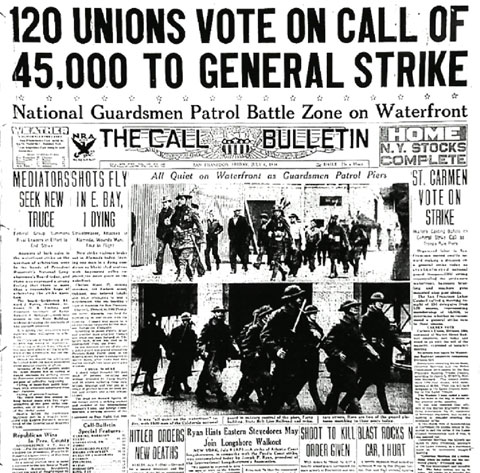
On April 20, 1914, the Colorado National Guard and a private militia employed by the Colorado Fuel & Iron Company (CF&I) opened fire on a tent camp of striking coal miners at Ludlow, Colo. At least 19 people died in the camp that day, mostly women and children.
A century later, the bloody incident might seem a relic of the distant past, but the Ludlow Massacre retains a powerful, disturbing and growing relevance to the present. After a century of struggling against powerful interests to make American workplaces safer and corporations responsive to their employees, the US is rapidly returning to the conditions of rampant exploitation that contributed to Ludlow.
That’s especially true in mining, where a coordinated union-busting campaign, the corporate capture of federal regulatory agencies, and widespread environmental degradation leave coal miners unsafe and mining communities struggling to deal with the massive environmental impact of modern mining practices.
A century ago, miners led the fight for workers’ rights. The Gilded Age of the late 19th and early 20th centuries was a period of great upheaval for the American working class. For decades, the United Mine Workers of America (UMWA) had worked to organize the nation’s coal miners. Its success often hinged on whether the government helped mining companies crush strikes or protected workers. In 1897, deputies in Luzerne County, Pa., killed 19 striking miners in the Lattimer Massacre. But five years later, when Pennsylvania miners struck again, President Theodore Roosevelt intervened on their behalf, providing them with a partial victory. Roosevelt’s actions, while hardly indicative a new pro-labor federal government, reflected a growing belief that labor deserved a fair shake.
See, this guy actually believes that the truth has something to do with these decisions. Isn’t that cute?
“In a message “straight from the horse’s mouth,” a former oil executive on Tuesday urged New York state to pass a ban on the controversial practice of hydraulic fracturing, or fracking, saying, ‘it is not safe.’
“Making fracking safe is simply not possible, not with the current technology, or with the inadequate regulations being proposed,” Louis Allstadt, former executive vice president of Mobil Oil, said during a news conference in Albany called by the anti-fracking group Elected Officials to Protect New York.
Up until his retirement in 2000, Allstadt spent 31 years at Mobil, running its marketing and refining division in Japan and managing Mobil’s worldwide supply, trading and transportation operations. After retiring to Cooperstown, NY, Allstadt said he began studying fracking after friends asked him if he thought it would be safe to have gas wells drilled by nearby Lake Otsego, where Allstadt has a home. Since that time, he’s become a vocal opponent of the shale oil and gas drilling technique.
“Now the industry will tell you that fracking has been around a long time. While that is true, the magnitude of the modern technique is very new,” Allstadt said, adding that a fracked well can require 50 to 100 times the water and chemicals compared to non-fracked wells.
He also noted that methane, up to 30 times more potent of a greenhouse gas than carbon dioxide, is found to be leaking from fracked wells “at far greater rates than were previously estimated.”