You might be a shooting star

Meteor Shower

Tonight, 2-3 a.m on the East Coast:

VILLANOVA, Pa. (CBS) — A newly discovered meteor shower may be visible in the wee hours of Saturday morning if the weather cooperates.

One name for the meteor shower in “Comet 209/P Linear.” The other is the Camelopardalids.

Villanova astronoyy professor Ed Guinan says this meteor shower is the remains of a comet which is scattering debris in the Earth’s orbit.

Meteor showers, caused by the passage of Earth through a debris field during its orbit around the sun, normally occur on the same dates every year. But this is new debris field in the Earth’s path.
—-
Guinan says that since it’s so new, we don’t know what to expect.
“It may be spectacular, (we) might see 200 to 400 meteors an hour,” he notes. “On the other hand, since it’s never been seen before, no one knows what’s going to happen. It could be just a few shooting stars. So this is the odd thing: it’s never been seen. So this is kind of fun.”

Interesting

Santa Maria de Colombo

I wonder what information they will glean from the wreckage:

The leader of an undersea expedition says a pile of wreckage on the bottom of the Caribbean Sea, off the north coast of Haiti, may well mark the spot where Christopher Columbus’ flagship, the Santa Maria, sank in 1492.

“All the geographical, underwater topography and archaeological evidence strongly suggests that this wreck is Columbus’ famous flagship, the Santa Maria,” team leader Barry Clifford is quoted as saying by The Independent, a British newspaper.

Clifford said the next step would be to work with the Haitian government on a detailed excavation of the wreck.

The claim is based on photographic documentation of the underwater site, plus Clifford’s interpretation of previous research that identified the location of La Navidad, the fortified settlement that Columbus established on the coast of present-day Haiti after the Santa Maria ran aground on Christmas Day, 1492. The Independent quoted Clifford as saying that the location of the wreckage site was consistent with descriptions set down in Columbus’ diary.

Heartbleed

UPDATE via Steveeboy: Paypal not affected. Check this list of sites or try this. If you use Chrome, you can add this extension to warn you of any unsafe website.

I am so tired of changing my passwords. One of my friends told me I should use a password service that generates a random stream of characters — but who’s to say that can’t be hacked? I’m at the point where I think I just want to pay cash and buy things in person:

The cryptography expert Bruce Schneier, who has been writing about computer security for more than fifteen years, is not given to panic or hyperbole. So when he writes, of the “catastrophic bug” known as Heartbleed, “On the scale of 1 to 10, this is an 11,” it’s safe to conclude that the Internet has a serious problem. The bug, which was announced on Tuesday—complete with an explanatory Web site and a bleeding-heart logo—is a vulnerability in a widely used piece of encryption software called OpenSSL.

Heartbleed is as bad as it is possible for a security flaw to be. It can be easily exploited by anyone on the Internet without leaving a trace, and it can be used to obtain login names, passwords, credit-card information, and even the keys that keep our encrypted communications safe from eavesdroppers. The bug first appeared in OpenSSL code that was released in March, 2012—so the vulnerability has been open to exploitation for more than two years. The Internet-security firm Netcraft reported that up to five hundred thousand sites thought to be secure were, in fact, vulnerable—including Twitter, Yahoo, Tumblr, and Dropbox.

Security

On September 2, 1969, the first automatic teller machine to use magnetic-striped cards opened to the public at Chemical Bank in Rockville Centre, New York.

So I was checking my bank balance online Friday night and noticed something odd. When I put in my password, it was visible — instead of a bunch of dots. I don’t know a whole lot about computer security, but I know enough to know that’s not a good thing, so I never pressed “enter.” I tried for about 15 minutes and finally got the dots back, but it made me suspicious. I called my bank this morning and talked to one of their IT people, who seemed to think I was eccentric but promised to look into it.

And then I read this.

Game-changer

USS Bonhomme Richard conducts flight operations.

This is very interesting:

WASHINGTON – The U.S. Navy believes it has finally worked out the solution to a problem that has intrigued scientists for decades: how to take seawater and use it as fuel.

The development of a liquid hydrocarbon fuel is being hailed as “a game-changer” because it would significantly shorten the supply chain, a weak link that makes any force easier to attack.

The U.S. has a fleet of 15 military oil tankers, and only aircraft carriers and some submarines are equipped with nuclear propulsion.

All other vessels must frequently abandon their mission for a few hours to navigate in parallel with the tanker, a delicate operation, especially in bad weather.

The ultimate goal is to eventually get away from the dependence on oil altogether, which would also mean the navy is no longer hostage to potential shortages of oil or fluctuations in its cost.

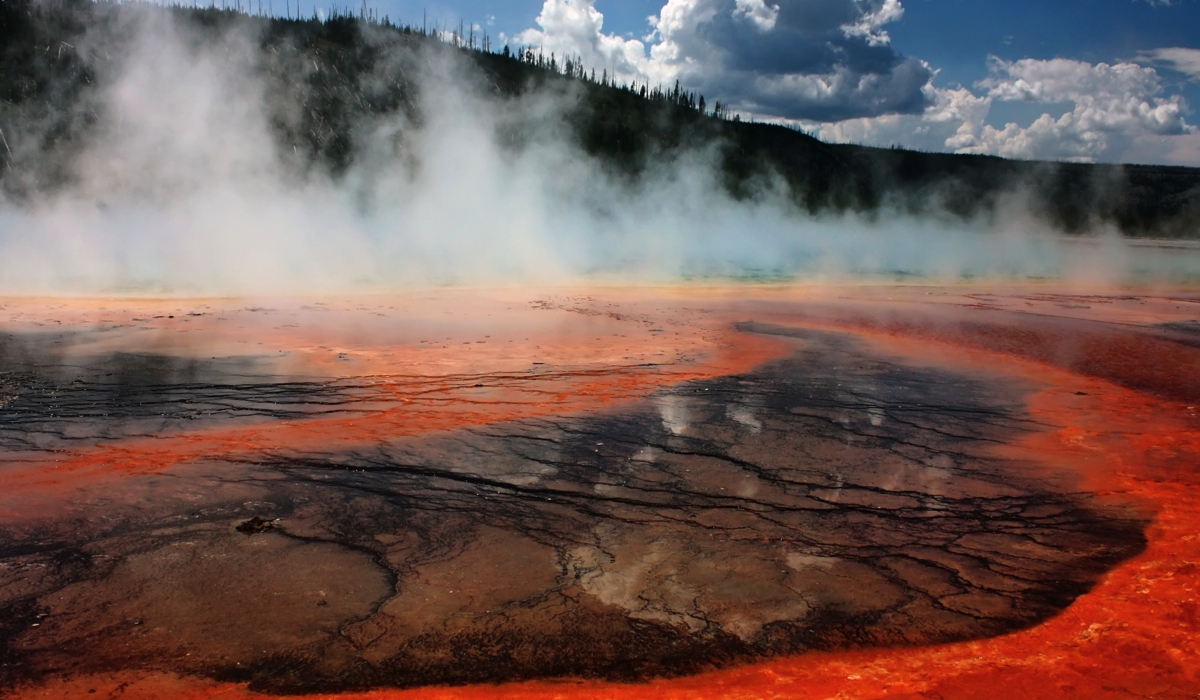
The supervolcano

volcano

One of my friends is absolutely obsessed with this, so I know a little something about it alreadyLots more at the link:

Currently, the Yellowstone caldera shows no signs of preparing for a super eruption. That doesn’t mean that there aren’t regular earthquakes in the area — that’s just a natural part of being in a volcanic region. And the caldera itself rises and falls all the time, the ground moving up and down as pressure increases and decreases in the magma reservoir below. “It rose about 27 centimeters max over the past 6 years,” Lowenstern said. “Calderas are big and hot, so they don’t break very easily and they just move up and down. It’s the way heat and gas get out of these deep systems — the system breathes.”

He added that if a super eruption were coming, “you’d need extraordinary activity,” something that went way beyond centimeters of movement and a few small quakes. Right now, the Yellowstone caldera is breathing normally, exhibiting behaviors typical of any massive hydrothermal system. Lowenstern and the team of scientists at the Yellowstone Volcano Observatory are constantly studying the caldera, looking for changes and working on projections of what the next eruption might be like.

An eruption could “come at any time,” Lowenstern admitted. But would it be a super eruption? Probably not. And even if it were, the damage wouldn’t be the inferno you might be expecting. Instead of fleeing from hell on Earth, you’d just be slogging through lots and lots of ash cleanup.