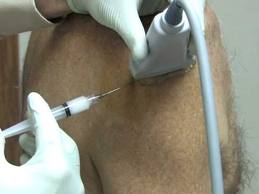
My physiatrist is frustrated by this problem I have with my left knee. It feels like someone put a giant strip of adhesive across the front and I can’t move it freely. It feels really tight, and nothing (yoga, massage, a previous cortisone shot) seems to help. (Oh, and it can be pretty stiff when I first wake up.)
So he sent me to this radiologist, who was going to do an ultrasound and see where the trouble was. I went today; of course I’d lost the prescription, and had to make a last-minute call to the physiatrist’s office. They scanned and emailed me a copy.
Turns out the ultrasound shows all kinds of osteoarthritis in my left knee, and the new doctor was trying to figure out what to do. He thought about giving me a shot of artificial synovial fluid (possible side effects, still controversial) or a combo shot of cortisone and anesthetic. “What’s the down side?” I said. He told me the cortisone might not do anything.
“So what’s the upside?” I might get three to six months’ of pain relief and movement in the knee, he said.
“From the non-existent pain,” I said. He told me he couldn’t believe I didn’t have pain, that I must have a really high pain threshold. “I do have a really high pain threshold,” I said. “But I’m telling you, I don’t have any pain.”
My physiatrist told me this back when I first started seeing him: That you can’t really base your treatments only on the tests. “I get people in here who are in agony, can barely walk because they’re in so much pain — and nothing at all shows up on the MRIs. I get other people whose MRIs show all kinds of problems — herniated disks, arthritis — and they’re fine. You have to look at the function, not the tests.”
I got the shot. Maybe it will help. But if it does, it’ll be kind of like voodoo, because they won’t know why.