He who makes the rules

Dodd-Frank Act Used In NY State Subprime Lender Lawsuit
Very, very interesting piece, and you really should read all of it:

As Obama begins his second term, all the talk in Washington is about whether ongoing congressional gridlock and soul-crushing partisanship will block the administration from achieving significant legislative victories, be they immigration reform, a big fiscal deal, or an infrastructure bank. But at least as important to the future of the country and to the president’s own legacy is whether that potentially game-changing legislation he signed in his first term—like the Affordable Care Act and Dodd-Frank, as well as a slew of other landmark bills—is actually implemented at all.

It may seem counterintuitive, but those big hunks of legislation, despite being technically the law of the land, filed away in the federal code, don’t mean anything yet. They are, in the words of one CFTC official, “nothing but words on paper” until they’re broken down into effective rules, implemented, and enforced by an agency. Rules are where the rubber of our legislation hits the road of real life. To put that another way, if a rule emerges from a regulatory agency weak or riddled with loopholes, or if it’s killed entirely—like the CFTC’s rule on position limits—it is, in effect, almost as if that part of the law had not passed to begin with.

As of now, there’s no guarantee that either Obamacare or Dodd-Frank will be made into rules that actually do what lawmakers intended. That’s partly because the rule-making process is a dangerous place for a law to go. We might imagine it as a fairly boring assembly line—a series of gray-faced bureaucrats diligently stamping laws into rules—but in reality, it’s more of a treacherous, whirling-hatchet-lined gauntlet. There are three main areas on this gauntlet where a rule can be sliced, diced, gouged, or otherwise weakened beyond recognition.

The first is in the agency itself, where industry lobbyists enjoy outsized influence in meetings and comment letters, on rule makers’ access to vital information, and on the interpretation of the law itself.

The second is in court, where industry groups can sue an agency and have a rule killed on a variety of grounds, some of which make sense and some of which most definitely do not.

The third is in Congress, where an entire law can be retroactively gutted or poked through with loopholes, or where an agency can be quietly starved to death through appropriations bills.

And here’s the really alarming part: rules run this gauntlet largely behind closed doors, supervised by people we don’t elect, whose names we don’t know, while neither the media nor great swaths of the otherwise informed public are paying any attention at all. That’s not because we don’t care what happens; we do. After all, millions of us spent the better part of a year closely monitoring the battles to pass Obamacare and Dodd-Frank. Remember? It was high drama! Every detail was faithfully chronicled in front-page headlines and long disquisitions on The Rachel Maddow Show; in countless posts by wonky bloggers, who dissected every in and out, every committee hearing, every new study about the public option or the Volcker Rule.

Mental health and the long-term unemployed

IMG_1901

I think of the many people I know who got knocked down and never got back up. I think about my friend Lyn, who just couldn’t take it. I know there must be thundreds of thousands in the same horrible place:

A comprehensive study of long-term unemployed published by Rutgers University’s John J. Heldrich Center for Workforce Development in 2011 found that the vast majority of unemployed workers experienced stress in their relationships with family and friends and that at least 11 percent reported seeking professional help for their depression within the previous 12 months.

One in two of the respondents in the two-year national study said they began avoiding friends and associates out of a sense of shame and embarrassment — a self-imposed isolation that hurt their ability to network to find work.

“Because of the persistence of high levels of long term unemployment there are millions of people who are suffering from mental health problems and many of them are going untreated by professionals,” Carl Van Horn, a professor of public policy and economics at Rutgers and head of the Heldrich Center, said this week.

“Losing a job is more than just a financial crisis for people,” Van Horn says. “It creates numerous other damage: stress, anxiety, substance abuse, fights, and conflicts in the family and feelings of embarrassment and depression.”

The plight of many of the long-term unemployed became even direr in late December after Congress allowed jobless benefits to expire for more than 1.6 million Americans. Senate Majority Leader Harry Reid (D-NV) vowed that renewing an extension of federal unemployment insurance benefits would be the first order of business when the Senate returned in January, but Republicans have blocked Democratic efforts to extend the program for those who exhausted their 26 weeks of state benefits.

“There are now 1.6 million unemployed Americans cut off and 2.3 million children affected,” said Sarah Ayres, a policy analyst with the liberal Center for American Progress. “This money is going to people who are going to spend it — they’re putting it right back into the economy. This is really a self-inflicted economic wound.”

The number of individual recipients whose benefits expire runs to about 70,000 a week.

The mental health crisis among the long term unemployed rarely gets much attention, although Van Horn has described the combination of long-term unemployment and diminished government support as “a silent mental health epidemic.”

Long-term unemployment frequently causes depression, drug and alcohol abuses, spousal abuse, divorce, and even suicide. Many of these unemployed Americans couldn’t afford to seek professional help because they lost their employer-provided health care insurance when they were laid off. At the same time, federal, state, and local governments cut back on spending for mental health clinics and outreach in response to budget crises spawned by the bad economy.

A 2013 Urban Institute study on the consequences of long-term unemployment found, “The long-term unemployed also tend to earn less once they find new jobs. They tend to be in poorer health and have children with worse academic performance than similar workers who avoided unemployment.”

Thanks to Patrick Rooney.

Five ways massive inequality paralyzes society

tradingplaces

The answer may be an international financial transaction tax:

1. A Broken System of Compensation: The Combined Salaries of 350,000 Pre-School Teachers is Less Than That of Five Hedge Fund Managers

Pre-school teaching may be our nation’s most important job. Numerous studies show that with pre-school, all children achieve more and earn more through adulthood, with the most disadvantaged benefiting the most.

[…]
2. Diminishing Support for Society: The 1% Made More from their Investments in 2013 than the Entire Cost of Social Security, Medicare, Medicaid, and the Safety Net

America’s wealth grew by almost $9 trillion in 2013. The richest 1% own 34 percent of the wealth (Table 6 here or Table 2 here), or about $3 trillion of the 2013 gain.

[…]
3. Capital’s Long-Term Dominance of Labor: Since 1900, a Dollar of Labor has Grown to $127, a Dollar of Stocks to $1,247

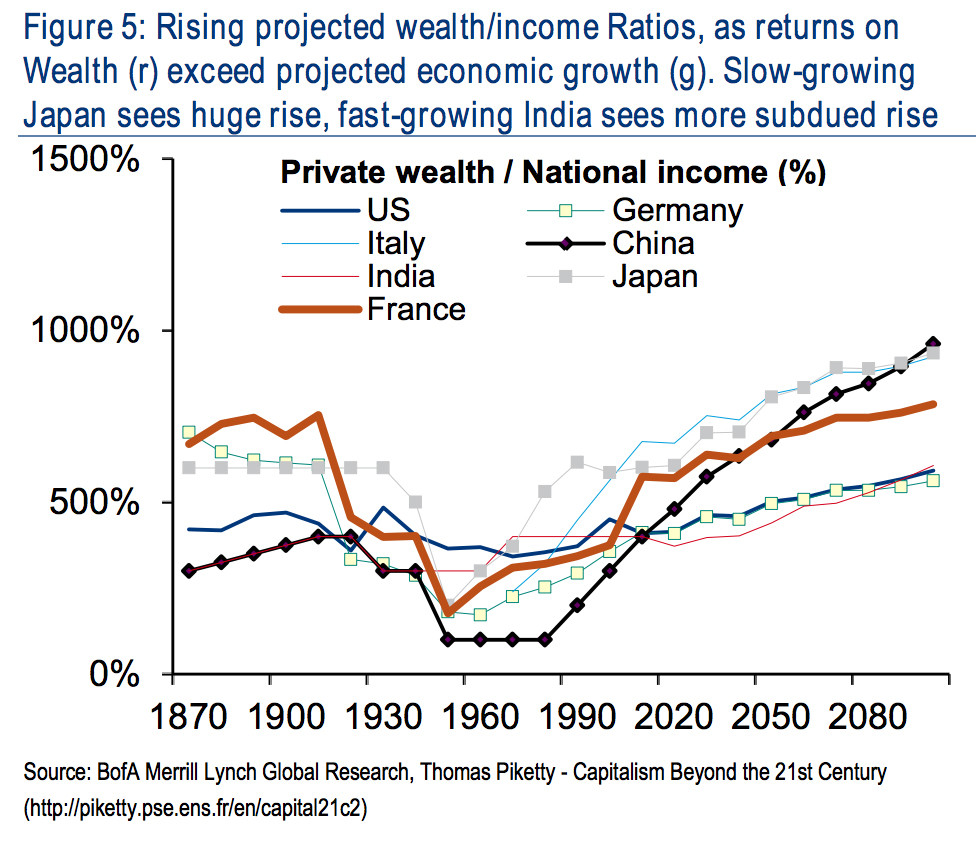
There’s a good reason why the super-rich are cleaning up in the stock market. Thomas Piketty explains that, barring war or depression, the return on capital far outpaces economic growth, causing average workers without a stock portfolio to drop further and further behind. A look at stock market growth over 114 years (Page 60) confirms that a dollar of capital is now worth ten times more than a dollar of labor value.

[…]
4. The Walmartization of America: A Few Super-Rich at the Top, then Everyone Else

Just like at Walmart, a few big moneymakers are ruling over a great majority of increasingly low-income workers. Low-wage jobs ($7.69 to $13.83 per hour) made up 1/5 of the jobs lost to the recession, but accounted for nearly 3/5 of the jobs regained during the recovery. And it’s getting worse. Nine out of ten of the fastest-growing occupations are considered low-wage, generally not requiring a college degree.

[…]
5. Toward Third-World Status: Our Shrinking Middle Class Gets a Smaller Cut of National Wealth than Anywhere except China and India

From a global perspective, we’re becoming the type of country that we used to dismiss as “third-world.” Among developed and fast-rising nations only the middle classes of China and India get a smaller cut of their country’s wealth than in the United States. Both of them are rapidly catching up to us.

HT Karin Riley Porter Attorney at Law

My head is exploding

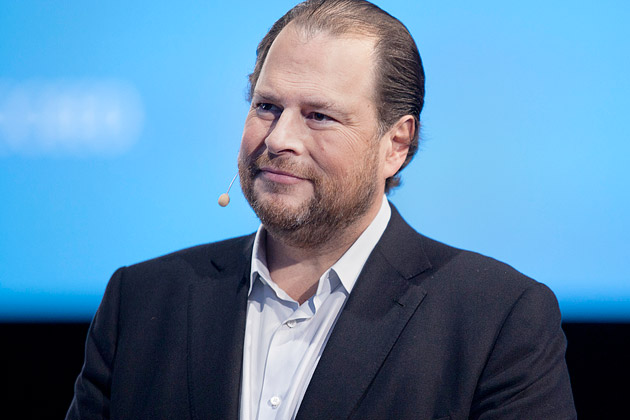
Marc Benioff.
Marc Benioff.

Go read the rest of the mostly self-serving blather:

Marc Benioff, the philanthropist and billionaire founder of Salesforce, may have been the angriest man at last week’s Code Conference, held at the Terranea Resort in Rancho Palos Verdes, Calif.

Onstage, Benioff launched into a fervent monologue, calling out the audience for failing on a range of social initiatives. The income discrepancy was growing, and techies were being too stingy. Benioff called out conference presenter Re/code for not having a charitable component, and asked people there to raise their hands if their companies had charity programs. Fewer than half did.

“You’ve got to show that we are part of the solution, not just part of the problem,” said Benioff, his voice rising in intensity.

San Francisco, the heart of the tech industry, now has the fastest-growing income inequality in the country, a gap on par with Rwanda’s. This has led to range of protests, including those that have begun targeting public tech symbols like Google’s commuter shuttle buses.

The connection between inequality and the tech industry may be fair: Innovation tends to make things more efficient, so fewer people can accomplish more work (in the Bay area, the WhatsApp texting service sold for $19 billion with 55 employees, while the Gap, worth about the same, has 136,000 employees).

So, what did the wealthy and influential attendees at Code — which was held at a secluded and exclusive beachfront resort — think about income inequality, the housing shortage, and whether tech was to blame or not?

The responses were varied, but the most common answer — no surprise, perhaps — was that tech wasn’t the cause of San Francisco’s income gap, but rather the best solution.

“Tech is solving the problem, because now we have these new qualified, nonprofessional market verticals,” said Mike Jones, CEO of Science and former CEO of Myspace. “You’re qualified to drive a car, but not professionally doing it. Congratulations, boom, you’re making [a] $90,000-a-year average Uber salary.”

Assuming you can afford a car. Assuming no one sues you for tripping on the way out of your car. Assuming… oh, never mind.

Thanks to Karin Riley Porter.

Our betters are getting nervous

Guillotine

But not enough yet to substitute public relations for substance:

Yesterday’s Conference on Inclusive Capitalism co-hosted by the City of London Corporation and EL Rothschild investment firm, brought together the people who control a third of the world’s liquid assets – the most powerful financial and business elites – to discuss the need for a moresocially responsible form of capitalism that benefits everyone, not just a wealthy minority.

Leading financiers referred to statistics on rising global inequalities and the role of banks and corporations in marginalising the majority while accelerating systemic financial risk – vindicating the need for change.

While the self-reflective recognition by global capitalism’s leaders that business-as-usual cannot continue is welcome, sadly the event represented less a meaningful shift of direction than a barely transparent effort to rehabilitate a parasitical economic system on the brink of facing a global uprising.

Central to the proceedings was an undercurrent of elite fear that the increasing disenfranchisement of the vast majority of the planetary population under decades of capitalist business-as-usual could well be its own undoing.

The Conference on Inclusive Capitalism is the brainchild of the Henry Jackson Society (HJS), a little-known but influential British think tank with distinctly neoconservative and xenophobic leanings. In May 2012, HJS executive director Alan Mendoza explained the thinking behind the project:

“… we felt that such was public disgust with the system, there was a very real danger that politicians could seek to remedy the situation by legislating capitalism out of business.”

Well, we can’t have that, can we?

The Initiative for Inclusive Capitalism’s recommendations for reform seem well-meaning at first glance, but in reality barely skim the surface of capitalism’s growing crisis tendencies: giant corporations should invest in more job training, should encourage positive relationships and partnerships with small- and medium-sized businesses, and – while not jettisoning quarterly turnovers – should also account for ways of sustaining long-term value for shareholders.

The impetus for this, however, lies in the growing recognition that if such reforms are not pursued, global capitalists will be overthrown by the very populations currently overwhelmingly marginalised by their self-serving activity. As co-chair of the HJS Inclusive Capitalism taskforce, McKinsey managing director Dominic Barton, explained from his meetings with over 400 business and government leaders worldwide that:

“… there is growing concern that if the fundamental issues revealed in the crisis remain unaddressed and the system fails again, the social contract between the capitalist system and the citizenry may truly rupture, with unpredictable but severely damaging results.”

There’s more, go read it.

Good news

Supporter of Cecily McMillan reads a statement from her following the verdict
Cecily McMillan got a light sentence:

NEW YORK (Reuters) – An Occupy Wall Street protester convicted of assaulting a police officer during a demonstration two years ago was sentenced on Monday to a 90-day jail term.

A New York jury on May 5 found Cecily McMillan guilty of elbowing a police officer, Grantley Bovell, in the eye as he was attempting to arrest her.

McMillan, 25, was arrested along with scores of others on March 17, 2012 at a demonstration marking the protest movement’s six-month anniversary in New York City.

While thousands of people were arrested during Occupy protests in 2011 and 2012, most of those cases were dismissed, some were resolved out of court and just 67 have gone to trial.

Moral surrender

Photo

Matt Taibbi talks about his new book and why only some people go to jail these days:

His relentless coverage of Wall Street malfeasance turned him into one of the most influential journalists of his generation, but in his new book, “The Divide: American Injustice in the Age of the Wealth Gap,” Matt Taibbi takes a close and dispiriting look at how inequality and government dysfunction have created a two-tiered justice system in which most Americans are guilty until proven innocent, while a select few operate with no accountability whatsoever.

Salon sat down last week with Taibbi for a wide-ranging chat that touched on his new book, the lingering effects of the financial crisis, how American elites operate with impunity and why, contrary to what many may think, he’s actually making a conservative argument for reform. The interview can be found below, and has been lightly edited for length and clarity.

So, what is “The Divide”?

The book is really just about why some people go to jail and why some people don’t go to jail, and “the divide” is the term I came up with to describe this phenomenon we have where there are essentially two different criminal justice systems, one that works one way for people who are either very rich or working within the confines of a giant systemically important institution, and then one that works in another way for people who are without means. And that’s what the book is about.

A point you make in the book, though, is that the justice system is starting to treat people who aren’t poor or part of a marginalized group with a level of brutality we tend to think is only reserved for the oppressed.

I made a conscious decision to start the book with the story of Abacus Federal Savings bank, which is this little bank in Chinatown. The people who run that bank were not poor. They weren’t even what you would typically classify as members of the victim class … But why was that bank prosecuted and why was Goldman Sachs or Chase not prosecuted? What I was trying to get at was, in this new reality, [legal authorities] consider it not feasible to go after companies of a certain size, and [Abacus] is how small you have to be now to be targeted …

There was an SEC commissioner who talked about “shot selection,” like in basketball, [and] how you should go for the baskets with the greatest chance of scoring. So while it may be more satisfying to go after the bigger companies, you’re more likely to get a successful action against a smaller company.

So it’s not just about poor people, it’s also just about the way the regulatory system works. Bureaucracies organically flow toward the easier result, and the easier result is always a smaller company, an undefended person, a low-level drug dealer. They hesitate before it decides to proceed against a well-heeled, well-defended company [against which] they’re going to have to fight for years and years and years just to get the case in court … It’s not just about the poor, it’s more about how there’s a class that enjoys impunity and then there’s everybody else.
Continue reading “Moral surrender”