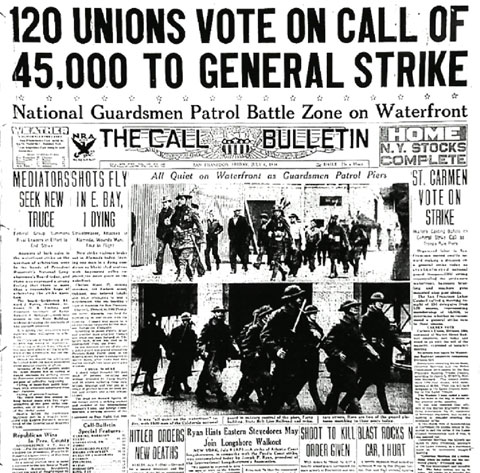
Remember when workers died for their rights?

strike

How did we end up right back where we started? Bill Moyers:

On April 20, 1914, the Colorado National Guard and a private militia employed by the Colorado Fuel & Iron Company (CF&I) opened fire on a tent camp of striking coal miners at Ludlow, Colo. At least 19 people died in the camp that day, mostly women and children.

A century later, the bloody incident might seem a relic of the distant past, but the Ludlow Massacre retains a powerful, disturbing and growing relevance to the present. After a century of struggling against powerful interests to make American workplaces safer and corporations responsive to their employees, the US is rapidly returning to the conditions of rampant exploitation that contributed to Ludlow.

That’s especially true in mining, where a coordinated union-busting campaign, the corporate capture of federal regulatory agencies, and widespread environmental degradation leave coal miners unsafe and mining communities struggling to deal with the massive environmental impact of modern mining practices.

A century ago, miners led the fight for workers’ rights. The Gilded Age of the late 19th and early 20th centuries was a period of great upheaval for the American working class. For decades, the United Mine Workers of America (UMWA) had worked to organize the nation’s coal miners. Its success often hinged on whether the government helped mining companies crush strikes or protected workers. In 1897, deputies in Luzerne County, Pa., killed 19 striking miners in the Lattimer Massacre. But five years later, when Pennsylvania miners struck again, President Theodore Roosevelt intervened on their behalf, providing them with a partial victory. Roosevelt’s actions, while hardly indicative a new pro-labor federal government, reflected a growing belief that labor deserved a fair shake.

The sliding scale of justice

Photo
Matt Taibbi’s new book is about how the rich are never punished for their crimes.

“The Divide” marks a shift in Taibbi’s tone. More Lincoln Steffens than Hunter Thompson, Taibbi drops most of the histrionics to reveal the corruption and injustice at hand. He even goes out of his way to be reasonable. He acknowledges that prosecuting financial cases can be expensive and risky, especially when the alleged crimes are complex and the defendants have vast legal resources at their disposal. That fact motivates prosecutors to settle such cases rather than try them in criminal court. He also concedes that many disadvantaged neighborhoods may benefit from tough policing. But he maintains that when combined, the two law-enforcement strategies add up to a glaring injustice. He also notes that it’s far too easy to introduce jurisdictional complications in financial cases that would never be allowed in less consequential cases. To make that point, he recounts a horrific case in which high-profile Wall Street financiers escaped punishment after trying to destroy a company they bet against as well as harassing its executives and their family members.

Taibbi’s is an important voice, especially in today’s media ecology. Support for investigative reporting has never been a given; when it comes to muckraking, you take it where you can get it. Taibbi has shown that he can deliver the goods, and “The Divide” is his most important book-length contribution to date. One wonders what the future holds for him. In February, he announced he was leaving Rolling Stone to join First Look Media, where his website will feature investigative stories with a satirical edge. In describing his new venture, he linked his Russian experience to his current interests. “There was a certain kind of corruption that I got to see up close in the ’90s,” he said, “and I think that a version of it is being repeated here in the United States.”

Government = protection racket for the 1%

Brother Orchid: Oddball Movie, But Intriguing

Bill Moyers:

The evidence of income inequality just keeps mounting. According to “Working for the Few,” a recent briefing paper from Oxfam, “In the US, the wealthiest one percent captured 95 percent of post-financial crisis growth since 2009, while the bottom 90 percent became poorer.”

Our now infamous one percent own more than 35 percent of the nation’s wealth. Meanwhile, the bottom 40 percent of the country is in debt. Just this past Tuesday, the 15th of April — Tax Day — the AFL-CIO reported that last year the chief executive officers of 350 top American corporations were paid 331 times more money than the average US worker. Those executives made an average of $11.7 million dollars compared to the average worker who earned $35,239 dollars.

As that analysis circulated on Tax Day, the economic analyst Robert Reich reminded us that in addition to getting the largest percent of total national income in nearly a century, many in the one percent are paying a lower federal tax rate than a lot of people in the middle class. You may remember that an obliging Congress, of both parties, allows high rollers of finance the privilege of “carried interest,” a tax rate below that of their secretaries and clerks.

And at state and local levels, while the poorest fifth of Americans pay an average tax rate of over 11 percent, the richest one percent of the country pay — are you ready for this? — half that rate. Now, neither Nature nor Nature’s God drew up our tax codes; that’s the work of legislators — politicians — and it’s one way they have, as Chief Justice John Roberts might put it, of expressing gratitude to their donors: “Oh, Mr. Adelson, we so appreciate your generosity that we cut your estate taxes so you can give $8 billion as a tax-free payment to your heirs, even though down the road the public will have to put up $2.8 billion to compensate for the loss in tax revenue.”

Studies of bloated CEO pay miss the fattest cats in America

Studies of Bloated CEO Pay Miss the Fattest Cats in America (via Moyers & Company)

Each year The New York Times creates a furor by publishing a list of the highest paid CEOs. (This year the top 10 averaged $30.3 million in total compensation.) And each year “the paper of record” misses the real story: Yes, CEOs of public firms…

Continue reading “Studies of bloated CEO pay miss the fattest cats in America”

Too big to jail

david Cay Johnston

David Cay Johnston really lets the Obama administration have it for refusing to prosecute bankers:

With a track record like that, you might think Black would have been the first person President Barack Obama called when he took office five years ago as the economy was being gutted because of reckless and rapacious banking practices that plundered profits through subprime mortgages and devilish derivatives. A second Great Depression was stalking America, as the stock market was tanking and businesses small and large were hemorrhaging jobs.

The economy is still recovering from those cynical depredations, and many people are still wondering why no one has gone to jail for pushing us all to the brink of ruin.

But to this, day no one in the White House or the Justice Department, no one in the banking regulatory agencies, will return Black’s calls. In 2012 he did get invited to brief Capitol Hill staffers on fraud by banks. He bought plane tickets to D.C. from Kansas City, Mo., where he teaches law and economics at the University of Missouri’s law school there. But before the plane took off his phone rang. “I was told not to come,” Black recalls. “The staff said they were afraid I would engage in too much bank bashing.”
Continue reading “Too big to jail”

I can dream, can’t I?

wwjd

Wouldn’t it be nice to see some bankers go to jail?

ALBANY, N.Y. (AP) — An official familiar with the investigation said the New York Attorney General’s Office has issued subpoenas to six firms and sent a letter to another for details about split-second stock trading and any unfair advantages.

The official told The Associated Press Wednesday that the subpoenas went last week to trading firms including Chicago-based Jump Trading LLC and Chopper Trading LLC and Tower Research Capital in New York. The official spoke on condition of anonymity because he wasn’t authorized to publicly discuss the subpoenas. He said he did not know the names of the other companies.

Jump Trading, Chopper Trading and Tower Research did not immediately respond to requests for comment.

Attorney General Eric Schneiderman has said advantages in computer hardware and placement enable some traders to get millisecond timing advances to make “rapid and often risk-free trades before the rest of the market can catch up.”

The new Gilded Age

_MG_9134

Krugman reviews the new Thomas Piketty book, Capital in the Twenty-First Century. It’s making quite the stir among the talking classes:

It therefore came as a revelation when Piketty and his colleagues showed that incomes of the now famous “one percent,” and of even narrower groups, are actually the big story in rising inequality. And this discovery came with a second revelation: talk of a second Gilded Age, which might have seemed like hyperbole, was nothing of the kind. In America in particular the share of national income going to the top one percent has followed a great U-shaped arc. Before World War I the one percent received around a fifth of total income in both Britain and the United States. By 1950 that share had been cut by more than half. But since 1980 the one percent has seen its income share surge again—and in the United States it’s back to what it was a century ago.

Still, today’s economic elite is very different from that of the nineteenth century, isn’t it? Back then, great wealth tended to be inherited; aren’t today’s economic elite people who earned their position? Well, Piketty tells us that this isn’t as true as you think, and that in any case this state of affairs may prove no more durable than the middle-class society that flourished for a generation after World War II. The big idea of Capital in the Twenty-First Century is that we haven’t just gone back to nineteenth-century levels of income inequality, we’re also on a path back to “patrimonial capitalism,” in which the commanding heights of the economy are controlled not by talented individuals but by family dynasties.
Continue reading “The new Gilded Age”

Andrew Cuomo, honorary chairman

Weasel (1) -  Elmley

Of course he is, the little weasel:

ALBANY—Governor Andrew Cuomo will headline an education retreat next month in Lake Placid hosted by hedge-fund managers who support the Common Core standards, charter schools, mayoral control of schools, testing and student-data collection.

Cuomo is the “honorary chairman” of Camp Philos, “a philosopher’s camp on education reform” presented by Education Reform Now, a group that has donated $65,000 to Cuomo since 2010 through its political action committee. The group, led by hedge funders who are active in the charter-school movement, is hosting the conference at Whiteface Lodge on May 4 to 6.

SEC was colluding with the banks on CDO prosecutions

Lloyd

If I hear one more nitwit “explaining” to me that giving mortgages to brown people destroyed the economy, I will scream — especially when it was brought down by massive system fraud and de facto deregulation. Felix Salmon:

Back in 2011, I asked whether the SEC was colluding with banks on CDO prosecutions. And now, thanks to an American Lawyer Freedom of Information Request, we have the answer: yes, they were.

This comes as little surprise: it beggared belief, after all, that every bank would end up being prosecuted for one and only one CDO. But now we have chapter and verse: the key precedent, it seems, was the first one, Goldman Sachs.

The SEC filed its case against Goldman and Tourre on April 16, 2010. Three days later Goldman reached out with a $500 million settlement offer, according to an email that Reisner sent Khuzami. Although that proposal was close to the final payment, it took another three months to announce a settlement. As Khuzami described to Kotz, Goldman wanted a global settlement that resolved not just the Abacus investigation but the SEC’s probes into roughly a dozen other Goldman CDOs.
Continue reading “SEC was colluding with the banks on CDO prosecutions”