
Harry Reid appointed Bernie Sanders to the budget conference committee — you know, the one that’s supposed to strike a deal with the Republicans?
Get out the popcorn!
Harry Reid appointed Bernie Sanders to the budget conference committee — you know, the one that’s supposed to strike a deal with the Republicans?
Get out the popcorn!
Love this new Barbara Buono ad!
More costly, less effective. For more than 20 years, I’ve been writing about the insanity of “running government like a business.” Outsourcing government has never been about cost savings or efficiency. As a Republican official gleefully explained to me, back when I was still a naive young reporter, it’s only about one thing: Having big fat contracts you can parcel out to political donors. Witness the outsourced clusterf*ck that is the national Obamacare portal (the vendor list reads like a Who’s Who of big-ticket campaign contributors and, as we’ve learned, the procurement process is a nightmare).
Which makes this Truthout story predictable:
Over the weekend, low-income shoppers in 17 states were unable to use their electronic food stamp debit cards. In this reporter’s neighborhood in downtown New Orleans Saturday evening, rumors swirled around grocery store cash registers and street corners. Was the government shutdown to blame? Did the deadlock in Washington mean nutritional assistance was gone for good?
The public soon learned that government shutdown was not to blame. Xerox, a private company that state welfare agencies had contracted for computing services, admitted that a “routine test” caused a computer glitch that temporarily shut down the Electronic Benefit Transfer (EBT) system in Louisiana, Ohio, Michigan and 14 other states.
It turns out that the EBT incident is not the first screwup under Xerox’s watch. Affiliated Computer Services (ACS), a subsidiary of Xerox since 2000 that specializes in privatizing government administrative services for the most economically vulnerable Americans, has taken heat in the past for siphoning excessive fees from welfare recipients, mismanaging Medicaid payment systems, and failing to complete multimillion dollar contracts for public agencies.
Continue reading “Running government like a business”
Wingnut Lite Rep. Mike Fitzpatrick, the lobbyists’ friend, isn’t doing so well these days:
According to the national political prognosticators at the Cook Political Report, PA-8 has become more competitive – along with 13 other Republican districts across the country
Here’s what Cook wrote:
Mostly as a result of the damage House Republicans sustained during the 16-day government shutdown, we are making changes to our ratings in 15 House seats, all but one in Democrats’ direction. Democrats still have a very uphill climb to a majority, and it’s doubtful they can sustain this month’s momentum for another year. But Republicans’ actions have energized Democratic fundraising and recruiting efforts and handed Democrats a potentially effective message.
Fitzpatrick mostly stuck with the GOP party line during the shutdown. He said he supported a ‘clean’ resolution to reopen the government from day one, but at no point voted against House Speaker John Boehner. They both voted against a majority of the House GOP this week for the bipartisan measure to end the shutdown.
His Democratic challengers seized the opportunity and hammered Fitzpatrick for not doing more to forge a compromise. Kevin Strouse and Shaughnessy Naughton both took turns calling him a hypocrite and equating him with the Tea Party.
I has a sad!
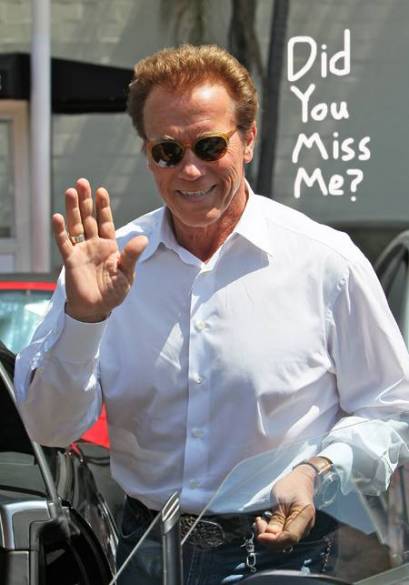
Hey now! Just because it’s Friday, and what the hell: Cali’s worst gov evah wants to expand his incapabilities to the entire country!
Action star and former California Gov. Arnold Schwarzenegger has been lobbying for support to change the law to allow him to run for president in 2016, Page Six has exclusively learned.
We’re told Ahnold has been openly talking about his political ambitions while in New York to promote his new movie with Sylvester Stallone, “Escape Plan.”
One source said: “Schwarzenegger has been talking openly about working on getting the constitutional rules changed so he can run for president in 2016.
He is ready to file legal paperwork to challenge the rules.”
Arnie was born in Austria, and the US Constitution prevents foreign-born citizens from holding the nation’s top job. Any amendment to the Constitution must be approved by two-thirds majority in the House and the Senate.
Hey, as long as it doesn’t favor a Democrat, the Republicans on the Supreme Court should go for it!
I just watched Sen. Chuck Schumer tell MSNBC’s Andrea Mitchell that once this deal is out of the way, Congress will resume budget negotiations, and everything, including so-called “entitlements,” must be on the table. House Minority Leader Nancy Pelosi was a little bit more balanced, insisting Democrats should only look at entitlement cuts in exchange for more revenues from people who can pay more. “Why should Granny pay the price?” without asking the rich to share the sacrifice, Pelosi asked.
But with all due respect to the once (and perhaps future) speaker, who’s been the toughest Democrat over the last five years: The answer is Granny shouldn’t pay any price. When Social Security needs “fixing,” we should lift the cap on income subject to the payroll tax. The chained CPI is a cut and shouldn’t be a first offer, but a last resort.
Likewise, President Obama took a tax rate hike off the table this month in an interview with CNBC’s John Harwood; Congressional Democratic leaders should put it back on the table immediately.
I’ve been impressed by the way Pelosi and Senate Majority Leader Harry Reid have kept their caucus together. I’ve also liked seeing new life among Congressional progressives. With the quiet backing of Reid in the Senate, they cleared space for the most progressive likely Fed chair pick, Janet Yellen. They need to make sure that any new budget deal doesn’t start with the president’s budget, which concedes too much to the GOP already.
Maybe Democrats, including the president, feel secure that they can nod to the debt-reduction wise men and promise to do the right thing — which in the real world is the wrong thing — because it’s a deal they’ll never have to deliver on: House Republicans won’t give up any revenue to get it. Still, I’m tired of Democrats endorsing what are essentially GOP narratives about the way the world works: Deficit reduction is more important than economic growth or income inequality.
Democrats so often snatch defeat from the jaws of victory. It would be a shame if they humbled the GOP this round only to hand them what they want in the next. Everyone’s looking to see whether Republicans learned their lesson from this debacle; we need to make sure Democrats did, too. If they return to their role as “enablers,” in Pelosi’s words, they’re part of the problem.
And I still don’t trust him, but he’s probably incrementally better than the teabagger, so there’s that.
 Booker: ‘We knew we were going to win by double digits’ (via NJ.com)
NEW YORK — Voice hoarse and flush with victory, Cory Booker today said he was never worried about winning Wednesday’s special election. “Our internals were consistent – we knew we were going to win by double-digits,” Booker said today in a…
David Dayen on just how stupid the concession on Obamacare income verification really is:
And you have to question whether income verification would ever be operational, and if that’s contributing to the major delays on the exchange website. Accurate, real-time income verification has been a cherished goal for members of the financial services industry for many years; they use this data to determine eligibility for loans of all types. Needless to say, big banks and financial services firms have massive resources relative to the federal government. And they haven’t been able to nail electronic income verification yet; they mostly ask people to mail or fax in forms proving income, rather than submit them through the Web (which leads to losing forms and multiple queries for data and all the rest).
Most of the information you can scrape from payroll or Social Security data would be 6-18 months out of date, especially for the types of part-time workers, freelancers, “unbanked” individuals and self-employed persons who comprise the primary group signing up for Obamacare. Demanding real-time income verification would require technology that doesn’t even exist for the financial sector, and to get it right would add significantly to the already burdensome delays in acquiring insurance coverage on the exchanges. It would also expand costs for IT development exponentially, achieving the neat trick of making Obamacare more costly and more ineffective at the same time.
As noted before, there’s an already existing method of income verification, through the IRS, that stands ready to handle any potential misreporting through clawbacks. In fact, the IRS will have to verify income anyway; people simply don’t have perfect information about their future income, especially part-timers and freelancers and the self-employed. This is how many means-tested programs like Medicare and Medicaid work, and despite the cries of conservatives, fraud in those programs mostly come from health care providers bilking the government rather than individual subscribers.
Instead of using a time-tested process that works (and would work better if Republicans weren’t so dedicated to defunding the IRS), the GOP wants to add this kludgey extra step to an already strained online exchange. The clear goal here is to make it harder to enroll or collapse the insurance exchanges entirely, along with creating the impression that Obamacare customers are automatically freeloaders and cheats, which aligns with conservative demonization of other government programs.
David Waldman on the with the short version:
4. Income verification for people getting subsidies on the health-care exchanges will be strengthened.
Details on exactly how this will work have yet to be released, but it looks like you’d have to have your income verified by the IRS before you can actually sign up. This is already a complex and potentially troublesome part of the signup process, particularly for people like freelancers and the self-employed whose incomes can vary from month to month. There is no reason Republicans demanded this other than to make getting insurance more difficult for as many people as they could and thereby throw sand in the gears of Obamacare. It’s really disappointing that Reid agreed to it.
In other words, I’m screwed.
H/t Jason Kalafat.
 Debt Ceiling Hostage Rescued — Now What? (via Moyers & Company)
It looks like the Republican Party’s overreach has led them to a decisive defeat in this round. The GOP is at war with itself, as it plumbs new depths of public disapproval. The tea partiers are on suicide watch, believing they’ve been stabbed in…