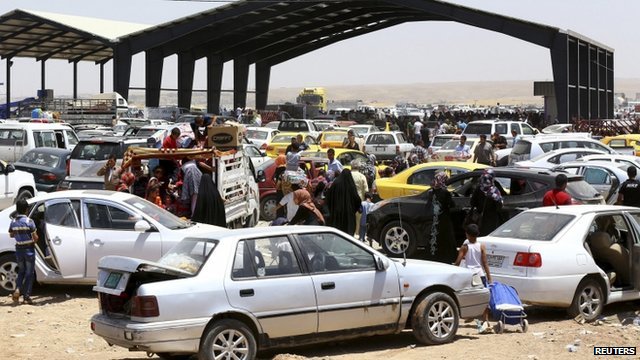
7 myths about the radical Sunni advance in Iraq

Emergency Relief in Anbar, Iraq

Juan Cole, who knows a lot more than most people:

1. “The Sunni radicals of the Islamic State of Iraq and Syria (ISIS) are popular.” They are not. Opinion polling shows that most Iraqi Sunnis are secular-minded. The ISIS is brutal and fundamentalist. Where the Sunnis have rallied to it, it is because of severe discontents with their situation after the fall of the Baath Party in 2003 with the American invasion. The appearance of video showing ISIS massacring police (most of them Sunnis) in Tikrit will severely detract from such popularity as they enjoyed.

2. “ISIS fighters achieved victory after victory in the Sunni north.” While this assertion is true, and towns continue to fall to it, it is simplistic. The central government troops, many of them Shiite, in Mosul and in towns of the north, were unpopular because representatives of a sectarian Shiite regime. The populace of Mosul, including town quarters and clan groups (‘tribes’) on the city’s outskirts, appear to have risen up in conjunction with the ISIS advance, as Patrick Cockburn argues. It was a pluralist urban rebellion, with nationalists of a socialist bent (former Baathists) joining in. In some instances locals were suppressed by the fundamentalist guerrillas and there already have been instances of local Sunnis helping the Iraqi army reassert itself in Salahuddin Province and then celebrating the departure of ISIS.

Go read the rest.

The Wire

wire

Don’t worry, I’m sure we can trust them all to do the right thing:

WASHINGTON — The Obama administration has been quietly advising local police not to disclose details about surveillance technology they are using to sweep up basic cellphone data from entire neighborhoods, the Associated Press has learned.

Citing security reasons, the U.S. has intervened in routine state public records cases and criminal trials regarding use of the technology. This has resulted in police departments withholding materials or heavily censoring documents in rare instances when they disclose any about the purchase and use of such powerful surveillance equipment.

Federal involvement in local open records proceedings is unusual. It comes at a time when President Barack Obama has said he welcomes a debate on government surveillance and called for more transparency about spying in the wake of disclosures about classified federal surveillance programs.

One well-known type of this surveillance equipment is known as a Stingray, an innovative way for law enforcement to track cellphones used by suspects and gather evidence. The equipment tricks cellphones into identifying their owners’ account information and transmitting data to police as if it were a phone company’s tower. That allows police to obtain cellphone information without having to ask for help from service providers, such as Verizon or AT&T, and can locate a phone without the user even making a call or sending a text message.

But without more details about how the technology works and under what circumstances it’s used, it’s unclear whether the technology might violate a person’s constitution rights or whether it’s a good investment of taxpayer dollars.

Interviews, court records and public-records requests show the Obama administration is asking agencies to withhold common information about the equipment, such as how the technology is used and how to turn it on. That pushback has come in the form of FBI affidavits and consultation in local criminal cases.

Jon Stewart v. Oliver North

Thank God for comedians who are actually old enough to remember exactly what happened in the past, because otherwise, these hypocrites would never be challenged by our Librul Media. An exceptionally good segment:

Jon Stewart rips Oliver North: Are you mad that prisoner-trading has ‘gone mainstream’? (via Raw Story )

Daily Show host Jon Stewart sarcastically commended Fox News on Wednesday for inviting convicted felon and former Army Lt. Col. Oliver North to comment on the U.S. deal to free POW Bowe Bergdahl — especially when North’s “commentary” included…

Continue reading “Jon Stewart v. Oliver North”

You have the right to be convicted

Judges gavel and law books stacked behind

By anonymous witnesses and unregulated surveillance technology:

A federal appeals court in Chicago held a highly unusual closed-door session with government officials today after debating in public whether attorneys for a local terrorism suspect should be allowed to view confidential surveillance documents filed in the case.

After 30 minutes of public arguments in the case of Adel Daoud, Judge Richard Posner ordered the stately courtroom of the 7th U.S. Circuit Court of appeals cleared for a “secret portion” of the proceedings.

Daoud’s attorney, Thomas Durkin, rose to object, but Posner did not acknowledge him.

Deputy U.S. marshals then ordered everyone out – including Durkin and his co-counsel. After about five minutes, marshals let back into the courtroom federal officials with the proper security clearance, including U.S. Attorney Zachary Fardon, his first assistant, Gary Shapiro, and about two dozen FBI and U.S. Department of Justice officials.

NYT: Uh, not so fast on Bergdahl-related deaths

bergdahl

Look, I’ve talked to Vietnam vets who still insist “guys I know” got spat on in airports, yet we have no record of such a thing ever being reported. I’ll take what these guys say with a large grain of salt:

The first two deaths the critics link to Sergeant Bergdahl involved a major assault by insurgents on a combat outpost called Zerok on July 4, 2009. Their view is that the Taliban knew the Americans were stretched thin by the search mission and took advantage of that opportunity to try to overrun it.

Mr. Bethea, the soldier who wrote the essay in The Daily Beast, said the company executive officer for the unit at Zerok believed that “the attack would not have happened had his company received its normal complement of intelligence aircraft: drones, planes, and the like. Instead, every intelligence aircraft available in theater had received new instructions: find Bergdahl. My friend blames Bergdahl for his soldiers’ deaths.”

Military officials, speaking in recent days, have countered that additional surveillance aircraft had been brought in from other areas to help in the search, so air traffic in the region was intensified, not diminished, by the search.

Separately, context supplied by the leaked logs complicates claims that insurgents attacked the outpost because of the hunt.

Insurgents had been shooting at the outpost with escalating intensity in the preceding months. A June 24 log described a mortar attack inside its perimeter and cited intelligence that insurgents were planning a “complex ambush” of the outpost.

And a log recounting the July 4 attack said it confirmed “recent reporting regarding Mullah Sangeen’s desire to conduct a spectacular attack” against the outpost. The log did not mention the hunt for Sergeant Bergdahl. Still, one soldier from Sergeant Bergdahl’s battalion said that response time after the attack had been slow, and argued the issue was not if the outpost was going to be attacked, but rather when insurgents chose to attack it.

The first and most intense phase of the search operation wound down after July 8. But former soldiers say and the logs show that the hunt continued sporadically as patrols were sent out to chase rumors that Sergeant Bergdahl had been spotted.

The other six American deaths in Paktika that summer occurred from Aug. 18 to Sept. 5, which Sergeant Bergdahl’s critics link to him as well.

“You see a lot of anger because we lost guys not only at Zerok, but a decent amount of good guys looking” for him, said a soldier from his unit who spoke on condition of anonymity.

Where those events are identifiable in the logs, they do not mention any link to Bergdahl search operations, although the logs are terse and contain few contextual details.

Mr. Bethea wrote that of the six men killed in August and September, two died in a roadside bombing while on a reconnaissance mission, a third was shot during a search for a Taliban political leader and three others were killed while conducting patrols — two in an ambush and one who stepped on a mine.

He suggested some connection to Sergeant Bergdahl for several of the deaths, saying the Taliban leader and a village that was in the area of one of the patrols were “thought affiliated with Bergdahl’s captors.” He also said a village in the areas of the other patrol was “near the area where Bergdahl vanished.”

Still, those villages and insurgents were in the overall area of responsibility for the soldiers, and the logs make clear that the region was an insurgent hotbed. A log on May 21, 2009, for example, said it had historically been a “safe haven” for the Taliban.

A retired senior American military officer, who was briefed at the time on the search for Sergeant Bergdahl, said that even though soldiers were instructed to watch for signs of the missing American, they would have been conducting patrols and performing risky operations anyway.

“Look, it’s not like these soldiers would have been sitting around their base,” he said.

The soldier who spoke on condition of anonymity agreed that it was “ludicrous” to lay 100 percent of the blame for the deaths at Sergeant Bergdahl’s feet, and he acknowledged that patrols were going to get hit in Paktika during fighting season anyway.

But, he said, the reason he and his colleagues are angry is that too often that summer, the purpose of their patrols into dangerous areas was not ordinary wartime work like reconnaissance, maintaining a security presence, or humanitarian projects, but rather “to go look for this guy.”

Continue reading “NYT: Uh, not so fast on Bergdahl-related deaths”

Proud to be an American

NSA-photo-by-Trevor-Paglen
Where privacy is a thing of the past:

The National Security Agency is harvesting huge numbers of images of people from communications that it intercepts through its global surveillance operations for use in sophisticated facial recognition programs, according to top-secret documents.

The spy agency’s reliance on facial recognition technology has grown significantly over the last four years as the agency has turned to new software to exploit the flood of images included in emails, text messages, social media, videoconferences and other communications, the N.S.A. documents reveal. Agency officials believe that technological advances could revolutionize the way that the N.S.A. finds intelligence targets around the world, the documents show. The agency’s ambitions for this highly sensitive ability and the scale of its effort have not previously been disclosed.

The agency intercepts “millions of images per day” — including about 55,000 “facial recognition quality images” — which translate into “tremendous untapped potential,” according to 2011 documents obtained from the former agency contractor Edward J. Snowden. While once focused on written and oral communications, the N.S.A. now considers facial images, fingerprints and other identifiers just as important to its mission of tracking suspected terrorists and other intelligence targets, the documents show.

Thanks, Ed Tayter.

Libya

Link:

The State Department on Tuesday told U.S. citizens in Libya to leave the country immediately, warning that the security situation remained “unpredictable and unstable.”

“The Department of State warns U.S. citizens against all travel to Libya and recommends that U.S. citizens currently in Libya depart immediately,” the State Department said in a new travel warning.

The last travel warning for Libya issued on Dec. 12 strongly advised against all but essential travel to Tripoli and against traveling outside the capital.

Was there ever any doubt?

140526-D-DB155-001

Remember Vietnamization? Good times!

President Obama is set to announce that the U.S. will leave 9,800 troops in Afghanistan after 2014 if the Afghan government signs a bilateral security agreement allowing their presence, a senior administration official said Tuesday. The announcement is scheduled for 2:45 p.m.

The president reiterated his pledge to bring the nearly 13-year war to a close by the end of 2014 this week during a surprise Memorial Day Weekend visit to Afghanistan on Sunday and his remarks at Arlington National Cemetery commemorating the holiday on Monday. But the future of U.S. troop presence has been uncertain for months as Afghan President Hamid Karzai has refused to sign a security agreement allowing U.S. troops to stay after the combat mission is concluded at the end of this year.

The candidates running to replace Karzai have indicated they will sign an agreement, but the uncertainty has delayed the U.S. military’s ability to plan for the future.

The senior administration official said the number of troops would be reduced by half by the end of 2015 and moved to a normal embassy presence with a security assistance office in Kabul, as is the case in Iraq, by the end of 2016.

The president has identified two missions in the country after 2014: training Afghan forces and supporting counter terror operations against the remnants of al Qaeda.