
Category: The Regime
Wyden: Surveillance is worse than they admit
Yesterday, Sen. Ron Wyden said U.S. intelligence agency violations of court orders on surveillance here are more serious than the intelligence directors are telling us.
Will they add up to the death of the IT cloud services?
Wyden (D-Ore.), as a member of the Senate Intelligence Committee, is privy to classified briefings on the government’s surveillance. On Tuesday, he told Andrea Mitchell on MSNBC that all he could say is that the violations are worse than being made public.
“We had a big development last Friday when Gen. [James] Clapper, the head of the intelligence agencies, admitted that the community had violated these court orders on phone record collection, and I’ll tell your viewers that those violations are significantly more troubling than the government has stated,” Wyden said.
[…] Wyden has been an outspoken critic of the surveillance programs but has been restricted with what he can release about them because of his position on the Intelligence Committee. He said since the government made the compliance issues public, however, he could warn about them.
“They did say last Friday that there had been violations of those court orders with respect to the bulk phone record collection, so that’s on the record, I’ll tell you those violations are more serious than they stated,” Wyden said.
But here’s the real story no one’s talking about. British academic John Naughton lays it all out in the Guardian:
[…] The issue of internet governance is about to become very contentious. Given what we now know about how the US and its satraps have been abusing their privileged position in the global infrastructure, the idea that the western powers can be allowed to continue to control it has become untenable.
Continue reading “Wyden: Surveillance is worse than they admit”
Good
Does the FBI have any records on the late investigative journalist Michael Hastings? I don’t know. But fellow FOIA terrorist Ryan Shapiro and I just filed a Freedom of Information Act lawsuit against the agency to find out.
Hastings died in a tragic car accident in Los Angeles June 18 at the age of 33. Immediately after the news broke, I filed a FOIA request with the FBI for any records the agency maintained on the award-winning reporter, which is something I do whenever a public figure passes away (yes, I realize some people think that’s weird).
A week later, Shapiro, a doctoral candidate at Massachusetts Institute of Technology who specializes in FOIA research pertaining to the policing of dissent, also filed a request with the FBI for “any and all records that were prepared, received, transmitted, collected and/or maintained by the Federal Bureau of Investigation (FBI), the Terrorist Screening Center, the National Joint Terrorism Task Force, or any Joint Terrorism Task Force relating or referring to” Hastings. [I also filed similar FOIA requests with DHS and other government agencies after Hastings’s death.]
The FBI, while acknowledging our records requests, failed to respond within the 20-working day time period with a determination as to whether the agency will comply as required by law. Nor has the FBI responded to Shapiro’s expedited processing request. So we decided to litigate and Jeffrey Light, our Washington, DC-based FOIA attorney, has also filed a motion for summary judgment seeking expedited processing of our federal complaint.
“By suing the FBI for failure to comply with the Freedom of Information Act, [we] hope to obtain records pertaining both to the unusual circumstances of Michael Hastings’s death and to the broader issue of FBI surveillance of journalists and other critics of American national security policy,” Shapiro said.
A few days after Hastings’s death, his friend, Staff. Sgt. Joseph Biggs, told a local news station in Los Angeles that Hastings blind copied him on an email he sent a day before his death that said, “The Feds are interviewing my close friends and associates.” The subject line of the email said, “FBI investigation, re: NSA.”
The FBI issued a rare public statement denying Hastings was under investigation. “At no time was Michael Hastings under investigation by the FBI,” FBI spokeswoman Laura Eimiller said June 21, three days after Hastings’s death.
Peace talks
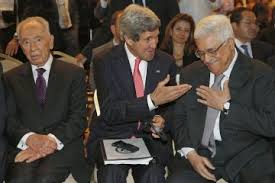
Secretary of State John Kerry is joined by Israeli President Shimon Peres (L) and Palestinian President Mahmud Abbas at the King Hussein Convention Centre on May 26, 2013 (Jim Young/AFP/Getty Images)
And the Palestinians, rightly, will never accept them. After all, they have considerably compromised from their pre-Oslo demand for the return of all of Palestine to 22% of it. They have recognized Israel’s right to security and, even without a peace treaty, they work hand-in-hand with the Israeli Defense Forces to defend Israel. Additionally, under international law, the occupied territories are just that – occupied – and must be returned to them.
What are they supposed to compromise on? They have nothing to give to Israel except an enhanced version of the security guarantees they already implement. Netanyahu likes to say that he will not sacrifice Israel’s security for any peace agreement. But he knows that he will never be asked to. Every significant proposal for Israeli-Palestinian peace contains extensive security guarantees for Israel. Notably, the Palestinians, who are infinitely weaker than Israel, don’t demand security guarantees, just their territory.
There is one last point as to why Kerry’s agreement will go nowhere. The Palestinians cannot trust the United States to be an impartial mediator, far from it. Even beyond the fact that the U.S. official expected to be chosen as mediator, Ambassador Martin Indyk, was long affiliated with AIPAC and then with the think-tank it created, the Washington Institute For Near East Policy, is the simple fact that the United States has unambiguously taken Israel’s side for decades.
Amash-Conyers
I’ve been trying to explain to people why I see it as a win, but this article does a better job than I did.
Surrender!
Give up that crazy illusion of privacy. Your life is no longer your own:
The U.S. government has demanded that major Internet companies divulge users’ stored passwords, according to two industry sources familiar with these orders, which represent an escalation in surveillance techniques that has not previously been disclosed.
If the government is able to determine a person’s password, which is typically stored in encrypted form, the credential could be used to log in to an account to peruse confidential correspondence or even impersonate the user. Obtaining it also would aid in deciphering encrypted devices in situations where passwords are reused.
“I’ve certainly seen them ask for passwords,” said one Internet industry source who spoke on condition of anonymity. “We push back.”
A second person who has worked at a large Silicon Valley company confirmed that it received legal requests from the federal government for stored passwords. Companies “really heavily scrutinize” these requests, the person said. “There’s a lot of ‘over my dead body.'”
Some of the government orders demand not only a user’s password but also the encryption algorithm and the so-called salt, according to a person familiar with the requests. A salt is a random string of letters or numbers used to make it more difficult to reverse the encryption process and determine the original password. Other orders demand the secret question codes often associated with user accounts.
Nixon never left
So the FBI has been investigating the leadership of Antiwar.com:
The FBI memo says:
“There are several unanswered questions regarding www.antiwar.com,” the [FBI] memo says. “It describes itself as a non-profit group that survives on generous contributions from its readers. Who are these contributors and what are the funds used for?”
Reporting on this document in August 2011, Antiwar.com raised concerns about government overreach and intimidation of critics of the country’s wars and national-security policy. Even disclosing the memo’s existence proved hazardous: the site began to lose major funders—to the tune of approximately $75,000 a year, according to Garris—who now feared that donating would draw unwanted attention from the feds.
Garris says Antiwar.com’s experiences are no different from the government obtaining phone and email records of top journalists or compelling writer James Risen to testify about his sources in court. “They’re getting away with systematic intimidation and sabotage” of those who seek to dig deeper into the goings-on of the national-security state, he told TAC.
So, without any evidence that Antiwar.com had committed any crime, but had only questioned and criticized US national security policy, the FBI investigated the readership of the website. The fact that the journalistic website drew the critical attention of the FBI was enough to scare off lots of donors. If that happens often enough, poof, no more Antiwar.com. Problem solved.
Read the whole thing. Pass it around. People need to know.
The CIA and the media
We were ‘actively misled’
Ron Wyden has been trying to warn us all along:
While some Senators are insisting that we need to keep going with NSA surveillance and just trust them that the NSA and FBI aren’t abusing the law and the information they have access to, others are pointing out that it’s a lot of hogwash. Senator Ron Wyden, who has been leading the charge against these programs for years (and was mostly ignored for that effort), gave a great speech describing how defenders of the program are directly choosing to mislead the American public. A key point, though it comes late in the speech, is the following:
The public was not just kept in the dark about the Patriot Act and other secret authorities. The public was actively misled.
Most of the speech is detailing exactly how that happened, and the distortions defenders of the program try to tell the American people and why they’re wrong. We’ll highlight a few, but reading or watching the whole speech is worthwhile.
He notes that he warned, quite specifically (and publicly) that when the American public found out how the laws were being interpreted, they would be surprised. That, clearly, proved accurate:
When the Patriot Act was last reauthorized, I stood on the floor of the United States Senate and said “I want to deliver a warning this afternoon. When the American people find out how their government has interpreted the Patriot Act, they are going to be stunned and they are going to be angry.” From my position on the Senate Intelligence Committee, I had seen government activities conducted under the umbrella of the Patriot Act that I knew would astonish most Americans.
Furthermore, he points out that officials chose to directly mislead the American public.
If that is not enough to give you pause, then consider that not only were the existence of and the legal justification for these programs kept completely secret from the American people, senior officials from across the government were making statements to the public about domestic surveillance that were clearly misleading and at times simply false.
At least 1 in 5 are civilian drone victims
There is something so deeply immoral about drones. We didn’t kill those civilians, the drones did! As if they had a life of their own, and we had nothing to do with it:
Leaked internal data produced by Pakistani officials documenting drone strikes on the ground reveal a high civilian death toll, countering US claims that the targeted assassination campaign results in “exceedingly rare” fatalities.
A 12-page report, titled ‘Details of Attacks by NATO Forces/Predators in FATA (Federally Administered Tribal Areas)’ describes 75 CIA drone attacks between 2006 and 2009, with death tolls compiled by officials in the turbulent border regions for internal use by the government. The Bureau of Investigative Journalism – a UK news website – says it obtained three identical copies of the classified document from various sources in Pakistan.
The numbers show a death toll of 746 people, 147 of whom were confirmed as civilians. Of those civilian deaths, 94 are children. Statistically, it means at least one in five victims of US precision strikes was a civilian, and more than 12 per cent were minors.