
Panhandle Slim… Art for Folk…

Ethnic purging
This is an awful story, and it’s getting very little coverage:
UAN GONZÁLEZ: The Dominican Republic is set to begin what some are calling “ethnic purging,” placing the fate of hundreds of thousands of Dominicans of Haitian descent into limbo. Half a million legally stateless people could be sent to Haiti this week, including those who have never stepped foot in Haiti and don’t speak the language. In 2013, a Dominican constitutional court ruling stripped the citizenship of children born to Haitian immigrants in the Dominican Republic as far back as 1929, retroactively leaving tens of thousands without citizenship. This is Dominican migration minister Ruben Darío Paulino.
RUBEN DARÍO PAULINO: [translated] Let’s not comment on any excesses in the reparation plan, but, yes, firmness in upholding the laws, so all the undocumented in this country return to their country of origin.
AMY GOODMAN: Today marks the deadline for undocumented workers to register their presence in the Dominican Republic or risk mass deportation. However, only 300 of the 250,000 Dominican Haitians applying for permits have reportedly received them. Many have actively resisted registering as foreigners, saying they’re Dominican by birth and deserve full rights. Dominican authorities have apparently organized a fleet of buses and set up processing centers on the border with Haiti, creating widespread fears of mass roundups. This is Tini Rosier, an undocumented migrant risking deportation.TINI ROSIER: [translated] If the deadline lapses, what they say is that we will have to go. There will be no fighting it and nothing that can be done. And I will have to go, because my mother and father brought me here when I was nine years old.
JUAN GONZÁLEZ: The Dominican Republic’s decision to denationalize hundreds of thousands of people has sparked an international outcry. Haitian President Michel Martelly has denounced it as “civil genocide.” The United Nations protested the ruling, and the U.S. State Department voiced measured disapproval. Meanwhile, Dominican-American writers Junot Díaz and Julia Alvarez, Haitian-American writer Edwidge Danticat and American writer Mark Kurlansky have united to express their shared condemnation of the decision. They wrote in The New York Times, quote, “One of the important lessons of the Holocaust is that the first step to genocide is to strip a people of their right to citizenship.”AMY GOODMAN: For more, we are joined by Edwidge Danticat right here in New York, the acclaimed Haitian-American novelist. Her latest book is Claire of the Sea Light.
Edwidge, welcome to Democracy Now! It’s great to have you back on.
EDWIDGE DANTICAT: Thank you.
AMY GOODMAN: Talk about the significance of what’s happening right now in the Dominican Republic, the other half of the island, Hispaniola, from where you were born, in Haiti.
EDWIDGE DANTICAT: Well, I think this—we’ve often had deportations from the Dominican Republic to Haiti, but this is the first time that they will be done with a law behind them that actually, since the law—this constitutional court decided to strip citizenship from that large number of people, has really made life much harder for Dominicans of Haitian descent, but also migrants who are on the island. So, this law not only now gives the Dominican government the power to deport mass amounts of people, but also creates an environment, a civil environment, that’s really hard for people, because, you know, others might feel now that we’ve had an increase of violence against Haitians and Dominicans of Haitian descent, because it seems like a state-sponsored open season on people who are not only—who are considered Haitians by the way they look, primarily, or by their Haitian-sounding name.
JUAN GONZÁLEZ: And most people here in the United States are not aware of this long, troubled history between the Dominican Republic and Haiti, occupying the same island. There are ultranationalists and conservatives among the Dominican Republic who still—who talk about, hearken back to what they claim was the Haitian occupation of their country, and they see a line running through historically on this issue. Could you fill us in on some of that history that’s led to what we are facing today?
EDWIDGE DANTICAT: Well, Hispaniola is shared by—the island—by Haiti and the Dominican Republic. And we share a history of colonialism and occupations, and at some point it was split between the French and the Spanish. And after the Haitian independence, there was a shift, where Haiti—and there was a—the whole island was under one rule, post-independence. And then, Dominican Republic, in 1822, there was a separation. But there are all these historical scars, where, you know, we, on the Haitian side, remember the massacre of Haitian cane workers in 1937. And then these things are brought up. But there’s also, for Americans, a common occupation of both Haiti and the Dominican Republic at the turn of the century, and both sides of the island have been marred, really, by the corporate—this other kind of occupation of the sugar industry that goes back to the beginning of the 20th century.
JUAN GONZÁLEZ: And the significance of the Dominican government deciding on 1929 as the date from which they’re going to start all of the tracing of the lineage of those Dominican nationals who are now—who have been—I mean, Haitian nationals who have been Dominican citizens now for generations?
Continue reading “Ethnic purging”
That other SCOTUS ruling

Robert Reich on the housing discrimination ruling:
Almost lost by the wave of responses to the Supreme Court’s decisions last week upholding the Affordable Care Act and allowing gays and lesbians to marry was the significance of the Court’s third decision – on housing discrimination.
In a 5-4 ruling, the Court found that the Fair Housing Act of 1968 requires plaintiffs to show only that the effect of a policy is discriminatory, not that defendants intended to discriminate.
The decision is important in the fight against economic apartheid in America – racial segregation on a much larger geographic scale than ever before.
The decision is likely to affect everything from bank lending practices whose effect is to harm low-income non-white borrowers, to zoning laws that favor higher-income white homebuyers.
First, some background. Americans are segregating ever more by income in terms of where we live.
Thirty years ago most cities contained a broad spectrum of residents from wealthy to poor. Today, entire cities are mostly rich (San Francisco, San Diego, Seattle) or mostly impoverished (Detroit, Baltimore, Philadelphia).
Because a disproportionate number of the nation’s poor are black or Latino, we’re experiencing far more segregation geographically.
The emperor has no clothes

You have to read the entire piece that ran in the Irish Times:
It surely doesn’t mean that Europe is proud that little Ireland was forced to bear the cost of a bank bailout put last week by Patrick Honohan, governor of the Central Bank, at €100 billion and rising. At the level of reality, it doesn’t actually mean anything at all. But that doesn’t mean that it’s a harmless fiction. “The Pride of Europe” is a makey-up story that is intended to take the place of the realities it displaces. It’s not a stand-alone narrative. It has an evil twin: Greece. It belongs to a particular genre of fiction: the morality tale. Ireland is the pride of Europe because it is the anti-Greece. We are good because we play along with the bigger stories of the euro zone crisis. Greece is evil because it stopped doing so.
One of those stories is that the crisis had nothing to do with reckless lending (by, for example, German state banks) and was created purely by reckless borrowing. The other, even more fantastical, is that so-called austerity (in reality a programme of sucking citizens dry to transfer their resources to private banks) produces economic growth.
These stories are as patently false as Enda’s fairy tale, but Ireland is the pride of Europe because it has gone along with them and Greece is the shame of Europe because it has not been able to sustain the suspension of disbelief.
Greece’s membership of the euro zone was always a fiction – a story that everyone agreed to believe because it was more convenient than reality. Greece never met the fiscal criteria for membership. So how was it allowed in? By cooking the books. A right-wing Greek government worked with Goldman Sachs to hide its debts using massive currency swaps at fictional exchange rates. Euro zone governments went along with the story.
When the crisis hit in 2008, there might have been a moment of truth. Instead we had the classic dynamic of a lie spawning more lies. The banks that lent so recklessly were bailed out by transferring their debts to European taxpayers and the IMF – their culpability disappeared from the story. A new fiction was invented – that Greece could simultaneously have its economy shrunk by relentless austerity and pay back hundreds of billions of euro.
The thing no one wants to talk about
Is that global warming has thrown a monkey wrench into everything we used to know. There are a lot of things that are now risky that didn’t used to be, or were rare, or confined to one part of the world — but not anymore.
Oh, and our medicine isn’t going to be able to keep up.
It ain’t exactly Tornado Alley
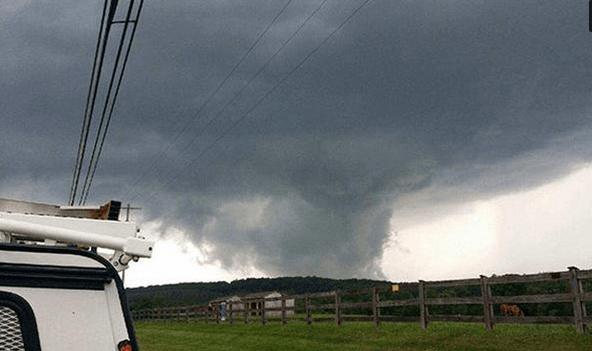
But damn, tornadoes are becoming a lot more frequent around here than they used to be. I was getting acupuncture treatment for a severe tension headache, which normally involves kicking back in a lounge chair for an hour while schlocky New Age “music” plays in the background. Instead, I had mixed emotions: High winds, rain and hail hitting the roof drowned out the “music,” but I had to watch the trees through the back window bend almost in half. (I’ve had more relaxing treatments.)
So this particular line of storms did generate a funnel cloud and knocked out power to a small town in Chester County, whose officials had to declare a state of emergency.
Fuck ’em, they’re Republicans. (Oh, I’m sorry. Did I say that out loud?) No, seriously, I have very little patience left for the people who kept empowering the global warming deniers. It might already be too late.
Catch the wind
Rickie Lee:
So far away
Carole King:
https://youtu.be/1GAaWz4X4nU
I’m so proud/Oo baby/La la means I love you
Todd:
https://youtu.be/sIJ8_JUrj5E