
Laura Branigan:
Happy Hour: One O’clock Jump – Red Garland …
Panhandle Slim… Art for Folk…

Bernie Sanders promises Supreme Court litmus test on Citizens United
Of course we know it’s nothing

Right? Because if it was something, they would let us know and they’d evacuate the area? Ha ha, just kidding!
NEW YORK/WASHINGTON (Reuters) – A nuclear power reactor 40 miles (65 km) north of New York City was shut down on Saturday after a transformer fire, but officials said the Indian Point plant was stable and there was no threat to residents nearby.
People in the area reported an explosion and smoke coming from the plant at Buchanan in New York state. But the U.S. Nuclear Regulatory Commission said the fire had been quickly extinguished.
“These events happen occasionally. They are not unheard of and the plant responded as designed,” NRC spokesman Eliot Brenner said in a statement. He added the fire occurred at 5:50 p.m. (2150 GMT) and was put out 25 minutes later.
The NRC designated the incident an “unusual event,” which is the lowest of four categories the agency gives to potential safety or security threats at nuclear plants.
Andrew Cuomo does something right

Whatever his reasons, I’m glad he’s doing it. I have often thought the working conditions in nail salons were deplorable — not to mention the toxic fumes from the various chemicals they work with.
History

Who would ever expect that we’d see this in our lifetime?
After leaving the Vatican, Castro, the brother of Fidel, the revolutionary leader who brought the Communists to power in Cuba, gushed with praise for Francis. The pontiff “is a Jesuit, and I, in some way, am too,” Castro said at a news conference. “I always studied at Jesuit schools.”
“When the pope goes to Cuba in September, I promise to go to all his Masses, and with satisfaction,” Castro said at a news conference at the office of Italian Premier Matteo Renzi, whom he met with after the Vatican talks. “I read all the speeches of the pope, his commentaries, and if the pope continues this way, I will go back to praying and go back to the church, and I’m not joking,” he said.
It was a startling assertion for the leader of a Communist country, whose crackdown on dissidents in the past had drawn sharp Vatican criticism.
“I am from the Cuban Communist Party, that doesn’t allow (religious) believers, but now we are allowing it, it’s an important step,” Castro said.
The killing of Osama bin Laden

UPDATE: NBC News confirms two parts of Hersh’s story.
Not that I’m really surprised, but they wonder why we don’t believe anything the government tells us? Seymour Hersh with an alternate version that was flat-out murder.
Within weeks of the raid, I had been told by two longtime consultants to Special Operations Command, who have access to current intelligence, that the funeral aboard the Carl Vinson didn’t take place. One consultant told me that bin Laden’s remains were photographed and identified after being flown back to Afghanistan. The consultant added: ‘At that point, the CIA took control of the body. The cover story was that it had been flown to the Carl Vinson.’ The second consultant agreed that there had been ‘no burial at sea’. He added that ‘the killing of bin Laden was political theatre designed to burnish Obama’s military credentials … The Seals should have expected the political grandstanding. It’s irresistible to a politician. Bin Laden became a working asset.’ Early this year, speaking again to the second consultant, I returned to the burial at sea. The consultant laughed and said: ‘You mean, he didn’t make it to the water?’
The retired official said there had been another complication: some members of the Seal team had bragged to colleagues and others that they had torn bin Laden’s body to pieces with rifle fire. The remains, including his head, which had only a few bullet holes in it, were thrown into a body bag and, during the helicopter flight back to Jalalabad, some body parts were tossed out over the Hindu Kush mountains – or so the Seals claimed. At the time, the retired official said, the Seals did not think their mission would be made public by Obama within a few hours: ‘If the president had gone ahead with the cover story, there would have been no need to have a funeral within hours of the killing. Once the cover story was blown, and the death was made public, the White House had a serious “Where’s the body?” problem. The world knew US forces had killed bin Laden in Abbottabad. Panic city. What to do? We need a “functional body” because we have to be able to say we identified bin Laden via a DNA analysis. It would be navy officers who came up with the “burial at sea” idea. Perfect. No body. Honourable burial following sharia law. Burial is made public in great detail, but Freedom of Information documents confirming the burial are denied for reasons of “national security”. It’s the classic unravelling of a poorly constructed cover story – it solves an immediate problem but, given the slighest inspection, there is no back-up support. There never was a plan, initially, to take the body to sea, and no burial of bin Laden at sea took place.’ The retired official said that if the Seals’ first accounts are to be believed, there wouldn’t have been much left of bin Laden to put into the sea in any case.
Go read the whole ghastly thing.
See, he really is a dick
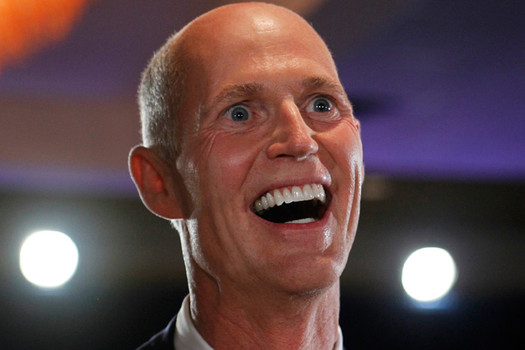
But you probably already knew that! Also, a douchebag:
In early 2013, Florida Gov. Rick Scott (R) surprised nearly everyone by announcing he’d changed his mind about Medicaid expansion through the Affordable Care Act. The Republican governor had long condemned the idea, but he apparently had a change of heart.“I cannot, in good conscience, deny the uninsured access to care,” he said at the time. Scott added that Medicaid expansion is “a compassionate, common sense step forward.” The governor even referenced the death of his mother when explaining his rationale.“A few months ago, my mother passed away, and I lost one of the only constants in my life,” Scott said. “Losing someone so close to you puts everything in new perspective … especially the big decisions…. As I wrestled with this decision, I thought about my Mom’s struggles raising five kids with very little money.”That was February 2013. In April 2015, Scott reversed course again, announcing his renewed opposition to the policy he’d endorsed. And today, the local CBS affiliate in Miami reports that that the governor offered an unexpected explanation for his posture two years ago.
Always snatching defeat from the jaws of victory
Philadelphia cops. WTF?
21-year-old Samir Hill is a point guard at Allegany College of Maryland. Recently Hill was playing a friendly game of basketball with some friends Philadelphia when two police officers happened to pass by. The officers engaged in friendly trash talk which lead to a an impromptu game of one-on-one with Hill.
Hill absolutely shook and burned both officers, making them look old, fat, and slow — which they were. But it was all in fun and the officers left the court smiling and joking with the youngsters.
Hill’s friend posted the video on YouTube and it went viral very quickly. This would seem like a great public relations video, maybe invite Hill down to the station for a few public relations photos for some billboards. And viola, you have a public relations win for the Philadelphia P.D. But Philly P.D. decided to take a slightly different approach.
Instead of embracing a public relations gold mine, they instead turned it into a public relations disaster. Not long after the video went viral Hill was “detained” by Philadelphia police for about two hours while they searched his car. They did this while Hill was handcuffed and brought to the police station. They claimed they were looking for his “friend.” No charges were filed and he was released.