
A NYC fast food worker talks about surviving.
Category: Fuck the Poor
Moral Monday 8
Via my friend Tom Sullivan in North Carolina:
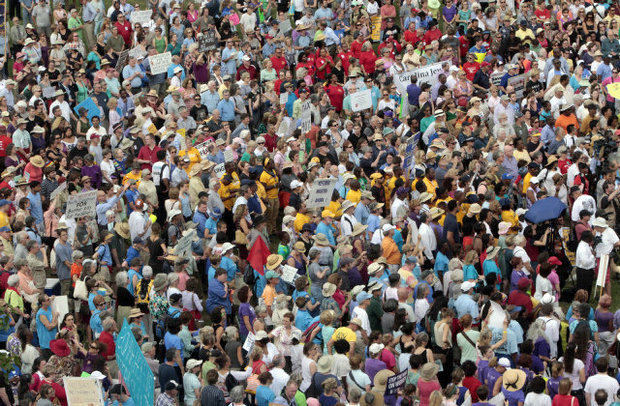
Last Monday, Raleigh, North Carolina saw what Think Progress called The Biggest Liberal Protest Of 2013, Moral Monday 8. According to the Raleigh News and Observer, at least 3,000 people attended the state NAACP’s ongoing protests against the rightward shift of the legislature. The theme for the week’s protest was labor issues, women’s rights and economic justice. Specifically, the loss of federal unemployment benefits for 70,000 people set to take effect on July 1.
About 120 protestors were arrested, with over 100 traveling in buses from Asheville, over four hours away. An artsy, LGBT-friendly mountain city dubbed the “Cesspool of Sin” by a Republican state senator, Asheville faces state seizure of its drinking water system in a bill authored by a board member of the American Legislative Exchange Council.
Raleigh weekly, The Indy, reacted to Gov. Pat McCrory and the GOP-led legislature cutting off federal unemployment benefits. The move will cost the unemployed (and the state’s struggling economy) hundreds of millions of dollars:
That’s right, this decision will deny the people of North Carolina $600 million in federal aid, and it’s not because McCrory and the Republicans slashed unemployment benefits more deeply than any other state—although they did that too. It’s because they insisted on cutting benefits in mid-2013 rather than waiting until Jan. 1, 2014, when the federal program expires. Costs $600 million. Saves nothing. That’s idiocracy.
Astounding
No, really. This is just awful:
When it comes to dashing the hopes of thousands of college-bound African Americans, you’d hardly think of President Obama as a culprit. Maybe the right-wing-dominated Supreme Court. But not Obama, the black Harvard law grad who likes to cite higher education as a path into the middle class and who pledges to make student loans more accessible to black scholars.
And yet, in what United Negro College Fund President Michael Lomax calls “a nasty surprise,” the Obama administration has begun denying student loans to disproportionately large numbers of black parents because of blemished credit histories.
Talk about audacity. Obama blames malfeasance by big banks for plunging the nation into a recession, then bails them out — and proceeds to punish black people for not making it through the economic maelstrom unscathed.
An angry-sounding Obama actually called Tuesday’s Supreme Court ruling against a key part of the Voting Rights Act a “setback” for blacks. You want to know what a real setback is, Mr. President? It’s using some bureaucratic fiat to prevent black students from going to college.
Obama declared that he will press for restoration of the portion of the Voting Rights Act the justices ruled on. But let’s face it: He’s a lame duck. Why not leave as part of his legacy tens of thousands of newly minted black college graduates to carry on what is sure to be a decades-long struggle?
“We’re getting calls and e-mails from parents, at least two and three a day, saying the denial of their student loans is a disaster,” said Johnny Taylor, president of the Washington-based Thurgood Marshall College Fund. “You have black students from low-income households about to enter college or already there and pressing towards graduation, persisting just as Obama urged them to do, only to have his administration pull the rug out from under them.”
The last mystery
http://youtu.be/F6wjFsfnseI
A recent Taibbi appearance on Washington Journal.
Another stunner from Matt Taibbi, and kudos to Rolling Stone for continuing to support his work. Just make sure to take your blood pressure medicine before you read it. It’s long, but worth it:
What about the ratings agencies?
That’s what “they” always say about the financial crisis and the teeming rat’s nest of corruption it left behind. Everybody else got plenty of blame: the greed-fattened banks, the sleeping regulators, the unscrupulous mortgage hucksters like spray-tanned Countrywide ex-CEO Angelo Mozilo.
But what about the ratings agencies? Isn’t it true that almost none of the fraud that’s swallowed Wall Street in the past decade could have taken place without companies like Moody’s and Standard & Poor’s rubber-stamping it? Aren’t they guilty, too?
Man, are they ever. And a lot more than even the least generous of us suspected.
Everything Is Rigged: The Biggest Price-Fixing Scandal Ever
Thanks to a mountain of evidence gathered for a pair of major lawsuits by the San Diego-based law firm Robbins Geller Rudman & Dowd, documents that for the most part have never been seen by the general public, we now know that the nation’s two top ratings companies, Moody’s and S&P, have for many years been shameless tools for the banks, willing to give just about anything a high rating in exchange for cash.
In incriminating e-mail after incriminating e-mail, executives and analysts from these companies are caught admitting their entire business model is crooked.
“Lord help our fucking scam . . . this has to be the stupidest place I have worked at,” writes one Standard & Poor’s executive. “As you know, I had difficulties explaining ‘HOW’ we got to those numbers since there is no science behind it,” confesses a high-ranking S&P analyst. “If we are just going to make it up in order to rate deals, then quants [quantitative analysts] are of precious little value,” complains another senior S&P man. “Let’s hope we are all wealthy and retired by the time this house of card[s] falters,” ruminates one more.
Yeah, you know who that Standard & Poor’s exec is? A guy named Elwyn Wong, who’s now working for the U.S. Office of the Comptroller Currency, our top federal banking regulator.
But no one did anything wrong, so move along now.
SCOTUS greenlights open war on Dem voters
UPDATE AGAIN: Adam Bonin says we’re pretty much fucked.
UPDATE: Okay, not as hopeless as I thought (although anything that counts on Congress to fix it is only a theoretical remedy). But it still invites voter discrimination in the next two elections:
The U.S. Supreme Court has ruled that Section 4 of the Voting Rights Act, which determines what states and jurisdictions are covered by Section 5, is invalid after less than 50 years of protecting African Americans and people of color. The currently covered areas are places that historically have disenfranchised people of color, or those for whom English is their second language. But Chief Justice John Roberts has ruled that the formula, which was last updated in the late 1960s-early 1970s, must be updated by Congress so that it covers areas that violate voting rights today. Chief Roberts, who’s had a beef with the Voting Rights Act since the early 1980s, wrote in the majority opinion:
“In assessing the ‘current need’ for a preclearance system treating States differently from one another today, history since 1965 cannot be ignored. The Fifteenth Amendment is not designed to punish for the past; its purpose is to ensure a better future. To serve that purpose, Congress—if it is to divide the States—must identify those jurisdictions to be singled out on a basis that makes sense in light of current conditions. … Congress did not use that record to fashion a coverage formula grounded in current conditions. It instead re-enacted a formula based on 40-year-old facts having no logical relation to the present day.”
This is not a total loss for the Voting Rights Act. Section Five can still stand if Congress is able to fix the formula so that it covers areas they consider presently running afoul of voting rights.
That’s the effect of today’s ruling. Watch the Tea Party states run with it:
The U.S. Supreme Court has struck down Section 4 of the Voting Rights Act, a law that was passed to ensure minorities in the South could get out to vote.
The Voting Rights Act requires states with histories of the discrimination to get permission from the federal government before making changes to their election laws.
Section 4 determines the “coverage formula” for determining the states that are actually subjected to the law. Here’s what the court held: “Section 4 of the Voting Rights Act is unconstitutional; its formula can no longer be used as a basis for subjecting jurisdictions to preclearance.”
Section 5 of the VRA — which was not explicitly ruled unconstitutional — requires 9 states with histories of discrimination (mostly in the South) to get permission from the federal government before changing their voting procedures.
The VRA was passed in 1965, when Southern states used more blatant tactics to keep blacks away from the polls such as literacy tests and “poll taxes.”
In recent years, the U.S. government has used Section 5 to stop states from passing laws that serve no real purpose other than keeping likely Democrats out of voting booths.
Moral Mondays, Week 8
http://youtu.be/ZncX0-dTzBA
I was talking to a friend from North Carolina about the Moral Monday protests, and he said, “You know, I think Rev. [William] Barber might be the new Martin Luther King.”
He might be right. Just listen to that speech.
Every week, they arrest people. And the following week, the crowds get even bigger. This, dear readers, is a movement. And if you have money to put gas in the tank and some time to spare, you should get down to Asheville and join the fight. Because this is what democracy looks like:
Lee Creighton’s voice started to crack as he stood on a stage among the throngs gathered outside the Legislative Building for the eighth weekly protest of the legislature’s agenda.
The Triangle resident has degrees in math, statistics and French literature but has been out of work or underemployed for the past four years. His LinkedIn profile describes him as a statistician, data analyst, technical writer, trainer, Ph.D., and mathematician who is “currently available.”
In one week, Creighton will be among the 71,000 North Carolinians who will see their extended unemployment benefits end – the result of a new state law that goes into effect July 1. The law, among the first passed by the legislature this year, reduces the maximum state benefits a laid-off worker can receive by roughly one third.
Creighton was called to the stage on Monday among the largest crowd yet gathered for the weekly “Moral Monday” demonstrations at the Legislative Building. Though organizers estimated that more than 5,000 were in the crowd, police put the count at between 2,500 and 3,000.
Continue reading “Moral Mondays, Week 8”
Progress
Happy to hear there’s an investigation!
As a lawsuit against a local McDonald’s franchise gains national attention, federal authorities are investigating the company’s practice of forcing employees to be paid only by debit cards that come with an assortment of fees.
Meanwhile, lawyers for the franchise owners say the lawsuit’s contention that employees incur fees on all transactions is wrong and there are several ways workers could access their money for free.
West Pittston-based attorney Michael Cefalo recently filed the class action lawsuit in Luzerne County Court on behalf of Natalie Gunshannon, a Dallas Twp. woman who quit her job at the McDonald’s in Shavertown after the company issued her a debit card as pay and refused to pay her by check or direct deposit.
Days after the suit was filed and garnered national media attention, Mr. Cefalo said an investigator with the U.S. Department of Labor called his law office.
“They called me and told me the U.S. attorney has shown a particular interest in the facts of this case,” Mr. Cefalo said. “They were looking to see if there are any violations of federal statutes.”
The U.S. attorney’s office for the Middle District of Pennsylvania asked the Department of Labor to “look into it to determine if federal action is appropriate,” Heidi Havens, a spokeswoman for the U.S. attorney’s office, said.
“At this point, it is too soon to tell what specific action, if any, there would be,” Ms. Havens said.
Lenore Uddyback-Fortson, a Department of Labor spokeswoman, said the department was aware of the McDonald’s case, but could not confirm or deny if there is an active investigation.
“The agency has seen more of the use of debit cards to pay employees within the past several years as it is growing in practice,” Ms. Uddyback-Fortson said. “As long as the fees do not cause wages to drop below $7.25 per hour, the federal minimum wage, the practice does not violate the Fair Labor Standards Act.”
Ms. Gunshannon, 27, believes she was paid $7.45 per hour, but wasn’t sure because she said the rate was not on a pay stub she received.
The J.P. Morgan Chase payroll cards issued to local McDonald’s employees carry fees for nearly every type of transaction, according to the lawsuit, including a $1.50 charge for ATM withdrawals, $5 for over-the-counter cash withdrawals, $1 to check the balance, 75 cents per online bill payment and $10 per month if the card is left inactive for more than three months.
What the lawsuit fails to mention is that there are options to obtain money from and use the card for free, said attorney Matthew Hank, a Philadelphia attorney who represents the defendants, Albert and Carol Mueller of Clark Summit.
Hero of the downtrodden
Paul Ryan? Who knew?
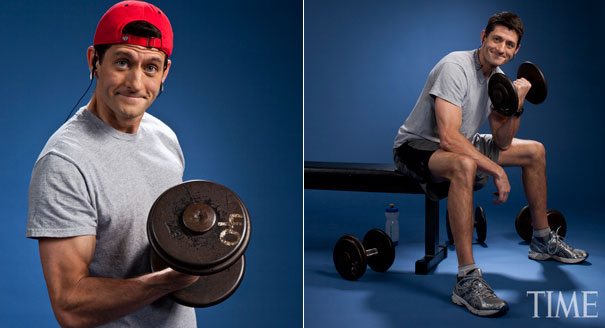
House Budget Committee Chairman Paul Ryan (R-WI) said Monday that he’s focused primarily on addressing poverty, a week after he complained that the farm bill did not include enough cuts to the food stamp program.
“Look, I’m a conservative who believes that our constitutional principles, founding principles are the key principles for the day and they’re the best if applied to our problems to solve problems,” Ryan said during an appearance on MSNBC’s “Morning Joe.” “And we need to have that kind of temperament. This is why I’m focused on poverty these days, this is why I’m focused on — we’ve got the 50th anniversary of the war on poverty coming up next year. We don’t have much to show for it.”
He argued that “there are better ideas that we can use to approach and attack the root causes of poverty” and that the right “should not cede the moral high ground on this issue.”
The Wisconsin Republican voted against the farm bill that failed in the House of Representatives last week. In a floor statement, Ryan lamented that the farm bill proposed only “modest changes” to the food stamp program, which he said had grown at an alarming rate. Ryan did, however, vote for an amendment to the farm bill authored by Rep. Steve Southerland (R-FL) that would have applied federal work requirements to the food stamp program, a measure that cost the legislation Democratic votes.
Let them eat garbage
It’s funny, how all these congressmen who eat steaks and drink fine wine on the taxpayer dime are somehow experts at shopping with food stamps!
Donny Ferguson (no relation to this reporter), an aide to outspoken right-wing congressman Rep. Steve Stockman (R-TX) claims that people who say that the Special Nutritional Assistance Program (SNAP), more commonly known as food stamps, isn’t enough to live on are lying and that the program should be cut even further. Think Progress flagged a Stockman press release in which Ferguson said he believed that the weekly allotment of food for one person of $31.50 is too generous because he claims was able to purchase a week’s worth of food for $27.58.
“I wanted to personally experience the effects of the proposed cuts to food stamps. I didn’t plan ahead or buy strategically, I just saw the publicity stunt and made a snap decision to drive down the street and try it myself,” Ferguson said in the release. “I put my money where my mouth is, and the proposed food stamp cuts are still quite filling.”
Ferguson was reacting to the “SNAP Challenge,” in which Democratic legislators and activists are protesting proposed cuts to the newest Farm Bill, which would slash benefits to people on SNAP. To protest the cuts, people taking the challenge will attempt to live for a week on the amount of food money allotted to people who receive SNAP benefits, $31.50 a week, or $4.50 per day.
Stockman’s office called the challenge “a left-wing publicity stunt” and claimed “Democrats have been intentionally buying overpriced food and shopping at high-priced chains to make it appear the cuts go too far.”
With his $27.58, Ferguson purchased:
Two boxes of Honeycomb cereal
Three cans of red beans and rice
Jar of peanut butter
Bottle of grape jelly
Loaf of whole wheat bread
Two cans of refried beans
Box of spaghetti
Large can of pasta sauce
Two liters of root beer
Large box of popsicles
24 servings of Wyler’s fruit drink mix
Eight cups of applesauce
Bag of pinto beans
Bag of rice
Bag of cookies
Gallon milk
Box of instant oatmeal
H/t Thomas Soldan.
It’s always about the money
Charlie Pierce catches the main problem with education reform:
Rebecca Strauss checks in at The New York Times and immediately tries to make Michelle Rhee cry.
The truth is that there are two very different education stories in America. The children of the wealthiest 10 percent or so do receive some of the best education in the world, and the quality keeps getting better. For most everyone else, this is not the case. America’s average standing in global education rankings has tumbled not because everyone is falling, but because of the country’s deep, still-widening achievement gap between socioeconomic groups. And while America does spend plenty on education, it funnels a disproportionate share into educating wealthier students, worsening that gap. The majority of other advanced countries do things differently, at least at the K-12 level, tilting resources in favor of poorer students.
I thought it was about teachers unions, and standardized testing, and Trigger Mechanisms, and not leaving any children behind in the race to the top, or some other gimmick thought up by a zillionnaire who’s no more ever set foot in a classroom than he has on the surface of Mars. You mean, it might be about...poverty? Do continue.
The problem is that the United States is not spending its education dollars effectively. At every point along the education track, from preschool to college, resources are skewed to wealthier students.