Now that’s how to regulate!

Excellence in Public Service Award 2014

David Dayen has a piece in the Financial Times that explains another reason Republicans want the Consumer Financial Protection Bureau to fail: Because they can shut down bad banks in a way the Department of Justice can’t:

After This American Life recently removed the mystery from the New York Federal Reserve’s cozy relationship with Goldman Sachs, multiple writers have offered their take on what financial regulators in America do wrong. But this week, we got an example of a regulator getting something right. If others follow their lead, we could finally get a more stable financial system.

The Consumer Financial Protection Bureau’s new rules on mortgage servicing took effect this year. Servicers collect monthly payments from homeowners, and make decisions on loan modifications and foreclosures. And they happen to be universally terrible at it, for reasons I’ll explain later.

On Monday, CFPB cited Michigan-based Flagstar Bank with violating the new rules.

And it violated them in earnest. In 2011, years after the start of the foreclosure crisis, Flagstar had 13,000 active loan modification applications, but only 25 full-time workers and an application review center in India. The backlog became unbearable, taking up to nine months to assess an application. And Flagstar would deal with applications that contained outdated information by simply throwing them out. These actions continued to the present day.Flagstar frequently failed to tell borrowers their applications were incomplete. It prolonged the decision-making process, despite specific CFPB deadlines for telling a borrower if it would modify their loan. Flagstar illegally denied loan modifications when borrowers qualified under its rules. It gave no explanation for the denials, a violation of CFPB rules. And it lied to customers about their rights to appeal the denials, another violation.

“Struggling homeowners paid a heavy price, including losing the opportunity to save their homes, as a result of Flagstar’s illegal actions,” said CFPB director Richard Cordray, who announced the enforcement action.

CFPB has in the past sanctioned mortgage servicers for similar violations, with limited success. This time, in addition to fining the bank $37.5 million (the bulk of which will go to victims of Flagstar’s bad servicing, who also must be offered new loan modifications), CFPB banned the company from acquiring new mortgage servicing rights, particularly for defaulted loans, until it can demonstrate its ability to comply with the law.

This is enormous. There’s a healthy trade in the right to service loans in default, because new capital rules make them less attractive to large banks, and because CFPB’s regulations are costly to follow. Because servicers don’t originate a massive amount of loans themselves, and because consumers constantly refinance, pay off, or lose a loan to foreclosure, servicers must constantly purchase new servicing rights to refresh their supply and stay in business. But CFPB ordered Flagstar to not purchase any more default loan servicing until it figures out how to do it properly. This “benching remedy,” as Georgetown law professor Adam Levitin calls it, can change the calculations for financial institutions over whether to commit a fraud, where the potential penalty is usually less than the profit they can make. In this case, Levitin writes, “compliance can be costly, and being taken out of the market can really squeeze the firm’s market position and potentially even its cashflow.”

Imagine applying this model to other parts of the financial services industry. Firms guilty of securities fraud could be barred from issuing that set of securities. Companies making high-risk corporate loans outside regulatory guidelines could be stopped from making corporate loans entirely. Banks caught laundering money for sanctioned organizations could be barred from U.S. dollar clearing operations, or from taking new deposits.

The message would come through clearly: Violate the law and you no longer get to participate in the business until you prove you can do it legally.

Go read the rest, it’s a rare bit of good news.

H/t Peter Biberstein.

Why no revolution?

I gotta say, when even the right-wing Telegraph says it…

Why aren’t the middle classes revolting?
Words you probably never thought you’d read in the Telegraph. Words which, as a Gladstonian Liberal, I never thought I’d write. But seriously, why aren’t we seeing scenes reminiscent of Paris in 1968? Moscow in 1917? Boston in 1773?

My current fury is occasioned the Phones4U scandal (and it really is a scandal).

Phones4U was bought by the private equity house, BC Partners, in 2011 for £200m. BC then borrowed £205m and, having saddled the company with vast amounts of debt, paid themselves a dividend of £223m. Crippled by debt, the company has now collapsed into administration.

The people who crippled it have walked away with nearly £20m million, while 5,600 people face losing their jobs. The taxman may also be stiffed on £90m in unpaid VAT and PAYE. It’s like a version of 1987’s Wall Street on steroids, the difference being that Gordon Gecko wins at the end and everyone shrugs and says, “Well, it’s not ideal, but really we need guys like him.”

I’m not financially sophisticated enough to understand the labyrinthine ins and outs of private equity deals. But I don’t think I need to be. Here, my relative ignorance is actually a plus. You took a viable company, ran up ridiculous levels of debt, paid yourselves millions and then walked away, leaving unemployment and unpaid tax bills in your wake. What’s to understand? We should be calling for your heads on a plate.
Continue reading “Why no revolution?”

Too big to fail — again

zzxzxzx

Yves Smith at Naked Capitalism:

As a new story by Shahien Nasiripour in the Huffington Post tells us, the Administration is now giving student loan servicers the “too big to fail” kid gloves treatment. The apparent justification is that correcting the records of borrowers who may have gone into default through not fault of their own would lead schools with bad servicers to lose access to Federal student aid, which could prove to be crippling to them.

So understand what that means: the law was set up to inflict draconian punishments on schools that used servicers that screw up and/or cheat on a regular basis, presumably because the consequences to borrowers were so serious. But rather than enforce the law, which would have such dire consequences for bad actors as to serve as a wake-up call for everyone else, the Administration has thrown its weight fully behind the education-extraction complex.

The key parts of Shahien’s story:

The U.S. Department of Education is turning its back on at least 1,000 borrowers in favor of shielding their former colleges from potentially crippling sanctions that would have resulted from high rates of default on federal student loans…

“Borrowers aren’t getting any relief or similar consideration from the Education Department,” said Debbie Cochrane, research director at the California-based Institute for College Access & Success, which advocates affordable education. “If the school isn’t held accountable for the default, then the borrower shouldn’t either.”

As many as 20 schools won’t lose access to critical federal student aid programs, an Education Department official said Wednesday. Losing access to taxpayer-provided student aid would be the equivalent of a death sentence for most colleges. The institutions that were let off the hook include for-profit schools, private and public colleges, and historically black colleges and universities, the official said on a conference call organized for news media.

“As many as 20 schools” being given a waiver they clearly don’t deserve suggests that the number of borrowers being thrown under the bus is considerably larger than 1000. Huffington Post identified 13, of which seven are for-profits and four started out as black colleges. And mind you, the schools have to be abjectly bad at making and servicing loans to be subject to the loss of Federal aid:

Schools whose former students subsequently default on their federal student loans at unacceptably high rates can cost their current and future students access to federal grant and loan programs. Penalties kick in once a school’s default rate exceeds 30 percent over three straight years.

The “get out of jail for free” card applies to servicers that screwed up by billing students for only some of their loans, and later declared the students to be in default on loans they didn’t know about. While that may sound nuts, recall that students typically sign loan agreements and the proceeds go to the educational institution. Moreover, payments are usually deferred while the student is still in school. So it isn’t hard to see that a student, having signed loan documents over the years, might not realize that they were to different lenders and hence they’d down the road be facing multiple bills.

Oh, the poor hurt fee-fees

jump-you-fuckers

They not only want to rob us blind, they want us to think highly of them for doing it:

The nation’s largest banks and debt collectors are worried that if you learn what people are saying about them, you might like them less. And that wouldn’t be fair, they say.

The financial sector is fighting a Consumer Financial Protection Bureau proposal that would have the agency publish complaints submitted by people who feel they have been mistreated by a lender, debt collector or other financial institution. As it now stands, the agency publishes some small amount of information about the more than 290,000 complaints it has received from aggrieved consumers, but has refused to release the full narratives — essentially, the details.

Under the new policy, consumer names would be redacted and banks and other financial institutions would have a chance to publicly respond to or refute any allegations. People who file a complaint would have to opt in to having their narrative published on the CFPB’s website.

“This is what consumers want,” said Susan Grant, the director of consumer protection at the Consumer Federation of America, a nonprofit. “It gives them better ability to make decisions about what financial institution to choose.”

Yet the banks and other financial groups opposing disclosure argue that the CFPB approach would unleash a dangerous flood of misinformation that might promote the faulty sense that somehow they are not good corporate citizens. Consumers would also be confused by all the un-vetted information, they assert.

The Financial Services Roundtable, a trade group that represents the banking industry, has gone so far as to set up an entire website to fight the CFPB’s proposal, called “CFPB rumors.”

They made the recession worse

Thanks, austerity hawks!

The Census Bureau’s latest headline numbers on income, poverty and health insurance received wide coverage: The poverty rate fell in 2013 while real (inflation-adjusted) median household income was little changed and the share of Americans without health insurance coverage fell. Here’s a look behind the headlines, courtesy of my Center on Budget and Policy Priorities colleagues’ deep dive into the Census reports, and a few reminders about how better policy could produce better results.

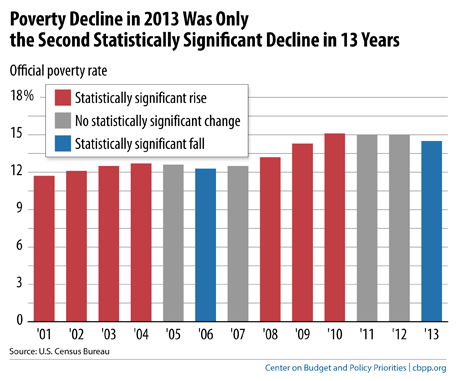
A significant drop in poverty is always welcome, but last year’s decrease was only the second statistically significant one in 13 years (see chart). Moreover, at 14.5 percent the 2013 poverty rate was still a full two percentage points higher than in 2007, before the Great Recession, and 45.3 million Americans were poor last year. Similarly, real median household income (the dividing line between the richer half of households and the poorer half) was little changed from 2012 and 8 percent lower than it was in 2007.

poverty
Chart on poverty decline in 2013
As I argued previously here, our austere budget policies of recent years have dragged out the jobs slump that followed the recession. That’s an important reason why median incomes stayed flat last year and the poverty rate did not drop more.

We shouldn’t be surprised that in an economic recovery that has left workers behind, the Census data show income inequality remaining historically high. CBPP reports that the share of the nation’s income going to the bottom fifth of households (3.2 percent) is tied for the lowest level on record, while median income of the top fifth of households was more than 12 times higher than that of the bottom fifth for the first time on record, with data back to 1967.

An interview with Bernie Sanders

http://youtu.be/rPh-qGcYruw

Thomas Frank interviews Bernie Sanders for Salon. Go read it all:

I’ve followed what you have been saying for a long time. You and I are both concerned about the big change of our time, which is the concentration of wealth in this country, deindustrialization, the slow decline of the middle class. 

The not-so-slow decline of the middle class.

Why is it so hard for Americans to talk about this? When the president talks about this, he uses this term “inequality,” and it sounds scientific, but it doesn’t speak to people. For many years, you were the only person on Capitol Hill talking about this at all. Why aren’t people furious about it?

People are furious about it.

We have a very conservative Senate and House. Congress is dominated by large campaign contributors who exercise enormous influence. I think, the people here [in Washington] have almost developed an instinct not to attack the people who put money into their coffers. Obviously the Republicans are beholden to these guys. But too many Democrats are nervous about talking about issues including income and wealth inequality.

But in fact, the American people absolutely want to hear about it. I talk about it all the time. I give a lot of speeches and large crowds come out. People are very, very concerned about the overall impact of income and wealth inequality in terms of morality, in terms of economics, in terms of—with Citizens United—what it means to our political system.

The Koch brothers are not tucking their money under the mattress. They’re spending it very significantly trying to buy elections so that candidates representing the wealthy are going to get elected. So it is a huge issue, which people are keenly concerned about. But you have a Congress significantly dependent on the one percent for their campaign contributions and you have the media that is owned by multinational corporations who are not excited about dealing with this issue.
Continue reading “An interview with Bernie Sanders”

$2 trillion in the hole

IMG_3116

Thanks, Wall Street! Time to expand Social Security:

The 25 largest U.S. public pensions face about $2 trillion in unfunded liabilities, showing that investment returns can’t keep up with ballooning obligations, according to Moody’s Investors Service.

The 25 biggest systems by assets averaged a 7.45 percent return from 2004 to 2013, close to the expected 7.65 percent rate, Moody’s said in a report released today. Yet the New York-based credit rater’s calculation of liabilities tripled in the eight years through 2012, according to the report.

“Despite the robust investment returns since 2004, annual growth in unfunded pension liabilities has outstripped these returns,” Moody’s said. “This growth is due to inadequate pension contributions, stemming from a variety of actuarial and funding practices, as well as the sheer growth of pension liabilities as benefit accruals accelerate with the passage of time, salary increases and additional years of service.”

U.S. states and cities are contending with underfunded worker retirement systems. The 18-month recession that ended in June 2009 wiped out asset values and forced cuts to contributions. Now, liabilities are crowding out spending for services, roads and schools.