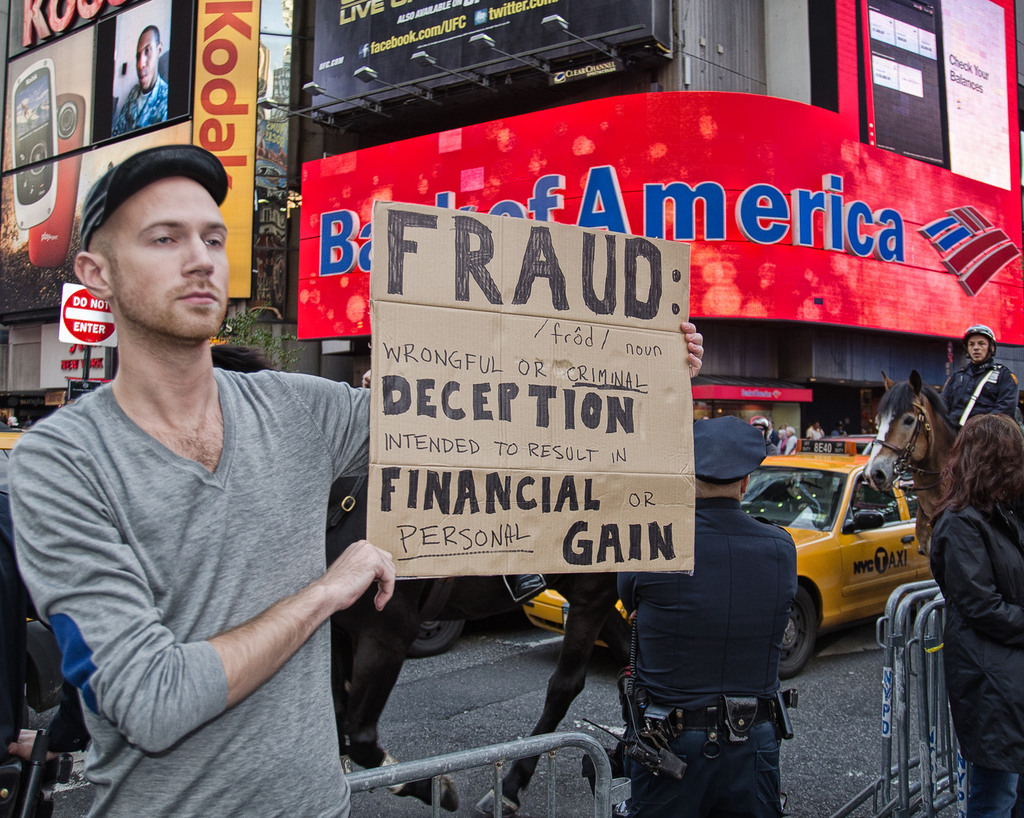
Five years after the crash

fraud

And no one’s learned anything. I wonder if that’s because no one went to prison the last time?

Several big life insurers are going to have to set aside a total of at least $4 billion because New York regulators believe they have been manipulating new rules meant to make sure they have adequate reserves to pay out claims.

The development stems from contentions by insurance companies that states’ regulations are forcing them to hold too much money in reserve. Many of them have engaged in secretive transactions to artificially bolster their balance sheets, often through shell companies in other states or countries. Regulators, who want to be sure companies have enough real liquid assets to pay all claims, have struggled to find a solution that all 50 states can agree on, and decided to test a new framework of rules.

On Friday, New York State plans to drop out of that agreement, according to a letter from Benjamin M. Lawsky, the financial services superintendent, to his fellow state insurance regulators. In the letter, which was reviewed by The New York Times, Mr. Lawsky said the test, which started in 2012, showed that the new framework did not work and was, in fact, making the “gamesmanship and abuses” in the industry even worse.

The move appears to be another attempt by Mr. Lawsky to address the much broader potential problem of the life insurance industry’s use of the secretive transactions. He has derided them as “financial alchemy” because they seem to create surplus assets out of thin air. In June, Mr. Lawsky called on other state insurance regulators to join him in blocking any more of these transactions. But other regulators said they wanted instead to keep pursuing a test of the new regulatory framework. The test covers a narrow segment of the life insurance business, but state regulators, through the National Association of Insurance Commissioners, are committed to extending the framework to all parts of the life insurance industry over the next few years.

Safety is such a relative term

As someone mentioned in the comments, we really are back to the days of Upton Sinclair’s “The Jungle”:

In interviews, six USDA inspectors working in the pilot plants raised health concerns. They spoke on the condition of anonymity because they believed their jobs would be in jeopardy otherwise.

Several said company and government workers are yelled at, threatened and shunned if they try to slow down or stop the accelerated processing lines or complain too aggressively about inadequate safety checks. They also warned that the reduction in the ranks of government inspectors in the plants has compromised the safety of the meat.

“We are no longer in charge of safety,” said an inspector with more than 15 years of experience. “That’s what the public needs to know.”

Yes, from the same people who keep telling us they’re keeping us secure, a nation where the food isn’t safe to eat. Progress!

H/t Edward Tayter Attorney at Law.

Isn’t that nice

Wheee:

The National Security Agency routinely shares raw intelligence data with Israel without first sifting it to remove information about US citizens, a top-secret document provided to the Guardian by whistleblower Edward Snowden reveals.

Details of the intelligence-sharing agreement are laid out in a memorandum of understanding between the NSA and its Israeli counterpart that shows the US government handed over intercepted communications likely to contain phone calls and emails of American citizens. The agreement places no legally binding limits on the use of the data by the Israelis.

The disclosure that the NSA agreed to provide raw intelligence data to a foreign country contrasts with assurances from the Obama administration that there are rigorous safeguards to protect the privacy of US citizens caught in the dragnet. The intelligence community calls this process “minimization”, but the memorandum makes clear that the information shared with the Israelis would be in its pre-minimized state.

The deal was reached in principle in March 2009, according to the undated memorandum, which lays out the ground rules for the intelligence sharing.

Weapons for Syria rebels! Whoopee!

I’m sure this will work out just as well as it has in every other country where we’ve done it:

The CIA has begun delivering weapons to rebels in Syria, ending months of delay in lethal aid that had been promised by the Obama administration, according to U.S. officials and Syrian figures. The shipments began streaming into the country over the past two weeks, along with separate deliveries by the State Department of vehicles and other gear — a flow of material that marks a major escalation of the U.S. role in Syria’s civil war.

The arms shipments, which are limited to light weapons and other munitions that can be tracked, began arriving in Syria at a moment of heightened tensions over threats by President Obama to order missile strikes to punish the regime of Bashar al-Assad for his alleged use of chemical weapons in a deadly attack near Damascus last month.

Pigs on parade

Five years later, and they’re still smiling!

The quants promised this house of cards couldn’t fall apart, because mortgage markets were regional, and that all of them couldn’t possibly fall at once. But that’s what happens with a bubble; it pops. And the extra layers of credit derivatives turned what could have been a somewhat more manageable crisis similar to the housing crash of the 1980s into a massive collapse. Everybody made bets with everybody – a system known as “shadow banking,” invisible to regulators – and then everybody bought insurance on them. And the insurers had no money in reserve; think AIG. Faulty links in this chain of borrowing reverberated through the system; once Lehman went bankrupt, nobody wanted to lend to anyone else because of the risk of default. Because banks relied on short-term lending, this lending freeze meant that even non-financial companies had no funds to make their payrolls.

In summary, the financial industry collectively decided that you could fund economic growth despite stagnant wages through piling on mountains of debt. But when it all went bad, the solution wasn’t to rebalance the economy, to get money into the hands of ordinary workers and preference wages over assets. The solution was to point a fire hose of money at the people who caused the problem, and inflate their assets to preserve the status quo. The Federal Reserve’s emergency lending and then quantitative easing rescued bank balance sheets. The five biggest U.S. banks are now 30 percent bigger than they were at the height of the crisis, nursed back to health by the government. Anyone who tells you TARP worked is looking at a tiny fraction of multi-trillion-dollar government support. And TARP didn’t translate support for the banks into the regular economy. Banks used the TARP program for foreclosure mitigation as a predatory lending system to trap borrowers. Lending for businesses did not increase.

Worst of all, despite a crisis built on fraud, nobody who perpetrated that fraud saw the inside of a jail cell, removing any meaningful deterrent for financial crimes. Most of those criminals walked away with enough money to fund their lavish lifestyles forever. The Justice Department recently had to admit that they inflated their own statistics on financial fraud prosecutions, and they disgracefully tried to re-insert the revised stats into old speeches to cover their tracks. I guess fraud is contagious.

Mixed messages

Let’s start with the good news.

Bill DeBlasio, an unabashed progressive with a biracial family, won the Democratic nomination for New York City’s mayoral race last night. (Although he won by a substantial margin, it was a crowded field and under NYC’s election law, he may face a runoff.) But victory is victory:

The result was a resounding vindication for De Blasio’s unconventional approach to the New York mayoral race in which he cut across traditional racial and ethnic lines to build what the Guardian analyst Harry Enten called “the most diverse coalition in modern history”. Key to his success, propelled from a little-known fourth place contender just a few weeks ago to his party’s front-runner, was his message of a “tale of two cities” – an implicit attack on the style of leadership of the current mayor, billionaire Michael Bloomberg.

In his victory speech, delivered in his home neighbourhood of Park Slope, Brooklyn, De Blasio returned to the theme tune of his campaign, promising an alternative to the Bloomberg era. New York, he said, had become “a tale of two cities – one where the very wealthy had not only rebounded from the great recession but life couldn’t get much better for them, and another New York where nearly half are living on or near the poverty line, where luxury condos replace community hospitals, where pro-active policing has slipped into racial profiling.”

Oh, and the 1% are horrified at the thought he might win.

He’ll face Republican Joe Lhota in the fall.

Now for the bad news. In recall elections pushed by the NRA and the right wing, two Colorado state senators were recalled from office and replaced with Republicans:
Continue reading “Mixed messages”

The Gut…

Charles Pierce….

Every time we celebrate a president who does things from The Gut, we get in some terrible trouble. The last guy celebrated how close to The Gut he actually operated, and we all know where that ended up…

…Barack Obama is not a man of The Gut, and it is driving official Washington crazy. This is a good thing, because resisting The Gut is what the Constitution is all about, especially in its war powers, which this president is conspicuously contemplative about exercising, at least in every context except launching drones.
It is a comforting — and comfortable — fiction to believe that the president’s decision to throw at least part of the decision to make war in Syria into the lap of the Congress is also a deft political move that will, in effect, exploit the “gap” between the hawkish wing of the Republican party and the isolationist wing thereof. I happen to believe that much of the congressional resistance to what the president wants will come because this particular president wants it. I also happen to believe that if the vote goes sour for him in the House, and the president lets the missiles fly anyway, you will see many motions for his impeachment set aloft simultaneously. I don’t know what it will take to get the country’s punditocracy to realize the simple truth that even crazoid vandals believe what they say, and will do what they say they will do…

Hence, when the president announced that he was bringing Congress in on the decision to make war in Syria, a very loud howl arose from the Gut crowd that obeying even that most minimal of constitutional niceties — and I say “niceties” because the Constitution requires that the power to make war in all cases resides in the Congress — weakened not only his office, but also the country itself, as though the United States had lost some kind of military advantage because its president is less free to act than Bashar al-Assad…

…This is of a piece with his entire presidency, another example of his stubborn — and endlessly futile — belief that there is an opposition with whom he can bargain in anything resembling good faith. It just so happens that, in this instance, seeking congressional approval also conforms more closely to the Constitution than would his simply launching Tomahawks into Syria on his own. The capital responded in many cases as though the president had abdicated his fundamental responsibilities rather than fulfilled them, which he did, at least in part, and in a perfect demonstration of his conception of the office. The Gut is left behind in the green room, shouting its impotence at John McCain. Meanwhile, policy, or something like it, gets made.

The address this evening will be most interesting, indeed.

I don’t see color. Obama looks just like Bush.

I was back at my shack in Tinicum swamp, eating pizza and reading the Obama administration’s rationale for bombing Syria. It passes the “common sense test,” an aide said. I don’t know how Barack Obama is defining common sense, but Tom Paine must be spinning in his grave.

Then I read this, from AP:

The U.S. government insists it has the intelligence to prove it, but the American public has yet to see a single piece of concrete evidence – no satellite imagery, no transcripts of Syrian military communications – connecting the government of President Bashar Assad to the alleged chemical weapons attack last month that killed hundreds of people.

In the absence of such evidence, Damascus and its ally Russia have aggressively pushed another scenario: that rebels carried out the Aug. 21 chemical attack. Neither has produced evidence for that case, either. That’s left more questions than answers as the U.S. threatens a possible military strike.

“Neat trick,” I said to the swamp rabbit. “Obama has turned himself into George W. Bush. This is worse than Libya. It’s the Iraq war scam all over again.”

The swamp rabbit was on the windowsill, leafing through the September issue of Vogue. “And this surprises you?” he said. “You got a lotta nerve calling me stupid.”

I threw a piece of pizza crust at him. It sailed over his head and into the swamp. I hate when the swamp rabbit is right.

Obama’s recent war dance made me think of Stephen Colbert’s recurring joke about race. He looks at the camera and in the solemn tone of a dewy-eyed liberal says something like, “I don’t see color. People tell me I’m white and I believe them because I don’t get frisked.”

I don’t see color either, not when it comes to politics in that swamp called Washington, D.C. From where I sit, out here in my swamp, Obama looks just like Bush.