10K Palestinians protest in West Bank, two killed

http://youtu.be/7RP0_66GTuI

I was just reading a story bemoaning how the West Bank never protests. Apparently something has changed, because a massive demonstration last night took place:

Violence broke out Thursday night near the Kalandia checkpoint, located in the West Bank between Jerusalem and Ramallah, as residents of the West Bank village clashed with police in protests against the IDF’s operation in the Gaza Strip.

Some 10,000 Palestinians protested near the checkpoint, throwing rocks, firebombs and fireworks at Israeli security forces, and setting tires ablaze. The IDF forces and Border Police were using crowd dispersal means on the masses.

Hospital officials in Ramallah earlier said three protesters had been killed, but revised that to one killed and three others in critical condition and on life support. Some 200 protesters were injured, a hospital doctor said. Thirteen Israeli police officers were lightly injured.

The IDF Spokesperson’s Office did not immediately confirm the Palestinian casualties. The military was checking reports of live fire targeting Israeli forces at the checkpoint.

The protest erupted after allies of Palestinian Authority President Mahmoud Abbas’s Fatah movement marched from the West Bank city of Ramallah to the edges of Jerusalem in protest against Israel’s 17-day-old campaign against Hamas militants in Gaza.

You know what Israel calls the periodic attacks on Gaza? “Mowing the lawn.”

Mayday PAC reaches its goal

Now let’s see what happens:

The “super PAC to end all super PACs” reached its fund-raising goal in just over two months, but now comes the hard part: winning elections.

The Mayday PAC, a project begun May 1 by the Harvard Law School professor Lawrence Lessig, seeks to elect a Congress that will achieve “fundamental reform in the way political campaigns are funded by 2016,” beginning with five pilot races in this year’s House elections. In a July 4 posting to supporters after announcing the PAC reached its goal, Mr. Lessig wrote, “You have guaranteed” change.

The PAC raised $1 million in its first month and reached another $5 million by Friday. A storm of donors posted on social media on the Fourth of July about getting “big money out of politics” and ending political corruption. The $6 million raised is to be matched by other donors, for a total of $12 million to spend on the midterms.

The Mayday PAC’s website says the $12 million will be spent in five House races to be announced on July 15. That amount isn’t insignificant: The reported outside spending so far this cycle in West Virginia’s Third District, one of the more competitive general election contests, is $2 million.

Mayday eventually plans to push for legislation that would replace the campaign finance system for federal candidates with incentives for candidates to raise small-dollar donations that would then be matched by public money (New York City has a similar system).

Damn straight

cochran

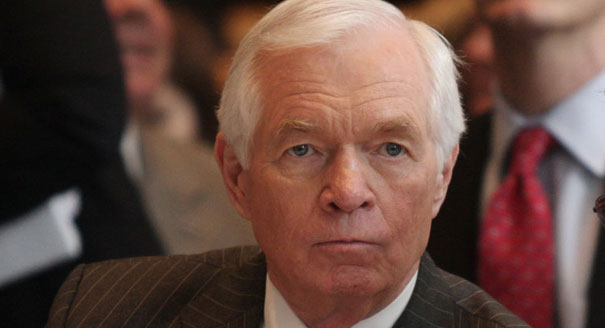
Of course he owes the voters who put him in! And good for the black voters who did it:

Thad Cochran won a primary runoff by turning out the black vote. Now they are asking — what are you going to do for us?
Already the members of the Congressional Black Caucus are talking about what they want Cochran to do. The wish list is fulling up with ideas like maintaining funding for food stamps, beefing up programs that help poor blacks in Mississippi and even supporting the Voting Rights Act.

“Absolutely we have expectations,’’ Rep Marcia Fudge (D-Ohio), said in an interview.

And while Cochran beat back a tea party challenger by reminding voters, particularly black voters, that he brings home the federal bucks, the policy asks are far more liberal than much of what the moderate Republican has championed in his four decades in office.

But that’s the Washington game. Cochran asked for a favor and now his new supporters are plotting how to cash it in.

“My hat is off to Sen. Cochran for being as desperate as he was, to actually go out and up front got out and ask for those votes,” said Rep. Hank Johnson (D-Ga.). ” Those votes were delivered and I’m hopeful he will be responsible and responsive to the voters that pushed him over the top.”

Rep. Emanuel Cleaver (D-Mo.) agreed that Cochran has an opportunity to support the black community.
“What I hope happens is that he comes to the realization that African Americans are the reason I have this final six years and therefore I’m going to try and be more responsible than I have been,” Cleaver said.

Maya Angelou passed away…

Maya


The free bird leaps
on the back of the wind
and floats downstream
till the current ends
and dips his wings
in the orange sun rays
and dares to claim the sky.

But a bird that stalks
down his narrow cage
can seldom see through
his bars of rage
his wings are clipped and
his feet are tied
so he opens his throat to sing.

The caged bird sings
with fearful trill
of the things unknown
but longed for still
and his tune is heard
on the distant hill
for the caged bird
sings of freedom

The free bird thinks of another breeze
and the trade winds soft through the sighing trees
and the fat worms waiting on a dawn-bright lawn
and he names the sky his own.

But a caged bird stands on the grave of dreams
his shadow shouts on a nightmare scream
his wings are clipped and his feet are tied
so he opens his throat to sing

The caged bird sings
with a fearful trill
of things unknown
but longed for still
and his tune is heard
on the distant hill
for the caged bird
sings of freedom.

Maya Angelou

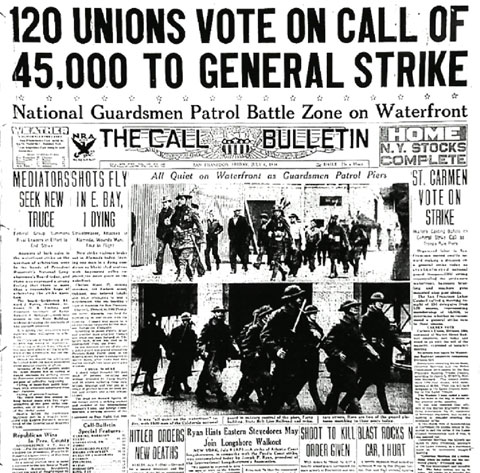
Remember when workers died for their rights?

strike

How did we end up right back where we started? Bill Moyers:

On April 20, 1914, the Colorado National Guard and a private militia employed by the Colorado Fuel & Iron Company (CF&I) opened fire on a tent camp of striking coal miners at Ludlow, Colo. At least 19 people died in the camp that day, mostly women and children.

A century later, the bloody incident might seem a relic of the distant past, but the Ludlow Massacre retains a powerful, disturbing and growing relevance to the present. After a century of struggling against powerful interests to make American workplaces safer and corporations responsive to their employees, the US is rapidly returning to the conditions of rampant exploitation that contributed to Ludlow.

That’s especially true in mining, where a coordinated union-busting campaign, the corporate capture of federal regulatory agencies, and widespread environmental degradation leave coal miners unsafe and mining communities struggling to deal with the massive environmental impact of modern mining practices.

A century ago, miners led the fight for workers’ rights. The Gilded Age of the late 19th and early 20th centuries was a period of great upheaval for the American working class. For decades, the United Mine Workers of America (UMWA) had worked to organize the nation’s coal miners. Its success often hinged on whether the government helped mining companies crush strikes or protected workers. In 1897, deputies in Luzerne County, Pa., killed 19 striking miners in the Lattimer Massacre. But five years later, when Pennsylvania miners struck again, President Theodore Roosevelt intervened on their behalf, providing them with a partial victory. Roosevelt’s actions, while hardly indicative a new pro-labor federal government, reflected a growing belief that labor deserved a fair shake.

Yee haw

Contraception Mandate Activism

I’m pretty sure the Texas wingnuts weren’t counting on this:

SAN ANTONIO (March 25, 2014) Planned Parenthood says it will build a $5 million abortion clinic in San Antonio that meets all of the strict new abortion standards adopted last year by Texas lawmakers.

Planned Parenthood South Texas President and CEO Jeffrey Hons said at a fundraising event that the facility will follow new ambulatory surgical standards.

He said $3.5 million has been raised so far for construction.

An estimated 16 clinics across the state have closed since the new law went into effect and additional clinics are expected to close in the coming months.

Critics of the law say women’s access to legal abortions has been severely limited.

Moral Mondays

Singing after Rev. Dr. William Barber spoke. Madison, Wisconsin.

I am so inspired by the people fighting back against the ALEC-fueled takeover of North Carolina:

Nearly 40 Moral Monday Georgia activists today were arrested for interrupting proceedings throughout the Georgia Capitol in an effort to urge Gov. Nathan Deal to expand Medicaid – and block legislation that would strip him of the authority to do so.

The first group of protesters was sitting in the state Senate gallery that overlooks the upper chamber. Around 11:10 a.m., four activists who were in the gallery’s first row, began to unroll a large banner and loudly chanted, “Medicaid expansion now!”

They were shortly followed by two more groups of four people each shouting, “Medicaid expansion, our lives matter!” The activists were also removed by Georgia Capitol Police. Both waves of activists temporarily stopped the upper chamber from going about their business. The commotion forced Lt. Gov. Casey Cagle, R-Gainesville, to offer a stern warning.

“We take great pride in the Senate being a very open body. But if we have one more outburst like we just experienced I’m going to clear the gallery,” Cagle said after the third interruption by protesters.

Night school

DFA Logo

Democracy for America’s Night School is coming to Crooks and Liars next week, and I highly recommend it. (We’re starting with the finance sessions, but trust me, they’re all interesting — and useful.)

Campaigns aren’t just about elections. They’re about fighting your zoning board or your local school board. They’re about making good things happen where you live, and they’re about building a real progressive movement. That way, when you need someone to run for election, you have some real progressives in the bullpen.

You don’t have to sign up, either. Just drop into a session to see if you like it. But if you do register, please add “C&L” after your name so we can track how many people are taking part.

We do suggest that you register, because DFA will be sending related emails to those who take part.

Next Week’s Session: Finance

Winning campaigns cost money. Although we can protest the growing costs of campaigning, the reality for any campaign is that without these funds, there can be no staff, no office, no phones, no computers, no signs, no media coverage — no campaign. How much money the campaign will need to succeed depends on a number of factors. The sessions will cover the key skills and strategies to effectively raising and managing your campaign’s finances.

Sessions begin at 6pm PT/ 9pm ET and run for one hour.

  • Monday, March 17th — Targeting your donors ;
  • We will cover building your donor list, tools and systems for donor research and how to determine ask amounts.
  • Tuesday, March 18th — Making the Ask
  • Participants will walk through principles for making a strong ask, how to train your candidate to make strong asks and what to do after the ask.
  • Wednesday, March 19th — Tactics: Calltime, Direct Mail, Event Planning
  • There are three core tactics used for fundraising. This session goes through preparation, keeping the candidate on the phone, creating call sheets, setting goals, logistics, recruitment, execution and follow up.
  • Thursday, March 20th — Budget & Finance Planning
  • We’ll cover how to document money in & out, prepare for reports and setting quarterly goals. By the end, you’ll be able to tie it all together in one document.

How Obama became a publicist instead of the president

Zelig Movie Posters

Just go read the rest. This is the best summation of Obama I’ve seen:

Like many days, March 3, 2014, saw the delivery of a stern opinion by President Obama. To judge by recent developments in Ukraine, he said, Russia wasputting itself “on the wrong side of history.” This might seem a surprising thing for an American president to say. The fate of Soviet Communism taught many people to be wary of invoking history as if it were one’s special friend or teammate. But Obama doubtless felt comfortable because he was quoting himself. “To those who cling to power through corruption and deceit and the silencing of dissent,” he said in his 2009 inaugural address, “know that you are on the wrong side of history, but that we will extend a hand if you are willing to unclench your fist.” In January 2009 and again in March 2014, Obama was speaking to the world as its uncrowned leader.

For some time now, observers — a surprisingly wide range of them — have been saying that Barack Obama seems more like a king than a president. Leave aside the fanatics who think he is a “tyrant” of unparalleled powers and malignant purpose. Notions of that sort come easily to those who look for them; they are predigested and can safely be dismissed. But the germ of a similar conclusion may be found in a perception shared by many others. Obama, it is said, takes himself to be something like a benevolent monarch — a king in a mixed constitutional system, where the duties of the crown are largely ceremonial. He sees himself, in short, as the holder of a dignified office to whom Americans and others may feel naturally attuned.

A large portion of his experience of the presidency should have discouraged that idea. Obama’s approval ratings for several months have been hovering just above 40 percent. But whatever people may actually think of him, the evidence suggests that this has indeed been his vision of the presidential office — or rather, his idea of his function as a holder of that office. It is a subtle and powerful fantasy, and it has evidently driven his demeanor and actions, as far as reality permitted, for most of his five years in office.

What could have given Obama such a strange perspective on how the American political system was meant to work? Let us not ignore one obvious and pertinent fact. He came to the race for president in 2007 with less practice in governing than any previous candidate. At Harvard Law School, Obama had been admired by his professors and liked by his fellow students with one reservation: in an institution notorious for displays of youthful pomposity, Obama stood out for the self-importance of his “interventions” in class. His singularity showed in a different light when he was elected editor of the Harvard Law Review — the firstlaw student ever to hold that position without having published an article in a law journal. He kept his editorial colleagues happy by insisting that the stance of the Review need not be marked by bias or partisanship. It did not have to be liberal or conservative, libertarian or statist. It could be “all of the above.”

This pattern — the ascent to become presider-in-chief over large projects without any encumbering record of commitments — followed Obama into a short and uneventful legal career, from which no remarkable brief has ever been cited. In an adjacent career as a professor of constitutional law, he was well liked again, though his views on the most important constitutional questions were never clear to his students. The same was true of his service as a four-term Illinois state senator, during which he cast a remarkable number of votes in the noncommittal category of “present” rather than “yea” or “nay.” Finally, the same pattern held during his service in the US Senate, where, from his first days on the floor, he was observed to be restless for a kind of distinction and power normally denied to a junior senator.

Extreme caution marked all of Obama’s early actions in public life. Rare departures from this progress-without-a-trail — such as his pledge to filibuster granting immunity to the giants of the telecommunications industry in order to expose them to possible prosecution for warrantless surveillance — appear in retrospect wholly tactical. The law journal editor without a published article, the lawyer without a well-known case to his credit, the law professor whose learning was agreeably presented without a distinctive sense of his position on the large issues, the state senator with a minimal record of yes or no votes and the US senator who between 2005 and 2008 refrained from committing himself as the author of a single piece of significant legislation: this was the candidate who became president in January 2009.