
Another voter lets us know what he thinks of Mitch McConnell:
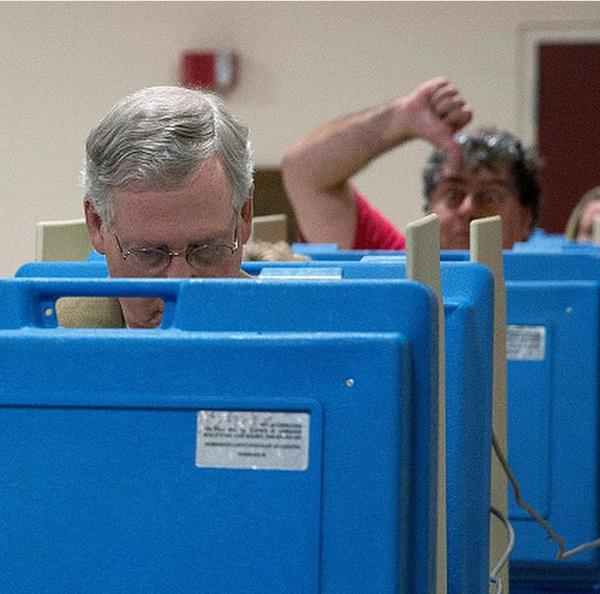
Another voter lets us know what he thinks of Mitch McConnell:
I was telling Swamp Rabbit that the key to re-election of unpopular Republican incumbents such as Pennsylvania Gov. Tom Corbett is to keep down the turnout among registered Democrats. That’s why the Republican Party, with help from the U.S. Supreme Court, is trying to impose restrictive voter ID laws in as many states as possible.
The rabbit, floating on his back in the swamp, said, “I don’t get it, Odd Man. Why bother passing laws? Most Dems don’t vote anyway.”
He reminded me that a GOP-backed law requiring PA voters to show a state-approved photo ID at the polls was struck down by a judge earlier this year. Which means the GOP is still pinning its hopes for victory in PA on voter apathy rather than voter suppression, especially in midterm elections.
“Here’s a fun fact,” the rabbit said after crawling onto the porch of my shack in Tinicum. “Voter turnout in heavily Democratic Philadelphia was about 700,000 when Barack Obama ran in 2008, but it was only 450,000 in 2010, when Corbett snuck in. No way Corbett wins if deadbeat Dems in Philly and other counties get off their asses.”
“You’re blaming the victims,” I said, watching the rabbit wipe pond scum off his fur. “Corbett won in 2010 because of the hick vote. I’m thinking of what James Carville said back in the day — Pennsylvania is Philly and Pittsburgh, and Alabama in between.”
“That’s a cute quote,” the rabbit said, grabbing the bottle of Wild Turkey he’d left on the windowsill. “But it don’t mean nothin’ if Dems vote for the Dem instead of just whining that Corbett is bad news for poor and fair-to-middlin’ people.”
The rabbit guzzled bourbon and rattled off facts. Corbett remained a rabid foe of tax increases even as the state sank deeper into debt. He took care of his friends in the fracking industry by taxing them next to nothing while he was cutting close to a billion dollars from the education budget. He endorsed vaginal probes in supporting crusaders against abortion. He blamed drug users for the state’s unemployment rate. He wasn’t even very popular with Republican voters.
All true, I said, but why assume Democrat Tom Wolf would undo any of the damage, especially given the fact that so many state legislators are as reactionary as Corbett? And what about all those voters who are registered as independents?
“No way of knowing how they gonna vote,” the rabbit conceded. “But you don’t change nothin’ by bitchin’ about Corbett on Facebook. You cannot win if you do not play.”
He had me on the defensive. “You talk a good game, rodent, but you aren’t going to vote, are you?”
He spat in the swamp and said, “I would if I was a human. What’s your excuse?”
Though it is not being reported much in the main stream news, a judge in Georgia on Monday said the court would not come to the aid of The New Georgia Project in reconciling the disappearance of over 40,000 (some even estimate 56,000) voter registrations from the Secretary of State Brian Kemp’s office. SOS Kemp has stated that these registration forms have been returned to the counties and all registrations have been processed. But, Kemp has also stated there is no deadline for the counties involved to process these registrations.
On September 9th Kemp had subpoenaed new voter registrations from the New Georgia Project to investigate what he believed was a conspiracy to commit voter fraud. Georgia State Representative Stacey Abrams, the organizer of the drive, was surprised at Kemp’s actions…
Abrams told the Washington Post the group was surprised by the subpoena because they reached out to the secretary of state’s office proactively in June to ensure they complied with state law.
Only 25 out of 85,000 registrations, according to the Washington Post, did not pass scrutiny. That is less than one percent.
I can bet if a Right leaning group did that good of a job getting legitimate registrations Kemp would have called them out as “Patriots.”
Secretary Kemp has publicly stated the reason for the subpoena was that he received over one hundred complaints regarding the New Georgia Project and their efforts. Public records tell another story…
An October 9th Open Records Act request shows a total of seven voter registration complaints made in 2014 to the Secretary of State’s office. Only one of them, from Butts County, complains about “individuals canvassing voters.”
“There was only one complaint related to the New Georgia Project,” said Rep. Stacey Abrams, who leads the New Georgia Project. “The rest were related to people who had tried to vote.”
“I call into question why (Kemp) took such an aggressive action based on a single complaint that he was notified about in June,” Abrams said.
A spokesman for the Secretary of State says there are more records of complaints, but they are exempt from the Open Records Act because they are part of an ongoing investigation. He claims the investigation spans 14 counties — but can’t document them now.
Comparing the state voters’ database to the New Georgia Project’s records shows at least 50,000 new registrations missing. That equals about 50,000 people that could be eligible to vote that haven’t received their voting cards and might not know what precinct they are assigned. Nearly, all of these registrations are in Chatham, Fulton and Muscogee counties, strong Democrat leaning areas of the state.
So, what does a person in Georgia do if they have registered and have not received their voting card? Go to the polls and cast a provisional ballot. Georgia Advocacy Office says this about provisional ballots…
If you arrive to vote at your polling place and your name is not on the list of registered voters, you can request to cast a provisional ballot. The ballot is “provisional” until your registration can be verified. The Registrars have 48 hours after the closing of the polls to determine if you were eligible to vote. You must cast your provisional ballot in the precinct in which you are registered. If you cast your ballot outside your precinct, it will not be counted. At the time you cast a provisional ballot, the poll officer will give you written information telling you how to find out (a toll-free phone number or a website) if your ballot was counted and, if your ballot was not counted, the reason why your ballot was not counted. Access to information about an individual provisional ballot will be restricted to the elector who cast the ballot.
The tricky part is determining your precinct. Ask your neighbor where they vote. Make sure you have your (approved) ID and extra documentation that shows your home address like a utility bill, bank statement, or a government document.
Casting that provisional ballot will put real pressure on the counties whose election boards have not correctly completed the process of registration. People that haven’t received their voting information should not be discouraged from voting.
Go to the voting precinct. Show up. Don’t give up. Be counted.
Cast that provisional ballot.

Good. This must be driving those Dallas cops crazy:
They call themselves the Huey P. Newton Gun Club, named after the co-founder of the Black Panther Party For Self Defense. Like the defunct organization which called for reform of community policing, demanding that police come from the neighborhoods they serve, the Huey P. Newton Gun Club says they are marching “to promote self-defense and community policing” in response to the recent high profile stories about police shooting unarmed African Americans across the country.
To the protesters, “community policing” is more than just a word. Communities should be protected by members of the community, and held accountable. Ironically this was the original vision for community policing, articulated in 1812 by Sir Robert Peel. That’s right, it may surprise many to discover that our communities have only had police as we know them for a little over 200 years. Even then, it took a little while for Peel’s concept of police forces to make its way to the United States. Since then it has become a norm that many cannot imagine a time before.
In Texas, the Huey P. Newton Gun Club are following in the footsteps of Newton, who was a law major, striving to stay within the bounds of legality. Though the historical Black Panthers had a notable slip-up which led to then Governor Ronald Reagan signing the Mulford Act which prohibited carrying loaded guns in public space. The goal of the Panthers, as they explained it, was to assert the rights of the people to defend themselves against corrupt police, within the bounds of the law. The Huey P. Newton Gun Club says that’s exactly what they are doing today with their open carry protests.
Police have kept a close eye on the protesters, while also trying to keep their distance. One officer we talked to said “there’s really nothing we can do about it. Open carry protests are not against the law.”
Others refused to comment.

I know a lot of people who really want to vote for him:
DURHAM, N.H. —People may be getting “ready for Hillary” and Maryland Gov. Martin O’Malley may be sending staffers to the Granite State, but Vermont Sen. Bernie Sanders is just showing up. A lot.
Sanders will be spending at least five days in the New Hampshire in October alone. While much attention has been given to New Jersey Gov. Chris Christie’s trip to the North Country with Republican candidate for Gov. Walt Havenstein on Friday, it is likely that Sanders will be addressing more people when he hits the University of New Hampshire campus on the same day.
Along with the Durham stop he will also have a number of private meetings with Democratic and labor activists. But then he is back a few days later for a private event at Dartmouth Hitchcock Hospital in Lebanon.
For the most part Sanders seems to be doing the college town circuit this month. He is hoping to both get Democratic voters excited to vote on Nov. 4 and introduce himself at the same time. On Oct. 21 he will travel Keene where he will speak at Keene State and then later hold a town hall meeting. He will do the same thing on Oct. 23 at Dartmouth College and at Plymouth State. He is then scheduled to be back in the state just six days later holding a town hall meeting in Claremont on Oct. 29.

David Dayen has a piece in the Financial Times that explains another reason Republicans want the Consumer Financial Protection Bureau to fail: Because they can shut down bad banks in a way the Department of Justice can’t:
After This American Life recently removed the mystery from the New York Federal Reserve’s cozy relationship with Goldman Sachs, multiple writers have offered their take on what financial regulators in America do wrong. But this week, we got an example of a regulator getting something right. If others follow their lead, we could finally get a more stable financial system.
The Consumer Financial Protection Bureau’s new rules on mortgage servicing took effect this year. Servicers collect monthly payments from homeowners, and make decisions on loan modifications and foreclosures. And they happen to be universally terrible at it, for reasons I’ll explain later.
On Monday, CFPB cited Michigan-based Flagstar Bank with violating the new rules.
And it violated them in earnest. In 2011, years after the start of the foreclosure crisis, Flagstar had 13,000 active loan modification applications, but only 25 full-time workers and an application review center in India. The backlog became unbearable, taking up to nine months to assess an application. And Flagstar would deal with applications that contained outdated information by simply throwing them out. These actions continued to the present day.Flagstar frequently failed to tell borrowers their applications were incomplete. It prolonged the decision-making process, despite specific CFPB deadlines for telling a borrower if it would modify their loan. Flagstar illegally denied loan modifications when borrowers qualified under its rules. It gave no explanation for the denials, a violation of CFPB rules. And it lied to customers about their rights to appeal the denials, another violation.
“Struggling homeowners paid a heavy price, including losing the opportunity to save their homes, as a result of Flagstar’s illegal actions,” said CFPB director Richard Cordray, who announced the enforcement action.
CFPB has in the past sanctioned mortgage servicers for similar violations, with limited success. This time, in addition to fining the bank $37.5 million (the bulk of which will go to victims of Flagstar’s bad servicing, who also must be offered new loan modifications), CFPB banned the company from acquiring new mortgage servicing rights, particularly for defaulted loans, until it can demonstrate its ability to comply with the law.
This is enormous. There’s a healthy trade in the right to service loans in default, because new capital rules make them less attractive to large banks, and because CFPB’s regulations are costly to follow. Because servicers don’t originate a massive amount of loans themselves, and because consumers constantly refinance, pay off, or lose a loan to foreclosure, servicers must constantly purchase new servicing rights to refresh their supply and stay in business. But CFPB ordered Flagstar to not purchase any more default loan servicing until it figures out how to do it properly. This “benching remedy,” as Georgetown law professor Adam Levitin calls it, can change the calculations for financial institutions over whether to commit a fraud, where the potential penalty is usually less than the profit they can make. In this case, Levitin writes, “compliance can be costly, and being taken out of the market can really squeeze the firm’s market position and potentially even its cashflow.”
Imagine applying this model to other parts of the financial services industry. Firms guilty of securities fraud could be barred from issuing that set of securities. Companies making high-risk corporate loans outside regulatory guidelines could be stopped from making corporate loans entirely. Banks caught laundering money for sanctioned organizations could be barred from U.S. dollar clearing operations, or from taking new deposits.
The message would come through clearly: Violate the law and you no longer get to participate in the business until you prove you can do it legally.
Go read the rest, it’s a rare bit of good news.
H/t Peter Biberstein.
“I go crazy with all these Democrats saying you have to go conservative to win, you have to go cautious to win. These damned consultants come in and say, ‘This is how you have to run,’ and it’s always the same: raise money, spend it on television, don’t say anything that will offend anyone. And the Democrats do it and then they end up in tight races, worried about whether they’ll make it,” says Sanders, who caucuses with Democrats but rarely takes advice from anyone in Washington.
“For the life of me, I can’t figure out why progressives listen to consultants. Building movements, making progress on progressive issues— you have to talk to people, educate people, organize people.”
I’d love to see him get America talking about real issues again:
Senator Bernie Sanders (I-Vermont) indicated on Meet the Press today that he would seriously consider running for president in 2016, even if that required him to switch his party affiliation to Democrat.
“The truth is, profound anger at both political parties, more and more people are becoming independent,” he began.
However, “the issue of whether you run as an independent, with the necessity of setting up a fifty-state infrastructure, running as a Democrat, that’s something that I’m looking at,” he continued.
Host Chuck Todd asked whether his running would necessarily be a criticism of Hillary Clinton’s record or policies.
“I don’t know that Hillary is running,” Sanders replied. “I don’t know what she’s running on. I know that the middle class in this country is collapsing. I know that the gap between the very, very rich and everybody else is growing wider. There’s profound anger at the greed on Wall Street, anger at the media establishment. The American people want real change. I have been taking on the big money and special interests all of my political life.”
http://youtu.be/5ZhLQTyLggI
Citizens are always far too slow to make the connection between their lack of participation in the political system and their likely oppression by said system. Politicians respond to constituents! I’m pretty sure we’re going to see a full-court press now to get Ferguson residents registered. Now if they just turn out and vote, they can make real change in their community. If I could wave my magic wand and do one thing, it would be to make voting mandatory:
Black political leaders in the area say it’s not surprising that Ferguson’s government isn’t responsive to their community’s concerns, because blacks across St. Louis County simply haven’t turned out to vote in large numbers, or run candidates for office.
No one collects data on turnout by race in municipal elections. But the overall turnout numbers for Ferguson’s mayoral and city council election are discouraging. This year, just 12.3% of eligible voters cast a ballot, according to numbers provided by the county. In 2013 and 2012, those figures were even lower: 11.7% and 8.9% respectively. As a rule, the lower the turnout, the more the electorate skews white and conservative.
“I think there is a huge distrust in the system,” said Broadnax, a Ferguson native. Many blacks think: “Well it’s not going to matter anyway, so my one vote doesn’t count,” she said. “Well, if you get an entire community to individually feel that way, collectively we’ve already lost.”
Ferguson’s election system may also be a factor. For council elections, the city has three districts, or wards, and each ward elects two members each. That means it’s edging toward an “at-large” voting system, in which there are no districts at all, and all candidates face the whole electorate. Numerous jurisdictions around the country have used such systems to reduce minority representation, since it makes it harder for numerical minorities to elect their preferred candidates.
[…] It doesn’t help that Missouri’s city council and school board elections are held in April, rather than in November when they would coincide with state or federal contests. That arrangement leads to lower turnout across the board, but especially among racial minorities. Some southern cities have been accused of deliberately moving their municipal elections to the spring or summer in order to reduce black turnout.
[…] But State Sen. Maria Chappelle-Nadal, whose district includes Ferguson and who has been involved in the protests, said she thinks the anger over the death of 18-year-old Michael Brown will translate into increased political engagement among the region’s blacks.
“I think this issue is changing the game completely,” said Chappelle-Nadal. “People are upset.”
