Freedom!

When I think of Paul Ryan, I think of this.

Freedom to become a pauper, freedom to hurry up and die! Digby says:

So Paul Ryan is out there instructing states not to set up state exchanges if the Supremes knock down the federal exchange subsidies. He said he’s been assured that Justice Alito will convince the majority that they need to delay kicking people off of insurance until the Republican congress can offer a conservative alternative that will be acceptable to the Republican Governors in every state.

Guess what they’re talking about as the alternative?

His remarks Thursday offered the most detailed vision yet of the House Republicans’ thinking. Mr. Ryan suggested the GOP caucus was most enthusiastic about allowing states to strip some of the health law’s requirements that insurance plans must provide certain minimum benefits and a requirement that insurers sell to all customers equally regardless of their medical history.

“We think things like community rating and other regulations make insurance needlessly expensive for most people and that there are better more targeted ideas out there to help those with pre-existing conditions get affordable care,” he said. “We just want to give people market freedom and personal freedom so that they can buy what they want.”

The single most important aspect of Obamacare, the one thing that one would assume nobody would try to mess with — the ban on denying insurance because of a pre-existing condition — is the main provision they want to get rid of. In other words, they want to make sure that people who are sick are either tied to their insurance companies (with back-breaking premiums that go with that) for life. Or maybe death since a lot of people just won’t be able to afford insurance at all so they’ll just die.

Unsafe water kills 500K babies a year

I know we’re all inundated with donation requests, but I always give to the water charities. It’s too basic to ignore:

Half a million babies die in their first month of life from preventable deaths in unclean hospitals and clinics across the world, according to a new report from the World Health Organization (WHO) and international nonprofit WaterAid. The report, published Tuesday, investigated health care facilities in 54 developing countries and found, for example, that more than… Continue reading “Unsafe water kills 500K babies a year”

Elections matter

Expanding Opportunity and Promoting Growth

Oh, here we go with the block grants again! Not that that some Democrats don’t try to chip away at Social Security and Medicare, but in general, voting for Democrats is still a reasonably good strategy for protecting the safety net:

WASHINGTON (AP) — Republicans now in charge of Congress offer their budget blueprint this week with the pledge to balance the nation’s budget within a decade and rein in major programs such as food stamps and Medicare.

More pressing for many Republicans, however, is easing automatic budget cuts set to slam the military. The chairmen of the House and Senate Budget panels plan to release their budget plans this week – the House on Tuesday and the Senate on Wednesday. The nonbinding measure called a budget resolution sets broad parameters on taxes and spending; it requires follow-up legislation later this year to implement its balanced-budget goals, and Republicans are unlikely to take on that task as long as President Barack Obama occupies the Oval Office.

House Budget Committee Chairman Tom Price, R-Ga., and Senate Budget Committee Chairman Mike Enzi, R-Wyo., plan to produce blueprints that would balance the budget within 10 years – without raising taxes.

Instead, they will propose major spending cuts to programs such as Medicare, health care subsidies, food stamps and the Medicaid program for the poor and elderly to produce a budget that’s balanced. Such cuts, if actually implemented later, would likely slash spending by $5 trillion or so over the coming decade from budgets that are presently on track to spend almost $50 trillion over that timeframe.

Oh, and their budget also includes plans to sell off the national forests.

Here we go again

Best Disability insurance

First of all, George Mason is a wingnut school whose economic programs are funded by the usual suspects. The other point (one which Michael Hiltzik hints at but doesn’t address directly) is that the Social Security disability system is not meant to deny eligible claims simply to fit the budgetary wishes of Congress. Either you’re eligible, or you’re not. And playing with the definitions to bring down the approval rate (as Republican push us to do) is the worst kind of moral sophistry. Why aren’t liberals fighting back on moral grounds?

At first glance, an op-ed in Monday’s Wall Street Journal makes a devastating case against Social Security’s disability system. On closer inspection, the case isn’t so clear.

“A system designed to serve society’s vulnerable has morphed into a benefit bonanza that costs taxpayers billions of dollars more than it should,” write the authors, Mark J. Warshawsky, a visiting scholar at the Mercatus Center of Virginia’s George Mason University and former member of the Social Security Advisory Board, and Ross A. Marchand, a George Mason grad student.

Their focus is on appeals granted by the program’s administrative law judges, who have the power to reverse denials of disability benefits. Their chief concern is that too many judges are approving too many appeals.

“In 2008 judges on average approved about 70% of claims before them, according to the Social Security Administration,” they write. “Nine percent of judges approved more than 90% of benefit requests that landed on their desks.” If all the judges who approved 90% or more of appeals before them were removed, they calculate, the taxpayers would be relieved of paying 98,000 disability cases costing an average $250,000 each. The authors say that’s a savings of $23 billion. (The math actually works out to $24.5 billion.)

Followers of disability politics will see this op-ed as the latest in a lengthening stream of attacks on Social Security disability, which is facing a near-term funding crisis that Congress is loath to address. Warshawsky and Marchand mention the disability program’s looming fiscal shortfall, which could force cuts in disability payments of about 20% as early as 2016. “Congress would be wise to begin much needed reform,” they say, and they suggest starting with these overgenerous judges.

So it’s proper to give their data and conclusions a close look. Warshawsky declined to answer my questions about the piece on the record, but referred me to a lengthier treatment he published in Bloomberg’s Pension & Benefits Daily in 2012.

First question: Why did Warshawsky and Marchand use case figures from 2008? It can’t be because those are the latest figures available–decision data for individual judges is available at least through the end of 2014. Social Security’s own inspector general’s office compiled the data through fiscal 2013 for a report issued last July. What the office found is that the average approval rate has been coming down for years–reaching 56% in fiscal 2013.

Warshawsky and Marchand even allude to this trend in their piece; they observe that reforms implemented by former Social Security Commissioner Michael Astrue have reduced the number of cases heard by supposedly overly generous judges. Their concerns about whether the trend will continue are entirely conjectural: “These changes can easily be undone, either intentionally by future administrators, or unintentionally as bad habits slip back into the system.” So far, that hasn’t happened, and there’s no evidence that it’s likely to.

The milk of human kindness

homeless in portland

Towns will do anything to harass homeless people now. This is one of the more egregious examples I’ve seen, taking place in Portland, Oregon:

This past July, a homeless Portland woman was charged with third-degree theft when she plugged her cellphone charger into an outlet on a sidewalk planter box in Old Town.

Cases in which people are charged with theft for plugging electronic devices into private outlets are uncommon, but defense attorneys say they’re another example of resources wasted for frivolous offenses.

In this case, the theft was first reported by Portland Patrol Inc., and two Portland police officers followed up to issue the woman and her co-defendant, a homeless man who was also charging his cellphone at the planter box outlet, citations to appear in court for third-degree theft of services — a Class C misdemeanor.

According to the Electrical Research Institute, it costs about 25 cents a year to charge the average mobile phone. If the phone in this scenario had gone from zero charge to full charge, the cost would have amounted to mere fractions of a penny.

“Jackie,” (who did not want her real name used), says she was shocked when four uniformed officers all agreed her actions warranted not only their response, but also charges and a court summons.

Jackie has never been convicted of a crime. If this charge led to a conviction, it would mean the difference between checking “no” or “yes” to questions about criminal history on a job or housing application.

Her attorney, Metropolitan Public Defender Stacy Du Clos, says Jackie’s main concern at the time was how this pending case might hurt her chances of getting a roof over her head – she’s homeless and on several waiting lists for affordable housing units.

Additionally, a theft charge is more likely to be associated with shoplifting or taking personal property, not plugging a charger into an electrical outlet. Jackie says the charge would give the wrong impression of what she had done, should someone see her record.

“It’s just my sense of right and wrong, and it just feels so damn wrong,” says Jackie. “The amount of time and money and wasted resources with the judge, the lawyers, the clerks, the police and on and on.”

Jackie’s was not an isolated incident. Public defender Jane Fox says she’s seen similar cases.
Continue reading “The milk of human kindness”

Even Charlie Crist would have been a step up from this putz

rickscott
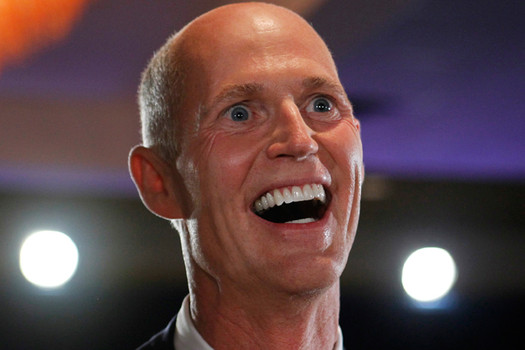
Millionaire healthcare fraud Gov. Rick Scott doesn’t give a shit about the uninsured — because he can’t squeeze any profit from them:

In case there’s anyone left who thinks Scott cares if even more Floridians die without health insurance, this quote from Scott in the New York Times should clear that right up for you. When asked what would happen if those insured under the ACA in states who didn’t create a state exchange, like Florida, lost their subsidies because Florida refused to set up such an exchange, Scott simply dismissed those Floridians as if they were excess baggage:

This week, the Supreme Court will hear arguments in a case, King v. Burwell, that challenges the legality of the subsidies in more than 30 states, including Florida. The case, developed by conservative legal scholars, argues that only people using state-run marketplaces are entitled to subsidies.

If the court agrees — a decision is expected in June — subsidies will disappear in states that do not have their own online marketplaces, almost all of which have Republican-led governments that oppose the law and have resisted creating state exchanges. No state would be more affected than Florida, where more than 1.6 million people have insurance plans under the Affordable Care Act, the most in the nation, and almost all of them receive subsidies.

Yet there is little talk of a Plan B here, such as creating a state-run exchange where subsidies would still be available, if the Supreme Court strikes down the subsidy program. Asked about the case last month at the American Action Forum, a conservative advocacy group, Gov. Rick Scott, a Republican, said, “This is not my program.” He added, “It’s a federal problem.”

Not his problem.
Continue reading “Even Charlie Crist would have been a step up from this putz”

Debtor’s prison

Galleries of Justice Museum - High Pavement, Nottingham - Debtor's Prison & Dark Cells - The Dark Cells

I was working on the mayoral race when I was shocked to find out that city jails were filled with harmless offenders who couldn’t afford to pay even a $100 fine. It’s disgusting, and it’s un-American. I’m glad that Georgia is taking some steps to reduce the financial penalties for poor people caught in the legal system, but of course it’s still not enough:

It’s not yet signed and sealed, but human rights advocates are feeling hopeful that Georgia will rein in its detested, Jim Crow-esque probation system, which routinely jails people who can’t afford to pay court fines and probation fees for offenses as minor as a speeding ticket.

The bill, which sailed through a House judiciary committee Thursday and is expected to be voted on by the state legislature Monday, won’t end the practice of farming out probation cases to private contractors, but it would at least redefine the terms. It would limit, for example, the number of months companies can charge a probationer for their services, force private players to disclose their finances, and remind judges of their power to sentence people to community service in lieu of unpaid fines. Finally, it would also create a new state agency to make sure the rules are followed. The bill already has the approval of Gov. Nathan Deal, whose criminal-justice panel made the recommendations on which it is based.

“It’s not just the companies that are the bad guys; it’s the courts, who are not paying attention to what those companies are doing.”

Since 2000, when the state transferred to the counties all responsibility for handling misdemeanors, many courts have hired private companies to track probationers, handle the paperwork, and collect payments. Yet because probationers are required to cover the management costs, the companies had an incentive to keep them on the hook as long as possible. It is, as reporter Celia Perry noted in a 2008Mother Jones story, “a way to milk scarce dollars from the poorest of the poor,” who, in many Georgia counties, are disproportionately black. Human Rights Watch, in a February 2014 report entitled Profiting from Probation, calls it “an extremely muscular form of debt collection masquerading as probation supervision, with all costs billed to the debtor.”
Continue reading “Debtor’s prison”

Unemployment changes you

Food Kitchen

I’ve seen this so clearly, both in myself and my friends:

Long periods of unemployment drain our bank accounts and weaken the economy. New research suggests extended joblessness could also dampen our personalities. And that can make it harder to find more work.

A study published this month in the Journal of Applied Psychologyexamined a sample of 6,769 German adults — 3,733 men and 3,036 women — who took the same personality test twice in a four-year window. During the experiment, 251 subjects were unemployed for less than a year; 210 faced joblessness for one to four years.

The authors focused on five traits: conscientiousness, neuroticism, agreeableness, extraversion and openness. Dispositions of perpetually job-hunting people transformed considerably — and dismally — compared with their steadily working counterparts.

“Unemployment,” researchers wrote, “has one of the strongest impacts on well-being … often lasting beyond the period of unemployment and being comparable with that of becoming disabled.”

The findings in Germany have domestic implications. One characteristic of America’s slow economic recovery is the extraordinary number of people who have fallen into the ranks of the long-term unemployed, those unable to find jobs for 27 weeks or more. An estimated 3.4 million fit this description, by the Economic Policy Institute’s measure.
Continue reading “Unemployment changes you”

Slave labor in Louisiana

Via In These Times.
Via In These Times.

If it wasn’t for these worker visas, employers might have to pay a living wage and provide safe working conditions! Can’t have that:

NEW ORLEANS—Yesterday, a jury awarded over $14 million in damages to the plaintiffs of David v. Signal International, the first of a series of lawsuits that together constitute one of the largest human trafficking and forced labor cases in U.S. history. After more than four weeks of testimony and several days of deliberations, the jury found that marine construction company Signal International and its agents engaged in human trafficking, forced labor and racketeering, among other violations.

It is “an historic verdict,” said Alan Howard, lead counsel for the plaintiffs, “finding damages against every defendant on every single claim that we brought, and finding punitive damages against every defendant for every claim for which we were entitled to ask for punitive damages.” Signal must pay over $12 million to the five plaintiffs, while the company’s recruiter and its immigration lawyer must pay over $900,000 each.

The original suit, filed on behalf of almost 600 Indian welders and pipefitters, alleged that the workers had been lured to the United States with false promises of green cards, which enable permanent residency. They paid $11,000-25,000 in recruiting fees for the opportunity, the complaint said, selling property, pawning jewelry, and taking out high-interest loans to finance the fees. The suit was brought by the Southern Poverty Law Center, a nonprofit civil rights organization, which enlisted the cooperation of several top law firms to litigate multiple cases pro bono after the original was not certified as a class action.
Continue reading “Slave labor in Louisiana”