Archive | Featured

05 March 2012 ~ 4 Comments

Finally, a banker who might go to jail

Well! It’s nice to see at least one Wall St. banker face criminal charges! He allegedly decided to stab his cab driver for the sheer audacity of asking for the agreed-upon fare. Geeze, I hope the court doesn’t hold it against the guy. After all, he’s been living in the 1% bubble for a long time, he probably doesn’t know any better. As to the racial slurs? As Mayor Bloomberg keeps reminding residents, New Yorkers should be grateful just to have the bankers spending money in their town. Threats and stab wounds seem a small price to pay for that privilege.

The New York Post, of course, has the details:

A mild-mannered, hardworking New York City cabby lamented to The Post yesterday that he was insulted, demeaned and threatened by a boozy bigwig who refused to pay him, screaming: “Go back to your own country . . . I’m going to kill you.”

Mohamed Ammar said investment banker W. Bryan Jennings — a $2-million-a-year fat cat for Morgan Stanley — went from being a sweet gentleman he picked up in Midtown to a surly, knife-wielding “drunk” who stiffed him on the $204 fare when they got to Jennings’ Darien, Conn., home.

“I said, ‘You have to pay me. It’s the law,’ ” Ammar recalled at his Queens home yesterday, where he lives with his wife and three children. “He says, ‘What law? You should go back to your own f–king country.’

“I say, ‘This is my f–king country, excuse my language. I’m an American citizen!’ ” said the driver, who is originally from Egypt.

“That’s when he pulled out the penknife . . . He leaned forward and yelled, ‘I’m gonna kill you, motherf–ker!” Ammar said.

“I saw his hand balled up into a fist and I thought he was going to punch me,” the cabby said.

“I put my hand out to protect, and that is when I saw the penknife. He went for my neck first but ended up slashing my hand many times as I was fighting him off . . . My hand was bleeding pretty bad” as Jennings fled on foot, Ammar said.

“He was drunk and out of control, and he could have killed me. That was one of the scariest moments of my life.”
Ammar needed six stitches to close his wounds.

[...]

Continue Reading

03 March 2012 ~ 18 Comments

If you can’t say anything nice

There’s an ongoing argument among bloggers about Andrew Breitbart, and whether we’re “stooping to their level” by saying what we actually think about him. Well, here’s what I think.

Wars split families. Benjamin Franklin refused to let his own son out of prison to see his wife while she was dying. What a terrible, unfeeling man. Or not.

This is also a war – of ideologies, class and culture.

Are those who say mean things terrible people for declining to whitewash Breitbart out of respect for his family? The real question is, why is his family more worthy of concern than the families once helped by ACORN? (Hint: It’s the same reason I joke that Apple-loving progressives would be a lot more concerned about Foxcomm workers if we described them as factory-farmed chickens.)

The very problem with the Village – the moneyed, connected, inbred establishment – is that that they value their personal relationships above all else, and use those personal relationships to justify and excuse all kinds of political and economic horrors visited upon the rest of the world, things that have serious ripple effects.

This is why we ridicule them. Isn’t that the point? Their emotional relationships render them incapable of connecting those dots between what they do and the results out in the real world. They live in the bubble.

For example, the top management at the Times loved Judy Miller and, I’m sure, they would have cried at her death. How many Iraqis are dead because of that relationship? Am I a monster if I don’t especially care, or if, even worse, I snicker? I don’t think so. I just use a much broader, more external measure of her worth.
[...]

Continue Reading

02 March 2012 ~ 10 Comments

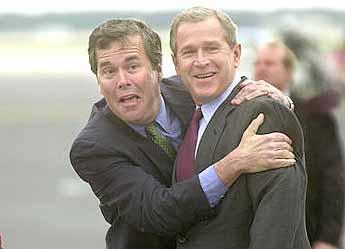
The Jeb scenario playing out?

Journalist Russ Baker, publisher of WhoWhatWhy.com and author of “Family of Secrets: The Bush Dynasty, America’s Invisible Government, and the Hidden History of the Last Fifty Years,” (an utterly chilling book, by the way) thinks the Bush clan is working behind the scenes to install Jeb next.

Baker is no whack job, although you’d think so from the reactions to his current topics. He seems to be avoided by the same establishment media types who used to hire him and praise his work, but also has his supporters, including James C. Moore (author of “Bush’s Brain” and Bill Moyers). He’s always worth a listen:

In 1990, when George H.W. was president, Jeb got him to release the convicted terrorist Orlando Bosch, who had participated in more than 30 terrorist acts (among other things, Bosch was implicated in the bombing of a Cubana plane that resulted in the deaths of 73 civilians). In 1998, with heavy help from the Cuban community, Jeb was elected governor, and thus emerged in a prime position to help his elder brother, George W., prevail in the 2000 Florida election fiasco, and thereby become president. As governor, Jeb nominated Raoul Cantero, the grandson of the Cuban dictator Batista, to the Florida supreme court, though he was lacking in experience—Cantero had been the terrorist Bosch’s spokesman and attorney.

In the aftermath of September 11, while the George W. Bush administration was pushing the colored panic light like crazy, and targeting terrorist suspects of all kinds and levels of probable guilt and innocence, it consented to the release of Cuban exiles convicted of terrorist offenses. Jeb advocated for these releases as well.

***

Jeb has been carefully laying a scenario in which he could indeed run — and could be very well received. He’s traveled the country extensively as a kind of elder statesman. And recently he criticized the GOP presidential candidates’ behavior:

“I watch these debates and.. it’s a little troubling sometimes when people are appealing to people’s fears and emotion rather than trying to get them to look over the horizon for a broader perspective and that’s kind of where we are…I think it changes when we get to the general election. I hope.”
[...]

Continue Reading

29 February 2012 ~ 2 Comments

Gov. Tom Corbett, the invisible man

Marcus Hook was one of the towns I covered as a reporter, and now it’s on the edge of losing the one main industry. The Republican governor is largely indifferent to their plight:

“Marcus Hook is a town teetering on the edge of destruction. Last year, Sunoco Oil announced that it would shut down its refinery in Marcus Hook. This refinery has employed residents for generations; it provides a tax base for the community, and directly funds part of the school district. As horrible as it is, I wish this were an isolated event; but Sunoco is also closing its south Philadelphia refinery, and ConocoPhillips is closing one in nearby Trainer, Pa. In total, 2,500 Pennsylvanians will be laid off, and thousands more will see their livelihoods affected as more residents struggle with unemployment and the tax base disappears.
[...]

Continue Reading

29 February 2012 ~ Comments Off

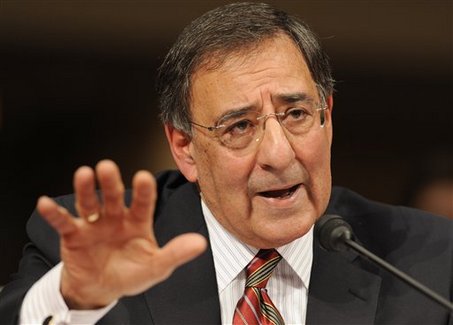
Panetta to the rescue

I don’t care if he’s doing it because of bad PR or because he genuinely cares, just as long as it’s done:

U.S. Defense Secretary Leon Panetta Tuesday announced a new layer in the Army’s investigations into a Madigan Army Medical Center behavioral health program that changed post traumatic stress disorder diagnoses for certain soldiers who were seeking medical retirements at the Army base south of Tacoma.

Panetta told a Senate committee that he asked a Defense Department undersecretary to look at whether the military is diagnosing post traumatic stress consistently.

It was not clear Tuesday whether that inquiry overlaps with at least two other ongoing investigations into Madigan’s forensic psychiatry unit. Pentagon and Army Medical Command spokesmen were not able to describe the latest investigation.

Panetta’s remarks came at a defense budget hearing at which Sen. Patty Murray, D-Wash., pressed him about his knowledge of the forensic psychiatry team at Madigan, on the grounds of Joint Base Lewis-McChord. That unit, created in 2008, reviewed PTSD diagnoses and sometimes adjusted them to other diagnoses.

The decisions were costly to some service members who were no longer entitled to the level of disability benefits the government provides to soldiers who suffer from PTSD. One psychiatrist in the forensic unit this fall encouraged other behavioral health specialists not to be a “rubber stamp,” and said a PTSD diagnosis could cost taxpayers $1.5 million in benefits over the lifetime of a retired soldier.

“I never want to hear anyone in any service say we’re not going to give you a PTSD diagnosis because we have a budget problem,” Murray said at Tuesday’s hearing.

Panetta replied that he was troubled by the Madigan reports and said he asked his undersecretary for personnel, Dr. Jo Anne Rooney, to look into the situation at Madigan.

Continue Reading

27 February 2012 ~ 3 Comments

‘It’s my brother’s turn tonight’

Just heartbreaking….

Last week, while working on a documentary about hunger in Michigan, Russ Russell had an experience that left him speechless.

“I was visiting with this family and one of the little boys said he wasn’t going to eat,” said Russell, development director for Forgotten Harvest, a Detroit-based nonprofit that rescues and redistributes fresh food. “He said, ‘Oh, I’m not eating dinner because it’s my brother’s turn tonight. Tomorrow is my night.’”

On Wednesday, state officials charged with helping to meet the needs of Michigan’s poorest and most vulnerable citizens publicly told a much different story. Maura Corrigan, director of Michigan’s Department of Human Services, assured lawmakers that changes to a core social safety-net program — cash welfare assistance — aren’t producing the kind of wide-scale woe critics predicted.

“There hasn’t been an uptick in the food banks; there hasn’t been an uptick in the homeless shelters,” Corrigan told the state’s House Appropriations subcommittee on human services, the Detroit Free Press reported Thursday. “It’s a dog that didn’t bite, as far as we’re concerned.”

Three months after implementing a plan to push many long-term welfare recipients off the state’s rolls, Michigan is deeply divided about its impact. It’s as if Russell and Corrigan are talking about different states.

[...] “You have to wonder if they are asking the right questions, really looking in the right places or if it’s just too early for the problems to show clearly,” said Gilda Jacobs, president and CEO of the Michigan League for Human Services, about Corrigan’s testimony and the impact of the changes to the welfare rolls. “I’m certainly hearing stories.”

Food banks and other agencies that help the needy are reporting a rise in those seeking help. Some of the more than 200 agencies to which Forgotten Harvest, a nonprofit that distributes fresh food, now have 30- to 45-day wait-lists for access to their food programs, Russell said. Forgotten Harvest provided the food for 12 million meals in 2008; if trends from the first two months of this year continue, the agency expects it will need to provide 36- to 40 million meals.

At the Gleaner’s Community Food Bank in Detroit, the agency distributed 22 percent more food between October and January than it did during the same period one year ago, staff said. But it’s unclear how much of the increase can be attributed to safety net program cuts.

Continue Reading

26 February 2012 ~ 2 Comments

A losing strategy

I don’t think this only applies to environmental groups, but okay, good place to start:

A searing new report says the environmental movement is not winning and lays the blame squarely on the failed policies of environmental funders. The movement hasn’t won any “significant policy changes at the federal level in the United States since the 1980s” because funders have favored top-down elite strategies and have neglected to support a robust grassroots infrastructure. Environmental funders spent a whopping $10 billion between 2000 and 2009 but achieved relatively little because they failed to underwrite grassroots groups that are essential for any large-scale change, the report says. Released in late February by the National Committee for Responsive Philanthropy, Cultivating the Grassroots was written by Sarah Hansen, who served as executive director of the Environmental Grantmakers Association from 1998 to 2005.

Environmental funders mainly support large, professionalized environmental organizations instead of the scrappy community-based groups that are most heavily impacted by environmental harms. Organizations with annual budgets greater than $5 million make up only 2 percent of all environmental groups, yet receive more than half of all environmental grants and donations.

The report makes the simple but profound argument that the current environmental funding strategy is not working and that, without targeting philanthropy at communities most impacted by environmental harms, the movement will continue to fail. “Our funding strategy is misaligned with the great perils our planet and environment face,” Hansen writes.

Continue Reading

24 February 2012 ~ 14 Comments

The predictable president

Charlie Pierce sums up the compulsive compromising of the Obama administration:

There was never any doubt that, in a great many instances, Barack Obama was going to accommodate and compromise because that’s the way the man’s built. He took a dive on telecom immunity in July before he was elected. That should have been a caveat emptor moment for everyone.

While running for his first term as president, on a campaign speech in Columbus, Ohio, FDR said:

“It was the heyday of promoters, sloganeers, mushroom millionaires, opportunists, adventurers of all kinds. In this mad whirl was launched Mr. Hoover’s campaign. Perhaps foreseeing it, a shrewd man from New England, while in the cool detachment of the Dakota hills, on a narrow slip of paper wrote the historic words, ‘I do not choose to run.’”

I can’t recall Barack Obama’s ever saying anything that direct or harsh in 2008, either about the incumbent, or about the situation in which the incumbent was handing over the country to him. (I don’t recall him saying anything that harsh and direct about anything or anyone, ever.) The moment of that election desperately needed — hell, demanded — an FDR, but there was no FDR on offer. Anyone who was listening to Barack Obama and thought they heard FDR was tuned into his own private frequencies. Handed an economic catastrophe a month before his election, and then governing through the worst of it in the early days of his administration, he sought consensus because that’s the most basic instinct in him, and, alas, consensus was that claque of Wall Street Magi whom he brought aboard. Not good, but entirely predictable.

So what now? There are some signals that the president is realizing consensus is impossible with an opposition made up primarily of Bible-banging pyromaniacs, and that, anyway, consensus is not always a desirable goal in and of itself. (His reflexive proposal to cut the corporate tax today, however, is not a good sign. He’s bidding against Mitt Romney on Romney’s home turf, on an issue that will not resonate with any great mass of Democratic voters at all.) His chances of being re-elected are better than they were a year ago, but it’s still going to be a long pull up a dirt road to get to 270 electoral votes. Once in that dreary effort, I’d like to hear all the eloquence that made him a star edged with the faintest amount of vitriol, just a dollop of scorn to liven it up. The country deserves that. A little more consensus and we might all go down together.

Continue Reading

21 February 2012 ~ 7 Comments

Best gun salesman ever?

Barack Obama! Even though he hasn’t done a thing to control guns, he gets accused of it anyway, because that’s how your basic paranoid wingnut thinks:

Although the nation’s largest gun lobby would never publicly acknowledge it, at least one gun-loving group seems to realize that a Democratic president isn’t always bad for business.

In a post published Tuesday by online ammunition supplier Ammo.com, President Barack Obama is hailed as “the greatest gun salesman in America.”

The site is even asking readers whether the gun industry should actually begin supporting him.

In an eye-grabbing message, the munitions outlet compiled dozens of statistics that show firearms sales skyrocketing in the wake of Obama’s 2008 election.

“Ironically, the perceived hostility towards gun owners by President Obama has actually helped the firearms industry tremendously,” they wrote. “Since the 2008 election, more Americans than ever before are purchasing firearms & ammunition. This has meant massive increases in sales by firearm & ammunition makers, billions more in federal and state tax collections related to guns & ammo, increased membership in the [National Rifle Association (NRA)], and hundreds of thousands of new Americans carrying concealed handguns. Therefore, should the firearms industry support President Obama for a second term or not?”

That’s actually a good question — although it’s not being taken seriously by the NRA.

During the recent Conservative Political Action Conference, NRA CEO Wayne LaPierre declared Obama’s lack of interest in gun regulations to be part of “a massive Obama conspiracy.”
[...]

Continue Reading

20 February 2012 ~ 1 Comment

The musical chairs economy

Ian Welsh:

Ok, for some time, folks have been after me for a formal economics post. What’s going to happen in the future in the US?

The answer, for around the next 5 to 6 years, maybe longer, is the musical chairs economy. Let’s lay out the basics.

Oil and Gasoline consumption in the US has been crashing for years and the trend shows no sign of stopping. The US is now a net exporter of oil.

The majority of people who lost their jobs in the aftermath of the financial crisis have not found new jobs. Nor are they going to. Those who did, have generally found jobs which pay a lot less than what they had before.

For those people who did manage to keep their jobs, things aren’t so bad, just as people who kept their jobs in Great Depression did ok.

What has happened is that the general circle of prosperity has been reduced. Less people now live in the “good” US economy. When they drop out of that economy they also use a lot less oil and gas, and even electricity.

Since the US can no longer sell nearly as much paper in exchange for real resources and goods, the US now has to sell something the rest of the world wants. One part of that is intellectual property, which is why you will continue to see stricter and stricter IP laws. The other part of that is hydrocarbons. The world is still hungry for oil. And if Americans use less of it, and if the US moves massively to fracking of unconventional oil (which it is) then the US can, again, become an oil exporter. (Remember, for most of the 20th century the US exported oil.)

This plan includes impoverishing large numbers of Americans, since the reduction in oil use is not being produced by providing the same services with less energy, but that is not an issue to those who run America’s industry or politics, since they do not, despite rhetoric, care about the welfare of ordinary Americans.

Continue Reading